
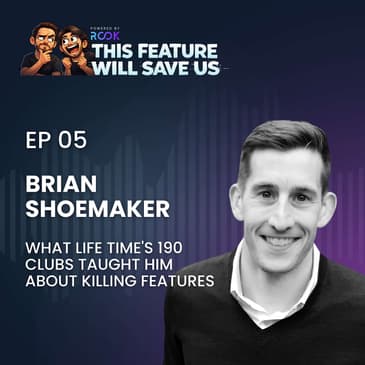
Brian Shoemaker started as a developer before he ever had a product title, and ten years later he's running Life Time Labs and the company's new Innovation Hub.
His background shows up in how he talks about product decisions: less about the pitch, more about what survives contact with 190 clubs and real staff on the floor.
It also means he's got a running list of the ones that didn't make it, and a few that got shelved only to come back around years later once the technology caught up.
He joins Marco and Jonas to talk through the Apple Watch feature that took eighteen months to kill, and what Life Time is trying next.
Brian breaks down:
→ Why LT Connect's Apple Watch integration made sense on paper and fell apart in practice
→ Building live streaming across 40 Life Time locations in a month during COVID, and why it later scaled back down
→ How the Labs team decides whether a pilot is ready to scale past a few clubs
→ Why a failed facilities-intelligence pilot from years ago is worth revisiting now
→ How the Labs team stays small by borrowing people from other teams for a few months at a time
→ What the Innovation Hub does with 190 startup applications and a 20,000-member beta pool
→ Where agentic coding tools are becoming a multiplier, and the new bottleneck that creates
→ What changes for Life Time once iOS 27 opens Siri up to booking classes directly
Follow Brian:
LinkedIn: https://www.linkedin.com/in/brianshoemaker/
Life Time: https://www.lifetime.life/
Follow Marco Benitez and Jonas Dücker
LinkedIn Marco: https://www.linkedin.com/in/marcobzg/
LinkedIn Jonas: https://www.linkedin.com/in/jonas-ducker-37460bb3/
Get in touch with This Feature Will Save Us Podcast
LinkedIn: https://www.linkedin.com/showcase/this-feature-will-save-us
Website: https://thisfeaturewillsaveus.com/
Powered by
ROOK: https://www.tryrook.io/
0:00 - Welcome and rapid fire questions with Brian
3:20 - Brian's path from developer to leading Life Time's Labs team
4:10 - Cardio, strength training, and the shift toward hybrid fitness
6:00 - Favorite AI tools for research, coding, and legal drafting
9:00 - The most underrated metric in product: L28
10:40 - A pilot that looked great in one club but never scaled
12:20 - Face recognition check-in, and why it never stuck
14:00 - Reviving a failed vibration-sensor pilot as a facilities intelligence platform
17:30 - When cost actually enters the product decision
19:20 - How big the Labs team is, and borrowing talent
21:00 - Life Time's squad structure and two-week sprints
22:40 - Launching the Innovation Hub and rehydrating the old beta program
25:30 - How 190 startup applications get vetted
29:40 - Agentic coding as a multiplier, and the new bottleneck it creates
32:30 - Structuring a day around constant stakeholder input
34:20 - Building live streaming across 40 clubs in a month during COVID
37:00 - Why live streaming scaled down once the world reopened
38:40 - LT Connect and the Apple Watch integration Brian was sure would work
41:30 - What's next: Siri, iOS 27, and whether the app is still the product
Every product team has that moment.
SPEAKER_03Someone pitch a feature and says this is the one. Sometimes they are right. Sometimes they are very wrong.
SPEAKER_01I am Marco Benitez. And I am Jonas Ducca, and this is This Feature Will Safe Us, where we dig into the decisions, debates, and occasional disasters behind building great products. Let's get into it. Brian.
SPEAKER_03Nice to meet you, Brian. I think I only had the opportunity to see you in different posts in LinkedIn and different events as you were before. So you're very active. Very, very active, right?
SPEAKER_00I'm trying to be a little more lately, just trying to raise more awareness about what we do at Lifetime. And uh, I think every bit uh every bit helps. It can't just be the Lifetimes uh company page on LinkedIn. Where are you based, Brian? In DC? Chan Hassan, uh Minnesota, which is in the southwest suburbs of Minneapolis.
SPEAKER_03Yeah, that's good. I didn't know that they have also headquarters over there.
SPEAKER_00Yeah, that's right. We were founded in Minnesota. I think uh Minnesota still has the most lifetime locations, but we expanded from there. Texas, New York, California, all over the uh country, about 190, I think over 190 clubs at this point. That's great.
SPEAKER_03Well, thank you so much for your time, Brian. Definitely it's gonna be a really interesting conversation with you. Your background, it's amazing. It's really amazing because you start with uh you're a developer, which is great. And then from there you start to build your own brand and also yourself. But now you are more outside talking and more outside, you know, doing all the brands. So it's it's really cool that path.
SPEAKER_00Yeah, it's been kind of an evolution over time, right? Yeah. I feel like starting out as a dev and an individual contributor, right? It kind of gives me a different uh perspective than a lot of others that are in more of those leadership roles that I get to work with. So I've been in the trenches.
SPEAKER_03Awesome.
SPEAKER_01Well, to kick things off, we want to start with rapid fire questions, Brian. And traffic or open AI, cloud or chat GPT?
SPEAKER_00What's what's your favorite currently? Anthropic, uh, Claude. Uh I think I made the switch over from ChatGPT about a little over uh a year ago. I think Cloud Code really was a big driver for a lot of people to switch their preference over to Claude. And then just some policy and some company perspectives on you know uh OpenAI versus anthropic kind of solidified that decision. And then we've adopted Claude here internally at Lifetime as well. Nice.
SPEAKER_03Now, favorite fitness or wellness product right now.
SPEAKER_00Well, uh I want to say like right now, I've been digging the uh actually I've got it on the uh Garmin Phoenix 8. It does everything I need. The battery life is ridiculously long. I actually think having buttons instead of uh touch screen is a lot better as well, especially when you're swimming. You know, it's not uh something new, but it's a really reliable device, and I love it. Window seat or aisle seat. Window. Um I'm a tall guy and I need to kind of fold myself into the corner there, otherwise the the drink card is hitting me in the elbow all the time.
SPEAKER_03Red or black?
SPEAKER_00Black. That was obvious almost by the t-shirt, right?
SPEAKER_03Yeah, exactly.
SPEAKER_00Early bird or night all? Early bird. My uh training is usually in the morning. I think when I was doing Iron Man, that kind of solidified that. That's the only time of the day I had. So I'm usually up at 5, 5.30 getting on with my day and kind of had that feeling of, hey, I accomplished something today at the uh in the morning, and I don't have to worry about it uh throughout the rest of the day.
SPEAKER_01I wanted to ask cardio sports or strengths as one of the questions, but I guess with the Iron Man.
SPEAKER_00Oh no, no. It's it's both, man. Absolutely both. Absolutely both. I guess there's a preference to the cardio site, I assume. Well, initially, yeah. Especially when I was really deep into Iron Man, it was there's no strength. I figured I was getting everything I need with uh swim, bike, run. If I could go back in time and tell young Brian, no, you need to incorporate strength training as part of your training regimen, I I definitely would. Once I started folding in strength training, I saw that I just felt better. My injury rate went down considerably, and I was able to recover faster as well. And then, you know, after COVID, I think I was got the Iron Man bug uh out of me, mostly focused on mountain bike and gravel, but then I am incorporating strength training three or four times a week. You've seen the hybrid fitness uh trend to kind of grow over the last two, three years. A lifetime launched LT Games, which is our hybrid fitness competition that I participated in in October. I loved it. This was so different than anything I've ever done. The type of athlete that shows up for these things is totally different than what I'm used to. And uh can't wait to do it again. When you say different different in what sense is like what what type of athlete just on the strength side, like so if when I show up at the uh starting line for like a gravel race, for example, you know, it's a lot of skinny dudes and it's you know obviously outside and an endurance event is gonna take, you know, six, nine hours to complete. But just the agility, the grace, the strength, and just like the raw power of these athletes that showed up at these competitions, I just I'm not used to being around that. And I was just in awe and I stuck around. I just watched I for for hours this competition, and it was great. It was so great. It's a community I'm just not usually a part of, and it was great to see.
SPEAKER_03That's really cool. AI feature that's actually useful for you.
SPEAKER_00Deep research, vibe coding, just on the research side, getting to the point now where I'm able to draft a dossier on uh startups that are applying to uh Lifetime's Innovation Hub and learn a little bit more about them. Even doing like legal research, drafting contracts, reviewing terms. I just just I love the power, the self-service of having an assistant with me. And then on the coding side, you know, listen, I feel like I'm losing my nerd cred uh every every month. And uh just talking to a lot of others who are in the same boat, it's just been a ton of fun to rediscover building things like I used to with an assist and then actually having the skills then to deploy them to production and and use them. So it's been both super useful and a lot of a lot more fun than I expected.
SPEAKER_03By the way, what's your thoughts around the legal stuff? Because probably your legal departments say different types of things.
SPEAKER_00So on the personal side, yeah, I've actually had to navigate like the Minnesota court system, uh, had a a contractor dispute, and just being able to draft uh documents and navigate the uh the system. I don't know how mere mortals do this without an attorney. And then um within lifetime, I will take a first pass at drafting things like a pilot agreement or reviewing terms and then sharing that with our legal team. I'm not sure if they appreciate that or not. Probably not. Everyone thinks that they're uh they're an attorney now, maybe. But uh we also provide tools for our legal team as well to help with research and drafting contracts and the like. So I think it just makes everyone better. And anything, anytime when we can give some support and enable self-service is a great thing.
SPEAKER_01More so personal use. Anything you came across like this is where AI in my personal life is really, really helpful, apart from like the professional side?
SPEAKER_00Yeah, a few a few things. So MCP servers and then being able to connect them to Cloud. So I've got this, I guess, environment now where using Cloud Desktop combined with uh To-Doist for uh for task management, and then BAER is my note-taking app that uses Markdown. Just the combination of those three things, being able to do research, set up tasks to do later, summarize that research in my notes, has collapsed the time it takes me to get things done. So I think the expansion of MCP connectors with these desktop agents is super useful. And then just uh helping me enable like hobby projects. My kids and I are always building something with Arduino or Raspberry Pi. And instead of trying to hunt down instructions or guess at things, just being able to really go deep and build some really fun projects together that with detailed kind of step-by-step directions when we get stuck has made made that a lot of fun.
SPEAKER_03I need to make a double-down on that one because I'm also doing a big project with my kids. I have two kids, and uh now they have their own 3D print, and now with Cloth they are doing their own toys. It's super funny. It's super funny. I have to be, you know, over there with A with A, of course, but it's really interesting now that what they can build with uh with Chat GPT, between ChatGPT and the 3D print, it's it's amazing.
SPEAKER_00It is, and it's you know a lot better than uh print 3D printing keychains and like little little chatch keys, right? It's something super uh maybe super useful. My dad, uh, when he retired maybe five, six years ago, kind of in thro 3D printing, and he is like looking for things around the house that have broken that he can fix uh through 3D printing. He's gets so excited. And then now that I've turned him on to trying to use uh again Claude to help uh complement his projects, he's just I mean, if this is what retirement looks like, then great, I'm looking forward to it.
SPEAKER_01I agree. Yeah, Marcus doing his own summer campus to kids currently at home because logistic problems, so there had to be some creativity, ChatGPT Claw that helping massively. Great. Most underrated metric in product.
SPEAKER_00I would say the L28 chart, right? So L28 is that count of distinct days that a user opened the app in a, I guess, trailing 28-day window, right? So it's a stickiness metric. It answers, hey, how habitual is usage of this app? Is it someone's daily driver? So you can imagine on the x-axis you've got you know zero through 28 days, on the y-axis, you've got maybe number of users. And Lifetime, we're always trying to push the like the highest bar of users further and further to the uh right, indicating that it's sticky. People are launching the Lifetime mobile app as uh maybe their daily driver. You can imagine an app like MyFitnessPal, you're you're using that every day if you're into it to log your food. And Lifetime wants to be that trusted, that dependable, and keep pushing our L28, I guess, highest number or our trend further and further to the right.
SPEAKER_03Awesome. Probably this is gonna be the last one. But I want to hear from you a pilot that looks great in one club, but never survived.
SPEAKER_00So if that pilot requires like a lot of training and puts a heavy burden on the club staff, it's never gonna work. It's never gonna scale. Or if the feature is something that like corporate is mandating, you know, kind of pushing on the clubs rather than the clubs asking for it, you know, pulling on the feature, it won't stick. So both things, when we launch a pilot and try to determine, hey, is this something that we want to scale beyond three clubs? That is a big metric. That is a big question that we ask ourselves before scaling to 100 and now 190 some lifetime locations.
SPEAKER_03Makes sense.
SPEAKER_00Do you have any example? So I would say one, we tried to for checking in at the club, we experimented with face recognition, maybe like soon after COVID, and tried a variety of methods and just trying to train up the staff, like, hey, no, you don't have to ask them to swipe their card. You can just look down and see if they already were detected, and sometimes it didn't work. And it just robbed them of that human connection, greeting someone when they enter the club and then trying to explain like how the system it was really immature. The technology was very mature at the time. And that was a great example of something that we're just like, this will even if the technology was great, it puts too much of a burden on that club staff, and we abandon it. I would say with a labs team, I don't have a hard metric, but maybe 30% of our projects ever go to production. We learn a lot and then we document it for future um reference, but we're always really cognizant of is this enhancing the member experience or is this improving club operations?
SPEAKER_03That's interesting. So when you document all these features that didn't work, eventually, maybe when the timing is correct, then you can use it again? Or do you have any case like that? Like this pilot didn't work right now, but then I don't know, after two, three years, five years, do you retake that feature and start, you know, do you try again?
SPEAKER_00Yes, I've got one right now. So pre-COVID, we wanted to understand uh equipment uh use on the fitness floor. So how often were pieces of equipment getting used? The camera analytics technology didn't exist at the time, and it not every piece of equipment is powered and online. So what we settled on was putting little coin cell battery-powered vibration sensors on fitness equipment. And then when the machine is in use, it vibrates and then transmits that over amp plus to radio receivers that we have in the club anyway. And then we logged that data. So we hit we actually paired each sensor to that piece of equipment and our asset catalog, and then we were able to visualize over time like use. And it was interesting. Those batteries don't last forever, and we have to hide them on the equipment, and it's kind of hard to find them when the battery dies. And it was just very difficult to understand how we could possibly support this going forward. So that was the early indications of like a facilities intelligence or digital twin type of platform. So super useful for club staff, but at the time very difficult to implement. Fast forward to today, we've dusted off that documentation. We want to revisit our facilities intelligence uh project. So now we're forming a new pilot that uses a combination of telemetry off the equipment from our equipment vendors, such as Technogem and Life Fitness. And then for unpowered equipment, we've got cameras, uh security cameras everywhere. And now the platforms exist where we can essentially draw a box around each piece of equipment and monitor their use at the edge. You know, no data, no video rather is leaving our facility, but we're processing it at the edge. So we're able to combine telemetry from the equipment and the camera analytics and understand what equipment is getting used, get uh perhaps predictive maintenance alerts logged to our service catalog, and then get recommendations on how to swap equipment around to even out the use of like treadmills, for example. If the one on the end is always the most popular, perhaps get recommendations on how to move things around to even the wear and tear on the uh on the treadmills. So that's a case where we tried this before, didn't work, but we documented what we did, and then four or five years later, we're dusting that off and trying again with new technology.
SPEAKER_01This is awesome. This is super interesting. I was about to say to you in the first pilot, uh, and then every time the cleaning staff comes and cleans the machine, the vibrations kind of, you know, calm as a usage as well.
SPEAKER_00Exactly. There was a lot of noise, and it was very difficult to separate the signal from the noise on the equipment use. But we learned a lot along the way, and then especially on the camera side, there's a lot of startups that are getting into that space of being able to leverage uh computer vision for the purposes of analytics by doing measurements through video. The video doesn't leave the hardware, it stays at the edge, and then we get the telemetry, we get the data from that monitoring. So that was not that wasn't a thing five years ago, six years ago. So we're taking advantage of it now. We're gonna pilot it one club, and then if it works, we'll pilot it maybe three to five clubs. And then uh from there, since the cost is very low, this might be something that we roll out in, you know, across all locations over the next three, five years. Great.
SPEAKER_01Cost obviously is a is a very important aspect, especially when you think about scale, right? 180 locations plus, etc. When you look at this from a challenge product perspective, do you normally first go about let's just figure out any way of doing it, or is cost something you have in mind kind of from day one already? Because that's kind of like a critical point of like we know we have to scale it at one point. So if the technology we're gonna use already feels like, oof, this is gonna be expensive, is it a no-go from the beginning? When when does cost really come into the equation from that product mindset?
SPEAKER_00Yeah, we've always got cost in the back of our mind. But at the during the homework phase, I'll say, I don't want any constraints on trying to solve the problem. Sometimes it will be just cost prohibitive, even to run a pilot, and we we know that this will never work. But I don't want my team to feel like they can't explore a possible solution because maybe during the process of that exploration, we're gonna figure something else out that's cheaper or uh less expensive. So that's what's really great about this team and the the freedom that Lifetime gives the uh Lifetime Labs team is we've got the ability to do that homework, to set up those pilots and really explore, come back with our findings, and which will include anticipated cost to scale to 190 locations if that's what we want to do. But up front, cost is a just only in the back of our mind, it's not a major factor in determining a technology solution.
SPEAKER_03That's really cool. And uh how how big the team it is today? Because someone has to review all the previous projects that you have and then the new ones and everything. How how big is is your team right now?
SPEAKER_00It's uh it's fluctuated over time, maybe just three to five folks, and I borrow from other teams as well. We owe it to our various dev teams to hey, do you want a tour uh duty with the uh with a labs team just to try something different, right? Variety is the spice of life. Maybe instead of focusing exclusively on our member management system or our mobile app, we give developers the opportunity to spend one to three months working on a labs team project. Or if we just don't have the expertise on our team, we know we need someone who's uh great building out like a Kafka architecture for us or ingesting telemetry in that example from our equipment vendors. We'll borrow someone for a month or two. So we try to keep the labs team itself somewhat small, but ensure that the pilot projects that we prioritize were able to pull in talent as needed.
SPEAKER_03So it looks like you you build like little squats?
SPEAKER_00Yeah, no. That's actually the way that we structure our teams at Lifetime is kind of a squad uh-based approach. So we'll have like a self-contained squad that contains front end, back end architecture, UX. And there might be two or three of those on a given uh product. So like the mobile team, I think, has maybe like five or six squads at this point. Another, like our member management system could have two or three. So they're very, for lack of a better term, modular. It makes it easy to borrow from various teams. And then we have two-week sprints here as well. So if we need to kind of pivot or we don't want to make too long of a commitment for an individual on a team, it's really easy to swap people in and out of projects as we need to.
SPEAKER_03And who is the lead on that squad? So it's like uh you have like a leader and then the squad, it's like uh, I don't know, it's like the ones who are performing really well, or it's everyone who is raising, you know, the hand. How how do you structure everything?
SPEAKER_00Yeah, on the squad itself, we've usually got um, you know, a project manager, a business analyst in some cases associated with the uh dev team. In the case of a group that we set for a lab, so a pilot project, I'll typically lead it because I've got enough of the business background, the technology background. And then it's just a lot of coordination. Like we know what we want to build. We've done all the homework prior to the dev team joining when it's time to build out the pilot. So we're able to keep it uh down to like, you know, individual contributors uh join our crew and I'll and I'll wrangle everyone to implement the pilot.
SPEAKER_01This is awesome. Lifetime just recently launched, right? Um, a new program actually. I I don't know the exact term. Is it innovation hub or innovation incubation hubs, right? Like is that directly tying into the labs? It is, yeah. Absolutely. Can you can you share us a bit more about your happily?
SPEAKER_00Yeah. In May or late April, we launched the Innovation Hub. And this was a new iteration of what the labs team had done previous to COVID. So we had a beta testing program at Lifetime where members could sign up and help us test features at Lifetime. So uh it might be something that's feature-flagged in our mobile app, or we've got something that we want to test in the clubs. We had at the time, maybe 8,000 members had joined our beta program, and we would give them early access to features or ask them to test something in the club and survey them for feedback and learn and iterate. COVID, like a lot of things, that disappeared. And then late last year, we were looking around and starting to get the feeling that maybe lifetime wasn't perceived as being as innovative as we know that we are. We looked at collaborations between OpenAI Health and uh, I think it was like Weight Watchers and Peloton, right? Or function health and equinox. And we know that we have the opportunity to play in that same space. So we rehydrated our beta testing program. Now we have close to 20,000 members who have opted in for our beta program. And then we open it up to startups, early stage companies that know they have a product, but they haven't yet had a chance to test it in a structured environment with actual users. And this could be an app, this could be a physical product, it could be something that helps enhance our facility operations. So we put out the call on LinkedIn to apply. We had around 190 companies apply of various levels of maturity. In some cases, it was like an established wearables uh manufacturer that I think was probably looking to get their uh wearables in our store all the way through like high school and college students that had a hobby project that they wanted to show off. I took every one of those calls. I love that. I love the high school kids that they're enthusiastic, they build something, want to show it off. I will always take that call. But as we go through these companies that applied, we look for those that have a good fit with our member base and that we could visualize, we can envision rolling out in our clubs, maybe as a small pilot or even as a broader, like, hey, this is something that's part of the lifetime ecosystem now. It's it's early, but we've got a few pilots that we've started up around nutrition tracking, and then that uh digital twin that I mentioned previously, and some other things in computer vision. And then at the end of the day, if there's an opportunity to draft a white paper and have some press around it, great. But we benefit, lifetime benefits from this greatly by getting some great insight on what is the cutting edge technology in this space, where is the market moving, what do our Members really want. And then I think in the case of the startups, they're benefiting from testing their products against a very opinionated member base for that feedback and able to find that product market.
SPEAKER_01Obviously, it's a huge opportunity for you to find new opportunities, new things you can tap in, position yourself even more innovative. But obviously, also for the for the incoming companies, it's a massive pool of users and locations they can obviously potentially expand to your test. That's right.
SPEAKER_03Brian, I I want to go a little bit more deep on that one because when you have all these hundred and ninety companies or people who want to join to this lab and build features and build different types of things. How do you select which ones could be a very good fit for life fitness? Because at the end of the day, also it's like you have so many things. You have your own roadmap, you have people who is looking for specific things, you have the end users, feedback, you have, you know, have too many things at the same time. How do you handle everything?
SPEAKER_00We cannot impact the technology roadmap. We cannot impact our broader strategic roadmap. So we look to put a lot of the burden on the startup to help us implement and roll out the testing. So in the case of like a physical thing in the club, they'll come on site and install. It could be sensors, it could be some sort of a product in the club. And then from my perspective, it's just a lot of coordination. I've got the pool of beta testers. All I need to do is communicate with them, have them opt into this particular beta test, follow up with some survey data. It's just a lot of, I guess, research and coordination. And that keeps the burden on our technology team, especially very low. Just if there's something that's very, I guess, more complicated, requires more integration, yep, we'll pull in folks that, like I mentioned before, with those squads. But the idea is to keep the level of effort as low as we can to still get a useful result out of that pilot.
SPEAKER_01I wanna I wanna hone in there a little bit. Especially right now is like we talked about in the beginning, right? Like cloud, cloud code, cursor, you can build product even faster right now. So like the engineering output can be increased quite a lot. But like, is it now even more important to actually do that deep research? And maybe even you you mentioned probably 30% only of the project actually make it to production. Maybe that percentage in the future should even be smaller because you can build even more products even faster. Like, what's your take on on now like the importance of research? Is it becoming even more important? New bottlenecks, which previously were maybe engineering power, is that now becoming more like a product innovation definition laps type of work where we see new bottlenecks coming up to define next products? Like, what's your take on this?
SPEAKER_00I think that at this point, using these like agentica coding tools and then I guess trying to infuse AI into your uh product. I'll focus on the first one. It is a multiplier. We're seeing it now where our developers are almost starting to morph here into more coordinators amongst various agents to build a product and then getting a boost. Lifetime isn't, I mean, our desire to build things will always far more things we want to do than we'll ever have capacity, even if we, you know, 2x, 5x the velocity of our dev teams. But on the flip side, for the startups that are hitting us up for the innovation hub, we're seeing a lot of like one, two-person teams, right? Or very small teams, where before it would be, you know, maybe 10, 12 people, because they're able to complement their dev team, their skills with, you know, cloud code, for example. That also leads to just in some cases, like people who don't have any technical background that are building things that they don't truly understand how it works, and it's never going to be in a position where it can be deployed to production. We've seen some of those, you know, so far where slapping a like a fitness layer on top of someone else's LLM, for example. So it does put more of a burden on the vetting process to understand what these guys really do. And we've seen a few that, yeah, this is uh there's not a real product here, and gently give that feedback. But uh by and large, I think it's both empowered these ambitious startups to be able to build more with a smaller team, which makes them faster and more nimble. And then on our side, just being able to vet these startups easier because of the research capabilities that we have, to understand what they are trying to build, what's the science behind this in some cases? I I don't have a team of researchers, or I didn't before, and now I uh I kind of do with some of the deep research capabilities that I get through uh cloud desktop, for example.
SPEAKER_03It's it's a really good moment. I mean, for a lifetime, it's like uh again, you have the whole ecosystem. You have the clubs, you have the end users, you have a lot of startups who want to work with you. And again, for me, it's around the coordination that you mentioned before. It's quite important. So that's why to identify the correct features is gonna be something really interesting. That's where I can imagine that your brain eats all the time, right? So how do you handle it? Again, for me, I'm I'm very curious about that. It's how do you structure yourself every single day to receive all these feedback from so many sources?
SPEAKER_00It's uh practicing what I preach. We have a we have a vibe-coded platform to manage all of the companies that applied here, and we slapped an MCP on top of it. So that does help, again, as an assistant uh for that research. I'm able to see who applied recently, proactively, do some background check before a human reviews the uh the product. There's always a small team that's reviewing every single applicant uh here. But then just being able to, like I said before, integrate with my to-do app, or my gosh, being able to integrate with the Atlassian Suite uh JPD, right, to to uh create individual cards for every pilot that we do want to chase down. So yeah, we're we we have help. It just is not in the form of a bigger team. It's with these agentic tools that we're utilizing here at Lifetime.
SPEAKER_01Just chasing the vision, too many stakeholders. I'm impressed. I'm I'm honestly impressed because like thinking about like a three to five type of laps team and then stakeholder interest from the market, from potential innovation partners, from the internal roadmap, or like challenges that come up. That's not an easy one to balance for sure. I want to change gears a little bit and and go back a bit to the the challenges, the highs and lows of of building product. Maybe you can share as like one kind of killer feature where you felt like this was amazing, like this had actual real impact, like and it was all the way through from you know, like we had this in mind and actually it executed well and impacted the way we thought about it. And then maybe also on the flip side, like what feature you felt like this is gonna be the one, this is gonna be great, and in the end it was just like a eh, whatever you can can share, obviously.
SPEAKER_00Yeah, let's see here. It's this is a little a little dated, but we rolled out live streaming during COVID under a very short timeline and at a pretty massive scale, and that was a huge achievement. So at the time, Lifetime was faced with closing our like our physical locations, and we didn't have much of a mobile training platform and no live streaming at the time. So we got creative and in about a month, we implemented live streaming from 40 Lifetime locations with a goal of like bringing our, hey, uh, you know, we're we're you we have to close our club, but we can still bring our members' favorite instructor to them if they're at one of those 40 clubs. But the scale of 40 locations, new live streaming platform through our mobile app under a very quick timeline, that was that was a pretty great undertaking, and I'm super proud of how we were able to execute that.
SPEAKER_01I mean a month and then that scale again. Was that like not too much margin for testing and just push, push, push, and we kind of fix in real time? Or like how do you have to imagine this?
SPEAKER_00Yeah, it was the the the level of quality that we would accept at the beginning was probably lower than uh we otherwise normally would, right? So initially, how do you scale 40 locations right away? Well, we used iPads uh and the front-facing camera on the iPad for our instructors, and then we had just had an app, I forget what it was called, that would act as the encoder and then stream to an ingest uh endpoint that we uh that we set up. And it worked. It wasn't great, but it worked. So definitely MVP. And then that's when the iteration started, rapid iteration. We'd start bringing in actual physical encoders that we set up in the studio. We get much better cameras, we get better mounts for those cameras, we have better microphone systems, and then we consolidate the number of locations that are doing live streaming to just focus maybe on those instructors and those performers that show that they are really good at teaching to a remote uh class. So just given the situation at the time, it was okay that it wasn't the best. But we like to say that we want to think big, start small, move fast here. And I think that the way that we rolled out live streaming is a great example of that ethos.
SPEAKER_01Sometimes I feel like we forget to build this way, or sometimes it would be actually good to build this way because it puts a lot of pressure, but positive pressure on you, right? Like because you build, you launch, you get immediate feedback, you you iterate, you change, you improve. Obviously, at a certain scale, or if you have a certain brand behind you, you want to take care of the the perception of the user. But yeah, no, this is great. Mark, you want to shine in?
SPEAKER_03Yeah, really quickly, I'm very curious because what happened with that feature?
SPEAKER_00It's live, it's dead, it is working a lot. So it evolved over uh over time. So we kept I think we went from 40 locations down to 12 for a while, and then five. But I mean, let's be honest, Lifetime is the product that we're best at is the physical club with all the amenities inside, all the classes inside. We have a free version of our mobile app, but when you become a member of Lifetime, you have a goal in mind, and you're becoming a member for the physical location. So the numbers as COVID waned started to decrease, and then we had like a stable kind of a plateau of people who were maybe traveling or they were digital only users of Lifetime. So at this point, we're scaling down, we're gonna maintain live streaming, but I think at this point our strategy is we'll stream from one studio, one location, and then we're going to start taking our previous classes that we've streamed, maybe that week or earlier in the day, and play an encore presentation of those as well. Uh, maybe automate that. So we'll keep our live streaming. You never know if there's an opportunity to use this in the future, even for like one-time events. Uh, we could certainly use this live streaming platform. It's a great asset. It's really well architected, but it's just the situation in the last six years has evolved so much that it's just not as important as it was uh during COVID.
SPEAKER_01Yeah, I can imagine. But it's also important from a company perspective to learn then, right? Like, but our real sweet spot, what we're really good at is something different. Just the context and the environment back in that moment obviously was totally different, and everyone had to adapt. But like in the end, you always have to go back to what are we really good at, and that's where you wanna where you wanna keep keep shining. But on the other hand, the products that didn't go so well, like I mean it's it's it's always the ones that work really well that we love to talk about, but like what about any type of features, products you thought of like this is this is the one, this is great, and in the end it turned out like yeah, not not doing really well in in adoption, execution.
SPEAKER_00We have a in-club heart rate tracking platform that we call LT Connect. So you can imagine join a class and then your heart rate is projected up on the screen and the instructors coach to it. We've had that system since 2015, and teams that I've been responsible for have have worked on that over the years. We have a very high usage of Apple Watch at Lifetime amongst our members. If I look at the numbers for our beta testers, it's about 61% of those in our beta program have an Apple Watch. It's probably a little lower amongst our general member base, but that compares to like, I think, 12 to 14% of the US population. So very high Apple Watch use. And unlike 10 years ago, everyone, or at least mostly amongst Lifetime members, they've already got a heart rate device on their wrist. And uh they don't want to buy a separate chest wrap to use that LT Connect, that heart rate uh tracking system in the club. So we thought, hey, let's use Apple Watch to send that heart rate uh telemetry to our heart rate tracking system and then uh project it up on screen. The we just couldn't get it to work. There's uh Bluetooth is a little more finicky than uh AMP Plus as far as uh sending data. We also encounter over time if you're using a kettlebell and you've got an Apple Watch and the face is up, you're gonna smash that Apple Watch face. And that happens uh more often than uh you might wish. So what we've found is amongst our members, they just don't care necessarily about projecting their heart rate up on screen. They've already got the data on their wrist, and the importance of coaching to a shared view of everyone's heart rate has kind of diminished over the last decade. And we're rethinking that whole uh that whole strategy now. We might re-invigorate our training amongst our coaches and trainers to emphasize heart rate training, or maybe we'll just uh focus on using it in the cycle studio only. But what was interesting about that project was I was so bullish that everyone's got an Apple Watch, we got to use this, it's gonna be great, but didn't vet the technology before we dove into developing it and uh didn't expect all those problems that we had along the way. And we really worked on this for like 18 months trying to get the thing to work, and it was just not reliable enough that I would feel comfortable telling our members to use this. It was just a poor experience, and uh we ended up uh abandoning the effort.
SPEAKER_01This is so funny. You see us smiling, and it's for a reason. This is this is almost the origin story of Rook. And I don't know if you if you knew, but previously we we had a company called Rook Motion, which was heart rate tracking in in-person studio environments or digital classes in real time. So, like heart rate for the arm or for the chest, and then real-time projectors. So, similar to what you just um described as a SAS business model, and similar thoughts of like why should someone buy another heart rate monitor if there's already an Apple Watch, a Whoop, a Garmin, we started integrating. It's messy to integrate with these different uh solutions, and that's kind of a bit of the original story of the leap into Rook and the aggregation of wearable data today, obviously, not in a real-time fashion in the sense of second by second heart rate anymore. But yeah.
SPEAKER_03Well, super fun because we solved that problem. In fact, to use in real time the Apple Watch information and create the effort zone sacrary burn, because everything went directly towards the your phone, and from your phone we reconnect with the all the device and the TV and everything. So it wasn't real time, was beautiful. But then that's when we switch everything because we saw the big problem with the wearables and everything. But yeah, to your point, we know the struggle over there. It's what's really interesting. I think right now it's going different because maybe you don't need the coach. Maybe you can use AI tools so you can bring these insights or something for the for the end user. But I think also the cycling, it's where everything works better, I think. Yeah. But yeah.
SPEAKER_00We uh one one of the phrases that we kind of repeat to ourselves is our members should be able to leave their phone behind. I don't like requiring the experience to work by having your phone with you. Especially like when I look at a cycling class, you go into the studio and around the perimeter of the room, people are setting up their phones so they don't sweat on them, right? So can I build experiences where people can just leave their phone in the locker and not bring it onto the fitness floor? And that's what that was the idea to focus so heavily on Apple Watch connecting directly to our system without the phone as a bridge. And in hindsight, maybe relying on the iPhone would have been a uh good architecture, but it it ran counter to what we were trying to achieve as far as a member experience goes. But uh that's another one of those where we learned a lot, and maybe we'll revisit this in the uh in the future. The case of cycling, it also benefits that we capture uh like cadence and watts off the bikes uh in conjunction with heart rate. So it's just it's a lot more useful than just heart rate.
SPEAKER_03Yeah, yeah, that's great. That's great. That's cool.
SPEAKER_01That's awesome. We're coming to a closing here, Brian. Yes. We have to do that one question, obviously. The podcast is called This Feature Will Save Us. So what is that next killer feature you're working on? What's that next big thing? What's the next product feature that you are super excited about?
SPEAKER_00I'd say something that was announced recently, actually, is um system-wide MCP support is coming to iOS 27, right? So Apple is opening the protocol that lets AI agents like Siri talk directly to app services without the member even, you know, ever opening up the app. So you could book a class at Lifetime, pull your workout history, get a coaching recommendation without, you know, through through that conversational layer that sits above our app. But that kind of raises a question that we haven't had to answer answer before. Is the Lifetime app the product, or is it just the delivery mechanism for services and data that will be consumed elsewhere? Right. So I think a lot of companies that treat the app as the moat are gonna feel this as a threat, maybe. But companies that treat their data and service layer, you know, as the moat will see it as just another maybe channel for uh for distribution. I don't know how this is gonna shake out, but we're going to we're gonna find out. I want to make sure that we are there when iOS 27 launches, and I cannot wait to see the analytics to see, hey, what percentage of classes were booked uh using Siri versus our app. That could be super interesting.
SPEAKER_01Awesome. That's awesome.
SPEAKER_03No, no, no. I'm just going to say that if the feature it looks amazing with all these AI tools and everything, and everything connected between different platforms and everything, it's gonna be amazing. I do believe so.
SPEAKER_01On that note, then from Marco, we're gonna we're gonna close it out. Brian, thanks so much for for joining today. It was a pleasure. Yeah, absolutely. Thanks for having me.
SPEAKER_03Thank you so much, Brian.
SPEAKER_02That's a grab on this feature will save us. If you are building with world or hell data, check out what we are doing at trirook.io.
SPEAKER_01And if this episode was useful, share it with the one person on your team who needs to hear it. See you in two weeks.