
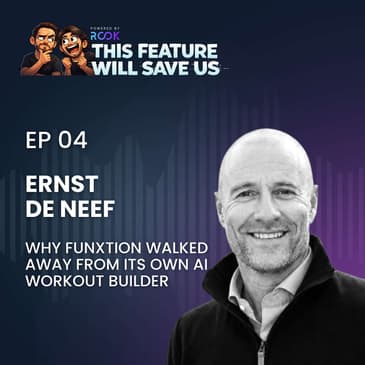
Ernst de Neef, CEO and co-founder of Funxtion, joins Marco and Jonas to talk about building digital products for large fitness operators.
After more than a decade in the industry, Ernst has seen what happens when customers want flexibility, product teams want simplicity, and the roadmap is expected to somehow make both sides happy.
They get into APIs, SDKs, enterprise sales cycles, customization, and an AI workout feature Funxtion spent a long time building before asking a harder question: even if the technology works, can you trust what it gives the user?
There is also the familiar question underneath all of it: when a big customer asks for something, is it a useful signal or just a very expensive distraction?
Ernst gets into:
→ Why poor prioritization can cost more than poor execution
→ The customer request that moved Funxtion from hardware toward APIs and SDKs
→ Why the fitness industry resisted digital products while the existing club model was still working
→ What makes enterprise fitness sales cycles take so long
→ How Funxtion connects engagement to member lifetime value
→ Why large customers often ask for customization they may later regret
→ How to say no to a feature request without shutting down the customer relationship
→ Why Funxtion stopped building a fully generative AI workout builder
→ Where AI can help personalize fitness programs without creating unpredictable outcomes
Follow Ernst de Neef:
LinkedIn: https://www.linkedin.com/in/ernst-de-neef-312a251/
Funxtion: https://www.funxtion.com
LinkedIn: https://www.linkedin.com/company/funxtion-international/
Follow Marco Benitez and Jonas Dücker
LinkedIn Marco: https://www.linkedin.com/in/marcobzg/
LinkedIn Jonas: https://www.linkedin.com/in/jonas-ducker-37460bb3/
Get in touch with This Feature Will Save Us Podcast
LinkedIn: https://www.linkedin.com/showcase/this-feature-will-save-us
Website: https://thisfeaturewillsaveus.com/
Powered by
ROOK: https://www.tryrook.io/
0:00 - Welcome and quick questions with Ernst
4:38 - Why bad prioritization costs more than bad execution
6:06 - Ernst’s background and what Funxtion builds
8:15 - What hyper-personalization means in fitness today
11:02 - What fitness products can learn from social media engagement
13:15 - Using data and connected platforms to make recommendations more relevant
14:31 - Why the fitness industry fell behind on digital experiences
17:04 - The customer request that moved Funxtion toward APIs and SDKs
19:00 - The reality of selling embedded software to large fitness operators
20:53 - Starting with lifetime value and working backward to engagement
24:20 - How much enterprise customization is too much
28:12 - Keeping the company vision steady while customers and investors ask for changes
32:41 - How to say no to a customer and still help them
33:00 - Why Funxtion stopped building its AI workout generator
35:30 - The next attempt at making personalized fitness programs work
37:06 - Why progress in fitness technology depends on companies working together
Every product team has that moment. Someone pitch a feature and says, This is the one. Sometimes they are right. Sometimes they are very wrong. I am Marco Benitez.
SPEAKER_03And I am Jonas Ducker, and this is This Feature Will Safe Us, where we dig into the decisions, debates, and occasional disasters behind building great products. Let's get into it.
SPEAKER_01How are you? I'm well, are you guys? Wow. Good. Where are you based? Headquartered in Miami.
SPEAKER_00Yes, exactly. Miami. Well, Jonas is in Miami. Yeah, exactly. Jonas is in Miami. I'm near Miami and in Naples, which is like an hour and a half from Miami. But also it's really close. It's like we have the beach in front, so it's it's really beautiful. What are you? Amsterdam. Yes, absolutely.
SPEAKER_01Yeah, you've been to Amsterdam?
SPEAKER_00Yeah.
SPEAKER_03We have been. I'm actually not too far from there. I'm I'm born and raised in Germany, close to Cologne. So Amsterdam is one of the bigger airports I can actually use if I fly out. And then it's all Frankfurt or Amsterdam for me. Yeah.
SPEAKER_01Yeah, yeah, yeah. Well, actually, from where I live, it's like a two-hour, two-hour drive to Cologne. So uh easy one.
SPEAKER_03Almost neighbors. We we would love to kick things off with a few rapid fire questions and then from there just keep it very conversational and go over what you're up to and the highs and lows of building product. Uh and you've been at least with functioned for what 15 years or so. So you know what is everybody ups and down. So yeah.
SPEAKER_02Uh yes, absolutely. I could tell you a lot about it. Can talk for hours about it.
SPEAKER_03Yeah, that's great. That's great. Well, we have we have some time today, which is great. Uh good, great. So, yeah, let's kick us off with rapid fire questions. Marco, do you wanna do you wanna start? Should I start?
SPEAKER_00Yeah, yeah, yeah. Let me start with uh FIBO or HFA?
SPEAKER_01Definitely FIBO. It is the um I think the major event of the year. Uh it's the biggest one. I mean, um I did 25 of them. I also did many HFAs, by the way, and they're great too. Let me uh be very clear there. But I think if I have to choose, definitely FIBO. Cardio training or strength training? Um strength training. I mean, um it's becoming more and more clear that you know the health benefits of strength training are massive. So if I would need to recommend something, I would say uh strength training. I mean, you see the topic longevity, metabolic health, all those kind of things, all being related to you know strength training. So I would say definitely strength training.
SPEAKER_00Red or black?
SPEAKER_01Which color? If this is related to the casino, I would say red.
SPEAKER_02I mean, that's where I'm I won the most money. Most times I won on red. I mean, I'm I'm not a frequent casino uh visitor, by the way, but um I did a few times, mainly during events like HFA in Las Vegas, right?
SPEAKER_01And then if I have to put my bets, I put them on red. Beautiful.
SPEAKER_03That's awesome. Uh one question we have to do I see favorite fitness product, uh maybe outside of function.
SPEAKER_01Yeah, yeah, yeah, yeah, yeah, yeah. Google them. Yeah. Well, personally, I'm I'm a big fan of the hyperized massage gun, but it's it's because it's my lifesaver, you know, uh uh working out a lot during the week, playing tennis, and uh and getting a bit older. You know, I'm not not a real youngster anymore. Uh I just love that product, it's just fantastic. And it uh I have uh kids uh in the age around 10 years old, and they know that you know, uh just before bedtime uh that they uh they could do a 10-minute uh hyper ice gun on my calls, and they have an extremely happy dad.
SPEAKER_03If they want something from you, they know how to go about it. Like first live in a hyper ice gun and then like that.
SPEAKER_02Either way, they're building they're building credits, I know, but uh it's worth it. It's worth it. Yeah. That's great.
SPEAKER_01Um, single or married? Married. I'm married um already for 10 years to uh uh uh a lovely wife, my lovely wife, and um so I can say not only married but happily married. That's awesome.
SPEAKER_00Because my my next my next question is gonna be like, which one do you prefer?
SPEAKER_01Well, I've experienced both being single uh and being married, and uh and actually it depends a bit on the season of your life, I would say. Um so and you just described uh that time when you visited Amsterdam with a big butter backpack. I think that's a cute uh moment to be single, right? In my season of life now, uh it's great to be married and uh to have someone next to you uh where you can share everything you want with and uh yeah, share the love. So in my season of life now, absolutely uh being married. Was the only correct answer you could give right now, anyway.
SPEAKER_03So that's perfect.
SPEAKER_02She will watch this one. So uh I have no choice in answering this one.
SPEAKER_03I had to go back to like building in in product, like what kills most products? Bad execution or bad priorization?
SPEAKER_01Yeah, the the last one. I mean, because it bad execution can be corrected, right? You can make a mistake in execution and you can correct it and and you know change uh core strategy or whatsoever. But if you have bad prioritization, that is very tough to correct. Probably you you end up something where you have to manage a lot of, well, I would say, um I I wanted to use a bad word, but uh a lot of nasty things. And um so better do it right by taking a proper time to think about you know what's the right order of priority when it comes down to creating a product, than to go fast and and and think, you know, we'll manage it in the execution. So I mean, and this is really based upon our own experience because you know, let me be very clear, we've made the mistake of bad prioritization, right? And I know that the cost of doing so is is way higher than uh than bad execution. So I have to choose for that one.
SPEAKER_00AI features that actually are useful.
SPEAKER_01Well, there there are a few, but um let me pick what I think currently is the best one, and that is I think personalized recommendation. I think that is the best AI feature related to our industry currently that uh that you can use. Awesome.
SPEAKER_03Yeah, maybe that's actually a good point of transition into what you're up to. I mean, maybe you can give us the 30-second spiel of uh function and the 15 years that you've been working at it, reduced to 30 seconds, and maybe a bit about like yeah, AI. How you how do you think about it today? How do you implement this? What is features and products you're building around AI with AI, etc.?
SPEAKER_01Absolutely, yeah. So I'm I'm co-founder, CEO of Function. We're an Amsterdam-based Dutch software SaaS company, and we're serving large fitness operators around the world, helping them with digital programming at scale. So most of the time we say we're the member journey specialists because we help large operators creating member journeys, mainly in an omni-channel way, and I'll come back there. And what's so fascinating about that is that, like I said, I did 25 FIBOs. So I'm in this industry already for uh for quite a long time. And you see that for decades this industry had this one size fits all approach, right? So there was only the physical location as a touch point. Members had to take a membership, and you know, the average visit frequency of let's say one hour, one time a week was the only moment where you could engage and interact with the customers, right? And I always stated that this industry is a motivation industry, and you know that in that model it is very difficult to motivate people and to keep them engaged for a longer period. So the retention issue that our industry has been facing for many decades, I think was directly related to the model. The great thing about the era that we've now entered with technology, digital content, is that we really can have an impact on the people's journey to a healthy lifestyle for whatever goal they have. And I think that last sentence is really important because we can evolve now from this one size fits all approach to a hyper-personalized fitness experience. And that's where AI, in the end, uh will play a very important role. So I'm aware this was not a 30-second pitch, but it gives a bit of understanding what we do and uh at least what's our passion and what drives us and what gets us out of bed every day.
SPEAKER_03That's awesome. No, that's perfect. I want to dive deeper on the point of like hyper-personalization. It's like how how far can it go? Like, what have you experienced so far? Like, what what does really hyperpersonalization mean today, and what can you even imagine moving forward?
SPEAKER_01Yeah, well, there's there's some good news and some bad news. And I think the uh the bad news is that this industry is very slow and behind. We're catching up, but compared to other industries, uh you see that uh yeah, we we're a slow industry in this area when it comes down to personalized customer experiences. The good news is that we can learn from other other industries where you see that personalization has been developed and evolved way further than in our industry. But I think if if you agree that this industry is a motivation industry, because theoretically people can you know achieve their health goals by you know eating healthy at home, working out at home, running, doing sorts, playing tennis, or whatsoever. But for some reason, they need the membership of a health club, their experts to guide them and to motivate them. And I think where we've done a lousy job as an industry is really understanding what a customer wanted and needed, because that differs, of course, per person, right? So I think that there's a stage in between the one size fits all approach and hyper-personalization, and that is where you more start thinking in persona groups, right? So I think that's what we've seen the last five years, maybe, where you see that large operators started thinking in personas, so creating different target groups, people that you know are already fit and just want to get fitter, uh, newbies, people who never did anything, we you know, we need to bring them from zero to hero, you know, all kinds of different personas. But in the end, the hyper-personalization is directly related to engagement. That's what we strongly believe. So if you are able to provide someone with the right type of content at the right moment, at the right place, you know that you are serving them exactly what they want and what they're looking for. And the probability of them staying engaged for a longer period is extremely high. So that's our view on uh on hyperpersonalization. It is not that I that I say that in the previous years we did a lousy job because we were lazy and the opportunity was there. We didn't, as an industry, simply didn't have the tools. And I think that uh again, I and I I I repeat myself there, I think with the technology that's currently out there and the AI developments, we finally get the opportunity to really move towards more hyper-personalized fitness experiences.
SPEAKER_03For me, the big question is always still because it feels so intangible, so abstract to really understand, like because it feels like such a tiny little gap that's sometimes missing to actually get the user to engage that day or to not engage the day, right? Like it's it's sometimes mini decisions that lead to okay, the user is engaged, is not engaged. And I always wonder if there is a way to kind of copy a bit more of what we know from like social media, right? Like people are hyper-engaged, they stay on there for so long, and everywhere it's being discussed, like even banning social media for the young, right? Like, because it's so engaging, it's even addictive. If there is mechanisms that work on the social media side that can be kind of transferred more into that personalization engine of if you get like you know, the people fit people doing the high-rex, it might be the one that pulls you and be like, Oh, I should also get up and do, or yeah, yeah.
SPEAKER_01It's a very interesting point that you're touched upon because if you uh compare to social media, what they do there is that they find out through their algorithms, their data, what you are interested in, right? Uh and I think that's where it all starts. That and what I meant with we lacked technology is we also lacked data. We just didn't have the insights. Currently, you see that we get more data input through wearables, through assessment tools, all kinds of sort of technologies that will uh help us understand what a customer is interested in way more than uh than before. And I think that's what what you see with social media. I mean, they provide you with the content that you obviously have an interest in, right? And that's why you stick with it, and that's the stickiness, and maybe not for the good sake in this example, but I fully agree with you. If you can turn that around or use that mechanism for for the good sake, for helping someone sticking to the to the health and fitness routine, yeah, we we made a major leap forward for sure.
SPEAKER_03Yeah, yeah. Is that capabilities you have thought about that are already available as well? Do you track all this information? How much time is spent consuming certain type of content, certain interface in the apps that you are pushing for your clients, etc., and just try to personalize at that scale then even the content which is showing up, or like where are you standing there with function?
SPEAKER_01Yeah, absolutely. Yeah, so we've invested quite heavily in data, so we can pull a lot of data already to provide back to our customers content drop-off rates, uh, popularity of uh different types of content, all those kind of things. But in the end, we are sort of the infrastructure and orchestration layer, I would say, in between, that can also connect to the data warehouses of our customers because that data game is a joint effort, I think. It will all be about relevance, and you can't achieve that alone. So you need to connect to the best of breathed, right? So you need to connect to players out there in their expertise. I mean, you you guys are obviously in the wearable side of the business, and there's there's all sorts of businesses that do a great job and can provide data, and I think if that is integrated and served to the operator or to the customer in a way that they can use it to help their members in the end, we're doing a good job.
SPEAKER_03Yeah, yeah, for sure.
SPEAKER_00I I stick with something that you mentioned at the very beginning about that this industry is a little bit behind other industries. I'm wondering why do you think that? And second one, which other industry you think that we need to follow when we are talking about personalization?
SPEAKER_01Yeah, I think this industry, what why we have been behind is that because that model of focusing on the physical location only works very well. So pre-pandemic, we were already in the digital space, actually, we launched our first digital product, including a platform in 2015 at FIBO. And I remember that in our marketing we stated members want to work out in the gym, at home, and on the go. So we already kind of like believed and preached that omni-channel model. What happened is that large fitness operators visited our booth and they said, we love your tech product, which was like a huge, huge smartphone, a touch screen, but we don't want members to work out at home or on the go. They need to come to the gym. What changed, I think, is that when the pandemic hit, is that this industry, the fitness industry, realized that the brick and mortar business, focusing only on the physical location, is a fragile model, right? And it's also not how the world turns anymore. So I think it went so well. You saw operators saying, really literate to us, yo, we're just opening clubs. We're opening clubs and we're burning and joining members, and it makes money, right? So, you know, find all your tech and your digital stuff and your on-the-channel approach. But this model works. We're opening clubs, and every club that we're opening makes our marketing spend more efficient. And so that model was really the reason why I think innovation and technology was pushed back a bit. The pandemic absolutely, I think, was a turning point where the industry had to embrace reaching out to members on other locations than the physical location of the club. So, and I think there we looked at other industries to answer the second part of your question. Is that you see, of course, also platforms like Spotify and Netflix showing that it works really well if you personalize your offering, right? I mean, what I like about Spotify, for example, is that people are recommended stuff that they really like, but they were not aware up front that they would like that, right?
SPEAKER_00Right, right.
SPEAKER_01And I think uh that that goes the same for our industry. If we are able to provide our members with experiences that they really might like, but they were not aware of up front that they would like it. I mean, that's a good trigger for success.
SPEAKER_00Got it. And that leads me also to another question. During the pandemics, the things that you change on your company and your business model, do you remember a killer feature that you made like this one is going to change the next thing of my company?
SPEAKER_01Well, I'm not sure whether it's one single feature, but I think one really turning point was that when we opened up our API, so we so we created uh a platform technology containing digital fitness content, and it was all wrapped in a in a physical product, so it was like a huge smartphone, iPhone from the gym floor and a mobile app. But I think when we got interest from large operators for not the hardware, but what's inside there, so that platform technology including the content, and we opened that up and we said, okay, we can integrate it into your own app. That was a game changer. I'm I remember that we spoke to the CTO of Fitness and Lifestyle Group, which is the leading operator in Australia, a very large operator. We met with the CTO back then in Amsterdam. We showed him our technology, our huge touch screen, the mobile app. And he said, I love it, but we're building our own app. And that was around 2016, I think, where you saw that large operators went on the path of building their own mobile app. And he said, I want to have what you offer, but only what's inside. So leave out the hardware, integrate it via an open API in my member app, and we did. And that was a game changer, I think. The second one I think is in line with an API integration, is that we moved to SDKs because an API integration is a quite a heavy lift. So we made the decision uh four years back to create SDKs, which makes it a very fast and easy integration uh nowadays.
SPEAKER_00That's very interesting.
SPEAKER_03This is something that speaks obviously right to us because our integration is API, SDK-based infrastructure component. It comes with challenges as well, though, right? So, like, what's what's the biggest challenges you've seen in this transition to API, SDK-based model, integration model, now working very B2B enterprise, I assume? Like, what's been the biggest challenges on that front?
SPEAKER_01Yeah. Well, the biggest challenge is when you deal with large operators, is that there's many stakeholders, right? So there's many people that you need to convince. And it's not only the technical people or the people in the product department or the CEO. It's a big group that you know needs to embrace it. Because once you embed, once you integrate, you're quite an important part of the of the member app in this case. So you see that the sales cycles are really long. And nowadays they become shorter because we have more or more evidence of the impact of our digital solution. But I think that's been really, if you ask me to be honest, the most challenging part the last 10 years is that there's a benefit of dealing with large operators because once they are a customer, they bring in significant revenue and great expansion opportunities and they tend to stay long with you. But it's not an easy sell. And especially a bit related to my to the to the previous subject where we where I said this industry has not fully embraced technology and innovation. It meant a lot of preaching and explaining those years.
SPEAKER_00That's really interesting because when we know that real. And when you're selling or you are having these conversations with big enterprises, it's really difficult to make them feel that everything is aligned, right? But I want to learn from you what type of things failed on that from that perspective. Also, how did you set the correct expectations with these big enterprises? Because sometimes as a small company, medium company, sometimes you have to show them the big picture. Yeah. Not necessarily that you have that already, right? So how did you make them feel that you have the correct roadmap to them?
SPEAKER_01Yeah.
SPEAKER_00And then they feel like, hey, I want to engage with this guy.
SPEAKER_01Yeah. A very good question. And and I always say begin with the end in mind, right? Because what every operator wants is lifetime value and increasing lifetime value. So I think that if you start talking about that, every operator would confirm and say, yes, that's what we are interested in. That's what we do, right? We're we're looking for lifetime value of our members. If you then take one step back, you need to ask yourself what's impacting lifetime value? What's the key driver for lifetime value? And that's engagement. We know that now. It's not it's not a personal opinion. There's many researchers, keynotes, you know, there's a lot written about it. So we know that engagement is a predictor for lifetime value. And it's Someone who's engaged tends to stay longer. And when a member stays longer, you know, it impacts the lifetime value. And then the question is, how do you engage members? Right? And I think we have many discussions over the last years with operators about the current model saying, Tell me, how do you engage your members? And most of the time, that's where the where the conversations became a bit awkward now and then, because they sometimes said, Well, we don't know. I mean, we ask questions like, do you assess your members? Do you create member journeys based upon personas? And in previous days, a lot of times they said, No, we just uh advertise and we have a website and people are walking in and we try to sell them a membership. And you know, if they take a membership, we provide them with a with a training program and we ask them to find the machines, and if there's anything, uh they should let us know, right? A big, big, black, white set. But in the end, what that does is that together you conclude on where's the real pain. And the real pain is, and it's still a hot topic, is how do you really engage a member? How do you really make sure that someone wants to stick to the fitness routine? And then, of course, you know, in the end, it's been brought back to what we believe is that if you are able to provide the right type of content to the right person at the right moment, at the right place, you for sure will have an impact on engagement. And if they agree with that model, they already agree with an omnichannel seamless fitness journey. They agree that only physic uh focusing on a physical location and providing them with a one-time schedule that never changes won't have an impact, uh, a positive impact on engagement.
SPEAKER_00Okay, so I'm trying to simplify everything. So it's like uh first of all, you need to have those conversations with them, learn their own pain, and then you have to adapt to that solution, right? So trying to solve a specific problem with your with your product and try to modify and make some tweaks so can really help this big enterprise, right? That's a strategy.
SPEAKER_01Yeah, absolutely. And also the large operators don't need a one-size-fits-all approach. So your technical solution, your product should be able to offer some customization, not too much, but some customization or some flexibility. Because I think what we've seen talking to very large operators over the last 10 years is that although they are in different regions, different territories, and they're in different segments from uh low-cost operators to high-end premium operators, in the end they all ha share the same problems, right? Right. But while they're so big, they do need some flexibility and some customizations here and there.
SPEAKER_03Let's go deeper on this one. How do you strike the balance of some customization but keeping it super simple? Because we know that simple works well normally, because it's easy to adapt, it's easy to understand, it's easy to execute. But then customization is is crucial to make it adapted to your client, actually. So, like, how do you how do you strike the balance there from a really like building products that are customizable but simple?
SPEAKER_01Yeah, it's a very thin line and it's a very tough balance. It means uh saying more no than yes, which doesn't feel uh always as if you are listening to your customers or serving them. But in the end, in the conversations, I mean it is a matter of really asking a lot of good questions on their request, right? So instead of you know, a large operator says, you know, can you build this feature and you start running or say, okay, yes, we can or we can't. You want to understand why they need that feature. Because a lot of times it is already solved in your technology, or in the end, when really, you know, unwriting it, it appears not to be necessary. And I think there's some technology companies in our industry, some suppliers that I know very well, who went down the path of really a lot of customizations and most of them regret it. But not only they regret it themselves, also the large operators that they are serving regret it. And I know that I can, I mean, I'm not gonna mention names, but I know there's some large operators who say, you know, while we have asked so many customizations and it's all been built for us, we're completely tied to this company. You know, it's we're locked in. It's our own fault because we asked them to build it, right? So in the end, it a lot of times it's not serving uh neither the supplier or uh the operator. And I think if you can't make everyone happy, but if in general your technology serves the majority of the needs uh of uh of the customers you're serving, you're doing a good job. Yeah.
SPEAKER_03I I always like to take that the reference of like with what happened now with Cloud and Open AI, etc. It's like very, very, very few companies used AI in a meaningful way before these companies existed because it was hard to deal and leverage this type of technology. And and what's so amazingly well done with Claude or any of the other tools is the balance of something very complex is made very simple in its form of access through a like you can ask everything you need to that same chat, basically, right? Even in cloud, and I don't know if you're a cloud user, but like even in cloud, if you're confused between should I use cowork, should I use chat, should I use a project, should I use artifacts, should I use code, whatever, you can just ask the chat. Like yeah, I don't know what to use and how to get started. Like, help me guide you, and the whole tool is just guiding you through whatever you need to know to actually then take most advantage of the tool, and that's that's fascinating. Well done. The the balance between you can customize everything or nothing, and it's super simple.
SPEAKER_01Yeah, and I think that you can do stuff that helps in this matter. So we are currently building hybrid SDKs, and um there's all different sorts of SDKs from very static SDKs where you can't customize anything all the way to hybrid SDKs where the customization can be done very easily by the customer itself. But if it runs through your dev capacity, your platform and your tenants, it's gonna be a mess. So it's also a matter of structuring it on your own side very well and make sure that it doesn't make things more complex, like you said, and in the end making sure that you're creating a spaghetti that you can't unwire anymore. So creating stuff that is in the base very stable, but with flexible options on the customer side, I think would be my recommendation uh to go for.
SPEAKER_00That leads me to another question for you, and it's around again the balance. Because now you have clients that are asking for specific features, long big companies. At the same time, you have your long vision, which whatever that means. Sometimes the long vision for you is something that it's related to the clients, right? Yeah, and then you have these AI tools that everyone are asking questions to this cloud and ChatGPT, and they have their own vision about the product. And then you have the investors. If you have in you know you you have investors and you know how to deal with them. So how do you manage everything and be very focused on your vision, which maybe is not your vision anymore? It's like a mix of everything, right?
SPEAKER_01Yeah, well, I think it should stay your vision all the time, no matter what. So if your investor asks you to change course but you don't believe it, don't do it. If your customer asks you to change course and they are willing to pay for it, don't do it. So I think we've managed to really stick to our vision. You know, we had this real, real belief about you know where this industry should go, where our company should go. And I think we've been quite rigid to all the stakeholders in saying this is what we believe. We're happy to listen to you, and uh, a lot of times your roadmap has been impacted by multiple customers, so not one single customer yelling something. But if there's a demand from many customers that you're serving, obviously it's something where the majority sees value in. You will be stupid if you don't add that to your roadmap, right? But in the end, everything should be kind of like in line with what you really believe. And I think if you look outside this industry, two great companies who have become very successful are those companies who had just a very strong vision and never left that path. I mean, I mean, companies like Apple and the real big ones did that, right? They just had a firm belief, and of course, they listen to consumers and they use feedback on you know what do customers really want. But also one of the famous quotes from Steve Jobs was that, you know, I create products that people don't know yet that they uh need it, right? So I think as a crazy, you need to have a bit of this mentality. Yeah, it's crazy, but I think it it's been part of the success.
SPEAKER_03Are you wearing new balance, Ernst? Uh no, no, sorry.
SPEAKER_04No, sorry. Today it's uh Adidas. German brand. Well, awesome. That's good. Yeah, yeah, yeah. Yeah. Sorry to drop you there, but I that question came up.
SPEAKER_01I know why I asked, yeah, yeah. Yeah. No, but I think I I really believe that. I mean, if I look back on our own entrepreneurial journey, you see that there have been many times where people or stakeholders try to make us change course, change direction, right? And it's very tempting a lot of times because you're always thinking, you know, where do we, where can we make money, how can we make money? And when someone says you well, tells you, well, if you go, if you do this, you know, that might be uh of high value, and uh, you know, we were willing to pay you for that. Uh but it's it's very dangerous if if you go down that path. So therefore, one of my mantras as an entrepreneur is say more no than yes. Because in the end, I believe that's that's needed to be very successful.
SPEAKER_00And it's very difficult though, because sometimes you have so much pressure and everything, and it's like you have to say yes sometimes just to figure out if that's the path or not. Or maybe that's the vision and it's really close with what you want to build. So it's like you you are not changing anything, it's like you are in the correct path, just moving a little things so everything can align. So yeah exactly.
SPEAKER_01Yeah, and I want to add something there because I once learned from a person that it is okay to say no, but a lot of time it helps when you say to this person, no, I can't do this, but let let me see where I can help you with on other areas, or so it's not like uh a no and you know, don't talk to me anymore. With this specific request, it's a no, maybe, but but let me see if we can help you out with something else, right? And that that already uh solves a lot of time uh the issue.
SPEAKER_00Right. Do you remember that feature that helped you open this new opportunity with the big enterprises? The feature that that was like this feature will save us, and it's gonna change the whole path of what we are building.
SPEAKER_01I think we're currently doing that with our AI initiatives, and it doesn't surprise you probably because everyone's building AI. But maybe one step back, so you see that you know, large operator used our platform technology to wire content together into digital programming, member journeys, etc. And we went down the path of creating an AI workout builder. And you see that quite some companies now currently try to build an AI workout builder, or some did already and launched it, like you know, EGM with Genius, etc. But we stopped that project after one and a half year. And it's because we saw that creating AI in the back end on the workout builder uh side is also creating hallucination, creating strange outcomes. And what we want in our industry is predictable outcomes, right? Yeah, of course. So you can train the model, etc. But we doubt whether whether it's possible to get rid of the hallucination and strange outcomes, even if you have many, many users in the platform and a lot of data, and training the model and having the time to train it. So we we said, you know, what we're gonna do is we're gonna take a step back and we're first gonna create an AI smart builder technology. And what does that mean? Based upon input data assessment, it creates a workout that is pre-templated. So it picks a workout from a scientifically backed framework of more than a thousand pre-templated workouts because those are the predictable outcomes that we want. And AI, the AI involvement there is that it helps to match the need, the persona, the input directly to finding the right program. So the benefit is that it creates in a very fast way a great program tailor-made to a specific person. And then end of the year, we now aim for first of January. We're gonna launch AI, but we launch the AI on the consumer side. Meaning the AI Smart Workout Builder creates a program in a very fast way for you, Jonas. You start working with the program, and then based upon data inputs, wearable inputs, AI changes the program automatically, or as a member, you say I hurt my knee, and automatically all exercises where you need your knee are disappeared. So I think to a long answer to a short question, but I think this approach of not building the AI on the workout builder side, but in the front end. So the the AI is powers in the consumer or the member's hand. I think that's the killer feature that will push us forward in the next years. I think.
SPEAKER_03That's awesome. And I and I love how as a founder, as a builder, we always say the next one we're building is the killer feature. It just confirms this continuous ambition of like, I think the next one it is, the next one it is.
SPEAKER_01Yeah, yeah, yeah.
SPEAKER_03It's it's great.
SPEAKER_01Well, well, well, but but also, and that's I'm gonna keep this very short, also because this specific feature is kind of like the next step or the last step, really needed to achieve our vision, our dream of you know, creating hyper-personalized fitness experiences. I mean, when we started this company, we already had the belief of you know changing a fitness experience that is completely different than the traditional fitness experience. So that's why I'm so excited about that AI, and I didn't know that a few years back, of course, but AI certainly gave us the opportunity to make that last leap to personalized fitness experiences. And yeah, that makes me enthusiastic.
SPEAKER_03Yeah, I think I think most builders are at this moment because they see the massive opportunity and are like how can I accelerate even more? How can I do build faster? How can I get 48 hours out of my day to to push things and put things in place?
SPEAKER_00Yeah, absolutely. That's why in Silicon Valley there is a new a new name for these developers and product team that is like AI vampires. It's like they are trying to build 24-7. It's like uh they are trying to suck everything from this AI cloud and chat GPT and whatever. So it's it's crazy, but it's really exciting. I'm I I believe that too. We will see more personalized things, definitely. Awesome.
SPEAKER_03Ernst, on that note, we're coming to a closing. Any final words? Anything else you would love to share with us, with the audience?
SPEAKER_01No, I think, like I said, somewhere in the middle of this podcast, is I think that it's a joint effort to to push this industry forward with in the end, you know, serving the consumer and the members. It's it is not something that our our company only can achieve. It is, you know, all working together, make sure that we integrate and cooperate. Because in the end, I think then everyone wins. So both the member, the fitness operator, and the supplier as well. So um, that is the last thing I would um I would say to the audience and to you guys.
SPEAKER_03Collaboration. Awesome. We love that.
SPEAKER_00That's a grab on this feature will save us. If you are building with wearable or health data, check out what we are doing at tryrook.io.
SPEAKER_03And if this episode was useful, share it with the one person on your team who needs to hear it. See you in two weeks.