
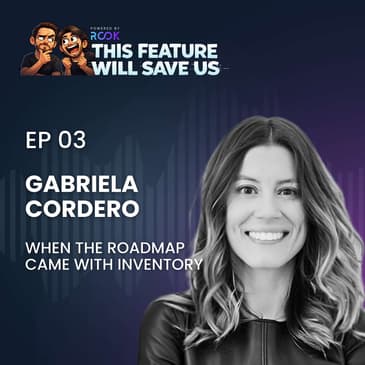
Some product bets fail because the idea was wrong.
Some get a lot messier because the world around it changed.
Gabriela Cordero joins Marco and Jonas to talk about building health and fitness products where that kind of thing happens. One launch had the product, the inventory, and the plan. Then COVID hit, gyms closed, and the team had to work through what happens when a hardware product is ready, but there’s nowhere for the inventory to go.
That leads into a bigger conversation about hardware and software product work. Software can move fast, at least in theory. Hardware asks for more commitment. Sensors, manufacturing, inventory, timelines, and physical design all make the product calls feel a little less reversible.
Gabriela also talks about what she’s building now at MedWatch Technologies: a needle-free glucose wearable. She gets into the process behind bringing that kind of product to market, from the science behind the signal and the hardware constraints to validation, FDA positioning, and how glucose data becomes useful beyond traditional disease management.
Gabriela breaks down:
→ What happens when a hardware product launches into conditions no one planned for
→ Why hardware product decisions are harder to unwind than software decisions
→ How customer research and market feedback shape product roadmaps
→ Why AI changes parts of software development faster than hardware development
→ Why product teams need to separate a good idea from the right feature to build now
→ How acquisition dynamics can create product conflict inside larger companies
→ What she learned from helping bring Nix Biosensors’ hydration wearable to market
→ Why form factor matters more as wearables move into more personal health use cases
Follow Gabriela:
LinkedIn: https://www.linkedin.com/in/gabriela-cordero1
Follow Marco Benitez and Jonas Dücker
LinkedIn Marco: https://www.linkedin.com/in/marcobzg/
LinkedIn Jonas: https://www.linkedin.com/in/jonas-ducker-37460bb3/
Get in touch with This Feature Will Save Us Podcast
LinkedIn: https://www.linkedin.com/showcase/this-feature-will-save-us
Website: https://thisfeaturewillsaveus.com/
Powered by
ROOK: https://www.tryrook.io/
1:50 - Hardware, software, and why Gabriela likes B2B2C
5:40 - The highs and lows of building hardware products
6:20 - Launching fitness equipment during COVID
11:10 - Hardware vs software product cycles
12:50 - Where AI helps, and where hardware is still very hands-on
14:20 - Sensor miniaturization and the future of wearable form factors
15:20 - What MedWatch Technologies is building
17:10 - The needle-free wearable Gabriela’s team is developing
20:40 - Chasing the founder vision when the product has never existed before
21:45 - Clinical trials, scientific validation, and building from data
24:45 - Managing product, commercial, marketing, and brand work in an early-stage startup
26:30 - How Gabriela thinks about roadmap tradeoffs
27:20 - What happens when leadership wants a feature the market may not need
30:45 - The product Gabriela is proud of helping bring to market
36:10 - The feature that will save us: glucose visibility
37:00 - Connecting glucose data to food, movement, sleep, and behavior
38:20 - Where to find Gabriela and MedWatch Technologies
Every product team has that moment. Someone pitched a feature and says, This is the worst.
SPEAKER_04Sometimes they are right.
SPEAKER_02Sometimes they are very wrong.
SPEAKER_01I am Marco Venitez. And I am Jonathan Tucker, and this is this feature will save us where we dig into the decisions, debate, and occasional disasters behind building great products. Let's get into it.
SPEAKER_04Gabriela Cordero, it's unplacer start contigo. We can do a mix between English and Spanish, and I'm so happy to do so. Because it's the first time I will feel comfortable with talking between English and Spanish. So really great to have you here. We would love to start with you with a fire question. All right. Because that will help us to be, you know, we can shake a little bit and start, you know, asking tough questions of product and features. So let's start. Do you want to start, Jonas?
SPEAKER_01I can start. We're going to start a bit more on the personal side. Cardio or strength training?
SPEAKER_00Oh, asby a year ago, it would have been cardio. Today it is strength all the way.
SPEAKER_01Then I have to do a follow-up question. Is it something like Hyrux or CrossFit?
SPEAKER_00Neither.
SPEAKER_01Full strength, weight training.
SPEAKER_00Full strength. I've I've become a gym bro.
SPEAKER_01Jim Bro.
SPEAKER_04That's cool. Mexico City or Chicago?
SPEAKER_00Ooh, both are different. And I you guys know I lived in Chicago for six years, and now I've been in Mexico City for four, officially a Mexican resident.
SPEAKER_04So congratulations.
SPEAKER_00Thank you. That's cool. You know, I think I would say Mexico City because I get to live a little bit of both worlds in terms of being able to relate to my Hispanic background and speaking Spanish every day. It's obviously improved tremendously since the day I first got here. But the culture is wonderful. And the weather, you can't beat the weather in Mexico City. It's awesome.
SPEAKER_01It is. Hardware product or software product?
SPEAKER_00For me, it's both, right? And I think hardware is what enables product adoption, but the software obviously helps include the interpretation layer to make your product really successful all around.
SPEAKER_03B2B, B2C, B2B2C? Which one do you prefer?
SPEAKER_00So B2B to C, and because I think it really helps enter the market with established companies that already have user bases that trust them and their product. And so for us, and we'll we'll get into what I've been doing for the last year or so, but you know, where we're going B2B to see allows us to really connect with our end users to the customers that we're going to be partnering with.
SPEAKER_01Awesome. Switching back to personal, the hardest physical challenge or competition you've ever trained for or you ever did?
SPEAKER_00Marathon training. I run four marathons and it's never the same. Each one is very different. And training in Mexico City at high altitude was a learning curve for me. Um together. You you know it well, Jonas. You run a marathon here in the city. Kudos to you, because I I still wouldn't attempt to do that.
SPEAKER_01First one here actually in Mexico City. Not a good idea to start in Mexico City.
SPEAKER_04It is not. One app outside healthcare you admire.
SPEAKER_00I have to say Strava. And Strava, I think, really understood the gap in the market, right? So I've always worn a Garmin watch for running, and obviously Garmin owned watches, bike computers, the data, but they really lost when it came down to community. And I think Strava saw the opportunity that fitness is social and emotional. And then that data piece just enabled them to really build a business and a community around rewarding people for achievements, different milestones. So I think Strava's really done a great job.
SPEAKER_04Do you saw the last news from Strava that now you can integrate with Cloth? That feature is really interesting.
SPEAKER_00It's really interesting. Um no, so I've I've pivoted away from using Strava because I haven't been running in the last year. So I'm not too up to date with that integration, unfortunately. But it is interesting. I don't my assumption is that people want more, and I don't want to say data, but they want more visibility into the trends week over week versus just, hey, you trained one hour over, you know, the last four weeks or you've increased XYZ. I think people want more personalization in real time as it relates to the historical trends that some of these applications are showing them.
SPEAKER_01What I found interesting as well is like it might lead into you can take your Strava data and now you can pair it with your Google Calendar data, et cetera. So you might even get more personalized recommendations on workout windows, you know, like any type of information that correlates more to your work-life kind of setting, rather than just the the actual fitness information, content, social aspect of Strava. So maybe we can switch gears a little bit and dive more into the conversation. As you know, the podcast is all about the highs and the lows in building products and great products. So as much as you're willing to share, we're we're keen to hear the good and the bad, especially the bad, actually. So maybe we can just dive right in. First of all, you giving us a little snapshot of like the highs and lows in your product career, whatever comes to mind from building great products to massive fails, and you don't have to you don't have to drop names on the fails uh if you don't feel comfortable. But yeah.
SPEAKER_04But please, if you can share with us, no one is going to hear about it. No worries.
SPEAKER_00I know, I know. Oh gosh. Um, you know, there's been a lot of highs and lows. And I think it's one of the one of the things we talked about earlier was around hardware development, right? And so that development cycle is very different to software. It follows a more waterfall approach, just given the the lead times in tooling, any sort of manufacturing components, testing, especially as it relates to fitness equipment, which is why I spent a good chunk of my career leading new product development for a global fitness company. And so, you know, one of the probably biggest challenges was how do you mitigate unforeseen risk? And for us at the time, it was unfortunately a global pandemic. And so, how do you launch a product in the middle of 80% of the world having their gyms being shut down? And you're sitting on inventory that you can't ship because there's no one there to receive it. So I would say that was probably one of our biggest challenges was you know, developing a product that took into account both the customer and the end user into perspective, but really it came down to not being able to ship because we weren't able to. And so early adoption for that product became a little challenging because we were sitting on inventory and some of the features that made this product really unique was that it re it used a generator to recharge the console. And if you have products sitting in a warehouse for months not being used, then once they were delivered to the gyms, well, people had to get on it to start charging them so they were actually functioning. So yeah, very challenging to launch a product during COVID that you thought was really going to disrupt a specific category, but unfortunately fell a little short because of just global conditions.
SPEAKER_04That's a really interesting one. And you don't have to say the name, I can imagine which which was, but how do you handle it as a product, as a team with your team? Is it you have this chunk of a lot of you know equipments in the inventory over there? How do you handle that part?
SPEAKER_00Yeah, I mean you ship to the customers that are able to receive it. So the US obviously was relatively open for the most part. Um, but Europe and Asia that was that was delayed for a while.
SPEAKER_04That's crazy. That's crazy. That happened.
SPEAKER_01Is that something then like that's really on the product team to iterate on? Like, is that a product decision, the core of okay, what do we do now is the inventory? How much is product has product been really involved there? Or has this been more of a company strategic direction then that you were like, okay, let's focus all in on US market? We net we need to get the inventory out because we can't sit on. I mean, that's also capital that's kind of locked in, right? Like from a business perspective, which is not moving, which is not generating. So, like, how how much is product involved in in that?
SPEAKER_00Well, it's it's involved to to an extent because obviously you have capital investment from the business on a new product launch, right? For that particular product, we went slightly over budget, but nothing too significant. But the delay, as we were mentioning earlier, in getting product over from, we were manufacturing this with a partner over in Taiwan, those containers, that shipment took longer than expected. So unfortunately, the business had to make a decision in okay, how do we mitigate this and where can we actually sell the product in order to minimize a significant loss, right? And and and slower ROI on a very favorable project that again was was going to be a slam dunk in the in the category.
SPEAKER_04That's interesting. And what happened after? So let's say you move forward, you start to bring those products to the US. How was that option? Uh, because you create the product with the whole team, and then what happened? Wasn't very good adoption, it wasn't. What happened over there? Because what was COVID, right?
SPEAKER_00Yeah, I mean, I had uh several products in gyms in downtown Chicago that I could actually walk to to measure engagement. Um, obviously, we did a lot of product testing, but ultimately it was an executive decision that I wasn't truly uh a part of once once product more product was in the market. I had already left Life Fitness at the time.
SPEAKER_01Challenging, challenging, challenging. I mean, that's that's almost like give leading me to a question around like product management in a hardware company setting and a software setting. In your background, you've done both, obviously. You've you've you've seen both worlds. What's your feeling there when it comes to especially this kind of market adoption, go-to-market side of things, when you compare a bit your experience in hardware and software, is that very different from how product interacts with go-to-market and marketing teams, sales teams, or is that pretty similar for both worlds, hardware and software, from your experience?
SPEAKER_00No, I would say it's pretty similar, the process, to be honest. I don't think there's much change. You know, a lot of what I've done throughout my career has always been driven by customer and market research, right? I think there's this notion that we're not just going to launch another product to create another solution in the market and ultimately it just creates another problem. I think it's really identifying how you can improve customer pain points and deliver a solution that's going to be a value to them. The difference is that obviously with software, you're able to iterate a lot faster than you do with hardware. And again, it's really around tooling, long lead item times, but with software, you have the ability to really iterate fast. So from that aspect, I really love software development a little bit more. Um, but really what I I've always been at the intersection of both. I've never really focused on one versus the other.
SPEAKER_04I want to ask you more things about hardware. I love hardware. Because it's really interesting. It's like uh do you see any difference between before and now with the new tools that we have with AI and modeling and everything? Because my thing is like before was a little bit more difficult because again, you have to think in the future, right? And you cannot iterate. That's the big problem. And now you have these AI tools that you can at least ask questions and try to make different hypotheses about what's going to happen and then the features and whatever. But do you see any difference between what happened before and now? And if so, what are those differences?
SPEAKER_00For my team, I I'm not sure that AI is leveraged very highly on the hardware development side, because if we think about the designs of board for electrical components, that's very specific. But yeah, I mean, I have a 20-person AI team on the software side. They're the experts in being able to leverage AI into the models that we're building. But on the hardware side, I would say that it's still very hands-on and a little bit more traditional in the sense of how that product is being developed.
SPEAKER_04That's interesting because my thoughts were like uh maybe now that you have more tools, you can do something different than before, because I think it's really difficult. How you are bringing all these new things and uh think on feature. It's like today, I'm not sure if you saw also the news with Tesla. Tesla, what's going on right now is the full-self driving, you cannot use it with the previous hardware, the hardware three, and the hardware four is the only one who is going to have that service. And it's good becoming something really interesting. It's a lot of discussions outside. Also, it's like a uh a lot of people making demandas. How do you say demandas demanding? Yeah, I don't know, in English, suing, sorry. They are suing Tesla because of that. And I mean, has a lot of repercussions if you don't take the good decisions at the very beginning, right?
SPEAKER_00Oh yeah, absolutely. Absolutely. I think for us on the hardware side, it's really more on the advancement in technology and being able to miniaturize sensors. That is really where the focus is on the hardware side, especially for for our business. Not so much on the AI side relative to that, but the other day I think I saw an implantable chip in a tooth. Like we're talking, that's how small sensors have been miniaturized today, where you know you're seeing it not just in in our world in wearables or in tech, and you're actually seeing it in in dentistry, right? So you're seeing this adoption of miniaturization of sensors across a vast majority of industries that are are really it's it's really remarkable.
SPEAKER_01Which is actually a great point to lead a bit into like what you're doing today, the company you're you're with. Um correct me if I'm mistaken, but director of product management, uh, MetWatch Technologies, and you're working on a needle-free glucose monitor. So, which is actually interesting with the question Marco just did previously, right? Hardware, software, is AI changing a lot on the hardware side as well. We all know on the software side, obviously, AI has massively helped with efficiencies around coding and developing of software, quicker iterations, etc. But is this helpful for what you guys are doing? And maybe you can just give us a little bit more of an a context as well, an intro to what the company's up to, what what what you're working on in particular. Uh, that would be awesome.
SPEAKER_00Yeah, I would love to. So have either of you worn a CGM before?
SPEAKER_04Yep. I think both of us. Yeah. Of course.
SPEAKER_00Okay. So then you've experienced how powerful it is to understand how glucose has an effect with your body, right? And then for those out there listening, if you've never worn one, then this is uh this is exciting because uh it's really what the opportunity that we have. So today, continuous glucose data is really inaccessible outside of disease management, right? Because it still requires a needle. And at MedWatch, we believe that glucose visibility should be accessible to a broader population. And so we're developing a needle-free wearable, and it is a rechargeable sensor that the battery lasts five to seven days, can be worn as a patch or with an armband. It's water resistant. And really the idea is to be able to provide people with glucose visibility, right? So if we think about the problem that exists today, right? Metabolic dysfunction happens silently. And for most people, that progression happens years before they're ever diagnosed. And, you know, eight in 10 adults live with metabolic dysfunction. And the problem is that solutions available today weren't made for them. There's a barrier to adoption with a medical device, there's a adoption to barrier, a barrier to adoption because of the invasiveness of it, because it still requires a needle. And so we really want to make glucose and metabolic uh visibility accessible to the proactive health user.
SPEAKER_01So is that thought as a medical device or are we talking wellness category, or where where are we standing on on that kind of parameter?
SPEAKER_00Oh, that's so exciting. So, you know, the market looks very different to what it did five years ago, right? And so if we think about a handful of forces that are really allowing us to define a category, we have GLP1s have accelerated consumer engagement with metabolic health, right? And most of those people will go off a GLP one within a year. And many of them never changed how they eat, fitness activity, really not much, right? Outside of taking the GLP one. And so it really creates an opportunity for platforms like us to build a solution to help drive sustainable behavior change. The second is I think that glucose awareness is growing. Both Dexcom and Abbott obviously launched over-the-counter continuous glucose monitors. And then the recent DEXCOM Aura integration is a huge shift in consumer behavior where the consumer has expressed that they want metabolic data along with physiological data, even if they have to wear two pieces of hardware. So that in itself is like so exciting to me because they've done some early market validation that what we want to deliver to the market is wanted. And so, you know, from a regulatory perspective, the FDA General Wellness Guidelines enables us to launch as a wellness tool for proactive health while we also do clinical validation in parallel for the future.
SPEAKER_04That's perfect. So when are we gonna start using that?
SPEAKER_00So, so soon, I hope. So soon.
SPEAKER_04Come on, we need to know the the the dates, Gavin.
SPEAKER_00We have a limited launch planned for July of next year.
SPEAKER_04By next year, okay. We are going to be the first ones.
SPEAKER_00Absolutely.
SPEAKER_04You guys are you need to come again, and definitely we can show to everyone to to see the the the CGM.
SPEAKER_00Absolutely.
SPEAKER_04That's impressive. That's impressive. It's it's crazy. It's really cool that everyone can use these these tools and start measuring. So that's great. That's great.
SPEAKER_01On that note, like I wanna I want to try to get an angle from you like more from the product perspective. So it's obviously something new. I I don't know. I think there's no needle-free glucose monitor out there yet existing. So we're really talking about something that's completely new, it's it's innovative, and it's it's figuring out how to get there, right? Like it's probably you guys sat down and you you thought it's it's possible, it has to be possible. But then obviously the the pressure is always on product, okay. The crazy founder, the crazy CEO vision, and now the product team is like, how do I deliver? Like, how can I get it done? Like, so like what's been the approach here? Has have you been working with academia as well, research institution? Like, how do you get to something where you feel like okay, we're we're actually getting something that's close to a medical clinical grade, that which is obviously needed for such a product? So, like, yeah, help us maybe in terms of methodologies and everything that comes to mind from a product angle, help us understand how do you chase that. Founder CEO vision as a product team behind the vision.
SPEAKER_00Yeah, I mean, you said it, right? There's no needle-free solution in the market today. This category has had a ton of capital invested in it for decades. And, you know, I think a lot of players, companies have solved for different pieces of the puzzle. What makes us unique is that we have really solved for accuracy, miniaturization, and form factor. And so, yeah, we have just completed our fourth clinical trial. You know, we have a team of scientists. Our chief science officer has 30 years experience in glucose research. He's uh a chair at the University of Alberta. So, you know, we we have a very extensive team, scientific and medical team, really working with us to make sure that, you know, everything that we do is grounded in data and science. And then from a from a product perspective, you know, I think earlier I mentioned we have two patents allowed, five pending, and they're really in two categories. And one is in our multi-sensor fusion approach. So part of where other companies have been unsuccessful is they've been focused in single technology solutions like optics, photonics, and we are combining light, RF, and other electromagnetic signals to produce that glucose signal. And then the other category where our patents are in are in our AI ML methodology to be able to correlate that glucose signal to actual data to the end user.
SPEAKER_01Do you have to calibrate against an actual glucose monitor medical grade, or is it something that actually because I'm still confused here, maybe between is it an actual reading or is it a proxy? Like, do we just get a like a close proxy to this should be where you are from a glucose level perspective? And you have to calibrate this from time to time against a medical grade device so that we can kind of keep it in charge and keep it like learning so that the proxy is becoming better and better, or is it an actual reading? Uh and I don't even know where the where the line is drawn between actual reading and and and like the proxy, but yeah.
SPEAKER_00No, yeah. So our product will not require any calibration, and all of our testing is done against the DEXCOM G7. That is really the gold standard around continuous glucose monitoring. And so we're able to actually have a glucose correlation to to a G7. Absolutely. Yeah.
SPEAKER_01Awesome. Excellent.
SPEAKER_04Yeah, that's great. Because normally it's what happens, right? You have to compare with the gold standard, and then depending on that, then you have the you have the ability to start to see that you are also uh FDA approved or you are a medical device, which is great. Uh I have more questions for you about your career, Gabi. Because Jonas mentioned something really interesting about the vision that the founder, the team, and everything. Uh you have been again, I I said that at the very beginning. You have an impressive career working with big, big companies and also building products. And we know it's really difficult. We know that it's super difficult to build products. But uh how do you take all the vision that the CEO has, and also the pressure from investors plus the pressure from the CTO, the whatever C level, and then the team, because the team they are the realistic that say, hey, this is impossible, or maybe not impossible, but will take longer. How do you handle everything? Because you are in the middle of all these discussions. How do you move forward to take hey, okay, this feature, we need to build this feature before this one, and then the other one, you know, make something that makes sense.
SPEAKER_01This feature will save us. You're allowed to say it, Marco.
SPEAKER_04I am allowed to say that. Oh, thank you, Jonas.
SPEAKER_00You know, it's interesting. Um, and thank you for the kind words. Um, yeah, I've worked with a lot of really incredible teams, and I feel very fortunate that I've, you know, I've had the ability to work with some incredible people and learn from them. And and in my current role, I'm actually managing all commercial efforts. And so, you know, you're looking at the commercial, the product, the marketing, the branding team, as you know. And in early stage startups, we tend to wear a lot of hats. And so for me, really, it always comes down to is what does the user actually need and what's going to be able to drive value for the business, right? That has always been at the core of any product roadmap that I've ever developed, any conversations, especially around trade-offs, because there's always trade-offs in any product development cycle. And really having those discussions with the team, because you know, it's not just about launching features, if those features don't help somebody move forward along the journey. So yeah, it's it's really making sure that the team is in alignment with the end user, end user needs.
SPEAKER_04What happened if the CEO or the team, the founding team, is not aligned with the answers that you found in the industry or with the potential clients?
SPEAKER_00You know, again, I feel really lucky because we have a really collaborative team. And this team, because it's comprised of scientists, doctors with PhDs in AI in their respective fields, everybody is really data-driven. And so although there is an element of, I have an old boss that would say, you know, sometimes you gotta follow your gut. But really, it's everything that we do is data-driven. We want to make sure that all the choices that we make are grounded in facts.
SPEAKER_04I I agree with you, but this is with your this new company. But what happened with the previous companies? Have you ever been in that situation where you were outside asking, and then the C level or someone told that, hey, this is not the correct way, because the correct way is my thought, my idea, my baby. And you and you found outside that no one wants that feature. Have you ever been in that situation?
SPEAKER_00Yeah, it's always pushing back on ideas that you have uh information that is not that that warrants it won't be as successful as somebody thinks it's going to be. And you know, I I always try to reframe it in one of two ways. Um, and it's not killing the idea, but it's opening up the discussion to either push out that feature for a different build, but really focusing on having the team answer who is this for? And again, like I said earlier, what value does it provide them if we were to release this feature in the moment? So usually those conversations tend to go in the direction that is is again just most beneficial for the business. Not so much me. I always try to remove as much bias when I'm developing products because although I may be a user of the products that I have developed in the past, I'm one sample set, right?
SPEAKER_04So you're such a good person, Gabby. Come on, I want one example. I want one no, if you have it, because maybe maybe you work with a really good teams, right? And that's okay. But have you ever been in that situation? But it's like at least an example of something that happens or a friend that happened that story. I don't know.
SPEAKER_00I I'll I'll share a story that happened to a friend. Um, you know, the the challenge sometimes isn't necessarily around individual features to to build and to release, but it's about different business priorities that happen when there are acquisitions involved, right? And so that has been challenging in the past at a couple of the larger organizations I've worked for, where how do you innovate a product line that is going to cannibalize an existing product line? So in the past, that has been some of the challenges for me, I think. More so than individual feature releases to be specific.
SPEAKER_01That are competing basically against each other within the same organization, which is which is which is tough. Awesome. I think what we've jumped a little bit, like we wanted to talk about as well, is killer features. What's been the coolest stuff you've been building? Like what's the the type of features product you say, like I'm super proud of that I have been involved? Anything that that comes to mind?
SPEAKER_00Oh, there's so many. And again, I think it's it ranges from hardware, software. I'd say the most exciting last product I helped launch was for a company called NYX Biosensors. So NYX was a client at a product development agency I was working at. And it's a hydration wearable sensor that gave, at the time, runners and cyclists real-time hydration strategies for electrolyte and fluid loss. And so NYX had come to us to help redesign their entire mobile app and do some electrical and mechanical redesign to the sensor. And funny how everything you do throughout your career almost like sets the stage for what comes next. And so that product is very relatable to what I'm doing today with our sensor. So there was a lot of synergies with the team when I came on board. But yeah, the ability for somebody to understand how to optimize their performance and for me as a runner was really exciting because training at altitude in Mexico City, I mean, I didn't realize how much fluid loss I was I was losing and how much I actually needed to hydrate to be able to ensure that I was hitting my paces kilometer after kilometer for a training session. So I think, you know, overall, I didn't give you a specific feature for them, but as a product, that, you know, most recently that that's been my favorite one that I helped bring to market.
SPEAKER_04And which feature do you think it's the most useful on that product? Because I think it's everything, right? And have different like mini features and that, you know, unlock a couple of things with the with your clients.
SPEAKER_00For that one, I think the ability to either select from pre-populated electrolyte products or being able to manually input your own because, and again, at the time when the product launched, because Meredith and her team have done an awesome job in really building out their partnership strategy. And I mean, they've I remember, you know, my first meeting with her and the team, and it was full focused on endurance runners and cyclists, and now, you know, she's got professional sports teams, fire departments, because hydration is also becoming a very important biomarker for people to measure. And so it's really exciting to see that she's developing this partnerships to be able to collect more data and and more awareness on the importance of managing hydration.
SPEAKER_04That's really cool. That's really cool. That leads me to another question for you. And it's like uh if you have to say one health or wellness uh product that you admire right now, which one could be and which feature?
SPEAKER_00So we haven't launched yet. Is that an answer?
SPEAKER_04No, that's it. That's a very good answer, Gabriela. That's a really good answer, but another one.
SPEAKER_00Another one. Oh man, they're putting me on the spot. Um, you know, I've been wearing my aura ring for four years, and I I love the the focus that they're putting into women's health as well. But I also want to say that a company that I'm really, really, really focused on uh is a company called Encora Health. They haven't launched yet, but they are, and I'll tie it back to or in a second. But Encora Health is launching wearable earrings that focuses on obviously all the physiological data that all these wearables capture, but really focusing on where women are at in their menstrual cycle. And I think that's huge, right? And so from a form factor perspective, I think the reason I continue to wear aura is because it's sleek, right? And obviously they just launched their Gen 5 ring, which is even smaller. But what excites me a lot about this category is that it's there's so much opportunity because each user is going to have very different form factor needs. And so there's a lot of opportunity for companies like in Quora Health, specifically focused in women's health, to bring their product to market. So I kind of gave you a little long-winded answer, but I'm very excited about what's what's yet to launch in the market, more so than what is available today.
SPEAKER_01I just searched them. And they look actually good, Larry. So um like Aura, it they it it it fits nicely into the you know everyday type of outfit without having to wear a sports watch or also which is great. With that, we're gonna lead a bit into the closing of the session. And we can't let you go without the question of obviously what feature will save us. So any particular feature, any particular function product, maybe even around what you're currently building, that will save us, that will be an absolute killer. Um keen to hear.
SPEAKER_00Uh yeah, I'm gonna go back and say it's glucose visibility. You know, it is the first indicator that there is something wrong metabolically in your body, right? And so for me, the ability to make glucose accessible to the broader population is going to be is is going to change how we think about proactive health and really prevention, right? And and I'm I'm very excited about the opportunity to bring a wearable product to the subset of the population that is interested, but the tools today weren't developed for them. And so giving them this visibility into how, you know, visibility and and tie to context like what they eat, how they move, how they slept is affecting their day-to-day life. And then being able to provide them with actionable insights to drive those measurable outcomes, I think is is what's gonna save us.
SPEAKER_04That's beautiful. Can we know the price?
SPEAKER_00We're still working through pricing, but uh it'll be comparable to to current wearables in the market today.
SPEAKER_04That means a lot because we have uh some of them that you only have like a monthly fee, and we have the other ones that are really sell their the the order. But yeah, we know that's that's the more or less the range.
SPEAKER_00Yeah, and you know, I think the the the consumer today is is used to that pricing model. They're used to paying a price for the hardware and then a monthly subscription in the range of you know six to thirty dollars a month to be able to access that data. Yeah, we're still working through some of that definition, but it'll be uh it'll be in line with existing products in the market today.
SPEAKER_04That's cool. That's cool. Well, Gabriela, it was a real pleasure. Thank you. Thank you so much for being here. Gracias por estar acá.
SPEAKER_00Gracias a ustedes, the dream team.
SPEAKER_02That's grab on this picture will save us. If you are building with world or health data, check out what we are doing at tryrook.io.
SPEAKER_01And if this episode was useful, share it with the one person on your team who needs to hear it. See you intuitive.