
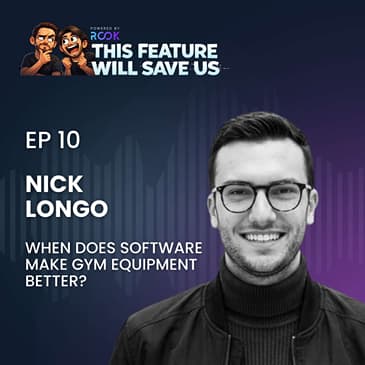
Nick Longo has spent the last five years at Life Fitness / Hammer Strength, starting as a biomechanics engineer before moving into product management and, more recently, partnerships and integrations.
He’s seen how seemingly simple product decisions can play out once equipment is actually in the gym. Making Quick Start easier to use on treadmills got people moving faster, but usage of other workouts dropped. Bringing casting to commercial equipment meant solving problems that don’t exist at home, especially when 20 treadmills are lined up next to each other.
Nick talks with Marco and Jonas about those decisions, why serviceability and uptime have such a big influence on product design, and how he evaluates partnerships when they have to compete with the company’s own product work for resources.
They also get into where today’s wearable integrations come up short and what could be possible if workout and recovery data moved more easily between the products people already use.
Nick breaks down:
→ Why serviceability and uptime have such a big influence on commercial fitness equipment design
→ What happened when Life Fitness / Hammer Strength made Quick Start easier to use
→ Why bringing casting into a commercial gym is harder than doing it at home
→ What Nick looks at when deciding whether a partnership or integration is worth pursuing
→ Why partnership work can be difficult to prioritize against internal product development
→ Where today’s wearable integrations still come up short
→ What could change if workout and recovery data moved more easily between wearables and fitness equipment
→ How Life Fitness / Hammer Strength learns how people use equipment that isn’t connected
→ Why product teams sometimes need to zoom out from the feature or product in front of them
→ How Nick decides when negative feedback is something the product team needs to act on
Follow Nick Longo:
LinkedIn: Nick Longo
Life Fitness/Hammer Strength: lifefitness.com
Follow Marco Benitez and Jonas Dücker
LinkedIn Marco: Marco Benitez
LinkedIn Jonas: Jonas Dücker
Get in touch with This Feature Will Save Us Podcast
LinkedIn: https://www.linkedin.com/showcase/this-feature-will-save-us
Website: https://thisfeaturewillsaveus.com/
Powered by
ROOK: https://www.tryrook.io/
00:00 Rapid-fire with Nick Longo
07:00 Designing for serviceability and uptime
12:00 Evaluating partnerships and integrations
15:00 Bringing casting to commercial fitness equipment
18:00 When Quick Start changed how people used workouts
23:00 Where wearable integrations fall short
25:00 Connecting workout and recovery data to equipment
27:00 Software, subscriptions and the fitness equipment business
33:00 Learning from equipment that isn’t connected
37:00 Knowing when to zoom out from the product
39:00 Handling negative feedback after product changes
41:00 Prioritizing partnerships against internal product work
45:00 What Nick wants to see next in connected fitness
Every product team has that moment. Someone pitch a feature and says, This is the one. Sometimes they are right. Sometimes they are very wrong.
SPEAKER_01I am Marco Benitez. And I am Jonas Dokka, and this is This Feature Will Safe Us, where we dig into the decisions, debates, and occasional disasters behind building great products. Let's get into it. I'm super excited to have you on the show. We want to kick it off with some rapid fire questions just to kind of heat up a little bit, and then we can dive into the highs and lows of building product in fitness, but also in that kind of starting to emerge intersection of fitness becoming a lot more kind of health and health prevention nowadays. So yeah, maybe we can kick it off with some rapid fire questions. I don't know if you want to start Marco or should I start?
SPEAKER_02Go for it.
SPEAKER_01I'm gonna start then with treadmill or rower.
SPEAKER_00I'm a treadmill guy. Alright. Awesome. Cardio or strength? I think I need to strength train more, but I fall back to cardio. I have a long history in my life of playing Ultimate Frisbee at a pr at a pretty high level, at a weirdly high level. So cardio is always where my heart is.
SPEAKER_01You took away one of my questions. I was about to ask now then next, is it what about like a cardio session or a good strength session versus ultimate frisbee game?
SPEAKER_00Yeah, strength sessions were my where I think I feel the best afterwards, but I can't deny that I spend way more time playing Frisbee than I do strength training.
SPEAKER_01I I have to ask though here, real quick, how popular or how known is Ultimate Frisbee in the US?
SPEAKER_00Not very. It's not very known anywhere. It's biggest in the US as opposed to anywhere else in the world, I think. But it's a niche sport for sure. So much so that someone of my size and stature can play semi-professionally. So that means that it's not that popular because I'm I'm far from an elite athlete.
SPEAKER_01So I remember the days we've been playing a lot of Ultimate Frisbee. That's why I thought actually it was more kind of coming from the UK or so. I I kind of placed it more in in Europe. And we used to play a lot in school, Ultimate Frisbee. A lot of like Ultimate Frisbee tournaments, etc. So yeah, love it. Super cool.
SPEAKER_02I didn't know Jonas, and you were good.
SPEAKER_01I mean it's it's been just school sports, like not never never like too too professional. Also, like I on the more professional side I played handball, which is again the which is super unpopular here in the US. It's more popular in Europe. Yeah.
SPEAKER_02That's cool. Alright, Nick. What about hardware or software? Oh, what do I prefer? Yeah.
SPEAKER_00Oh man. I prefer software for its flexibility. Hardware, you get one chance. That's tough.
SPEAKER_02Yeah.
unknownYeah.
SPEAKER_02I agree.
SPEAKER_01Talking about behaviors and limits, biomechanics or behavior, what is limiting more the results you want to achieve or you want to push a user to achieve?
SPEAKER_00I think this one's behavior in terms of limiting factors, and I think it's not even close. Uh I think if you don't have motivation, your biomechanics can't change that, right? As long as you're going to the gym or going to the track or wherever it is that you exercise and doing something, doesn't matter how poorly you're doing it, it's better than not doing it at all. And that's my biggest Achilles heel, honestly, is motivation. So behavior is what I need to change as well.
SPEAKER_02Yeah, behavior and discipline, right?
SPEAKER_00Exactly. They're one and the same.
SPEAKER_02Yeah, this one is tough. Life fitness or a hammer strength?
SPEAKER_00Oh man. That is tough. That is tough. I think my preference in terms of what I can play more with in my job is life fitness because connectivity is at the heart of what my role is. It's pretty hard to connect to a hammer strength piece that's uh not plugged into power and doesn't have an internet connectivity. But I can't deny the the elegance of the hammer strength brand. It's just been like it's been a staple in the industry for so long. And there's pieces that just live forever, right? Like it's it's just uh it's just a Titan.
SPEAKER_01I'm gonna I'm gonna double down on this. What's more fun to design a good software type of product or like a hardware product?
SPEAKER_00I like the flexibility of designing software, but I think my heart's with designing hardware. I really like sitting down, especially with like an industrial design team, like our designers who literally take pencil to paper and will draw out the curves and the corners and the edges of a piece. Uh we have these kind of like mood boards of our products that are some of my favorite things in the entire office to look at, which are just a giant bulletin board of sketches of adjacent industries, right? You have like cars and other household products and things that kind of show what your inspiration is from. And I think that's just super cool. And it's something I can't do. So I love seeing it done.
SPEAKER_02Oh my goodness, it should be very interesting. Is it I can imagine? It's like uh you're an engineer, so I'm too. I'm an engineer too. So I really love to, you know, all these things that you have to do since from the scratch and build everything. But again, what you said, it's like when you are building a hardware, it's one-shot opportunity. So that's exactly the most difficult part. Maybe this one is going to be interesting for you. On the commercial side, do you prefer gym, home gym?
SPEAKER_00Where is the future? I think the future is in a commercial gym. I think the pandemic showed us that they really matter. Community really matters. Seeing people exercising around people really matters. I think it going back to the earlier question we asked about biomechanics or behavior, I think a commercial gym and a community helps supplement behavior, right? When you have someone to hold you accountable, even if it's just the people that you see who you wave to, I think that brings you to the gym, which on the flip side, I prefer a home gym and I have a pretty decent home gym in my garage here in North Carolina. But I think that also might be inhibiting me from the behavior piece because it makes it really easy for me to skip a workout because there's nobody that I'm meeting at the gym to hold me accountable. There's no class that I've signed up for to hold me accountable. So I think I'm a sucker for a good home gym, because I have a pretty unique home gym myself, but uh I think the future is in commercial gyms.
SPEAKER_01What's the setup, Nick? What do you have in your home gym? From an equipment perspective, hopefully it's all life fitness, huh? Because otherwise it is.
SPEAKER_00It is. Uh from an equipment perspective, it's pretty thin. I have an IC7 spin bike, a group exercise spin bike. I have a power rack that I built myself actually during the pandemic because it was hard to get anything. I have a bunch of hammer strength bumper plates, which are super nice. They're my favorite piece in the entire gym. But the thing that is kind of where my heart is in my home gym is I have a climbing wall. I have a bouldering wall in my garage. So I have relatively high ceilings in my garage, and so I built a fully adjustable climbing wall. It's kind of insane, but that's taken over my entire garage. Wow.
SPEAKER_01That's cool.
SPEAKER_00We want to see pictures. I will send some.
SPEAKER_01I'll send some for you guys to see.
SPEAKER_02That would be great.
SPEAKER_01That's awesome. I wanted to actually double down there on what you just mentioned, especially like looking at from a product perspective, right? When you plan products, especially hardware, the interconnection of hardware, software, products with life fitness, and you think about the home space versus the commercial gym, like how much do you take kind of space and environment really into consideration when planning a new product line or a new product?
SPEAKER_00Yeah. I'll answer kind of from the like whole company perspective, because my specific product management and planning is very different. But I think at the heart of what we design from a hardware perspective and software really as well, is around serviceability and the ability for products to be repaired quickly if they happen to go down, right? That's something that you don't often think about when you're looking at a treadmill. You might think, you know, what's the fastest it can go? What's the highest incline? Things like that, right? But what our customers care most about is how easily can a technician get to that piece of equipment, fix it, and get it up and running again without having to shut down pieces around it or the entire gym, things like that. So it's not exactly the sexiest of answers, but I think that's kind of at the heart of what we design for is actually solving customer problems, which is making sure that our equipment has as much uptime as possible. The unsexy features.
SPEAKER_01We talk about that a lot internally at Rook as well, where we often say, like, we've built a lot of stuff. It's a lot of unsexy features that don't sound great when you push them through a marketing campaign, but they're so important. So yeah, totally totally understand that. And then help us understand a bit more like where is your sweet spot? Like, what's your real intersection at life fitness? Like, what is that you normally take care of in your kind of day-to-day?
SPEAKER_00Yeah, so my my role is managing partnerships and integrations. And the way that I usually describe that is it's effectively anything that intersects with our products but isn't branded Life Fitness or Hammer Strength. Uh, that excludes purely marketing partnerships. So we have a lot of really awesome partnerships that we do to both supply equipment places and also to kind of elevate what our equipment's capable of doing and showing off what it can do for some of the most elite athletes in the world. But anything, anything that has a different brand name to it and wants to connect to our products in some way, shape, or form will somehow get across my desk.
SPEAKER_02Got it. And just for everyone, how did you get into the life fitness environment and how was that process? Because you are an engineer. So it makes sense, right? At the very beginning, it's like, okay, building products, hardware components makes a lot of sense. Build a complete ecosystem over there. But how was your path to being in the life fitness industry?
SPEAKER_00Yeah, you're exactly right. It started with the biomechanics. So I studied biomedical engineering at Case Western Reserve University in in Cleveland, and I really loved it. And that school primarily focuses people on getting ready for academia and for research. And that was not exactly my lane. I think I've always wanted to be in product design, product development. I like the end of the day having a tangible thing that I can point to or hold or touch and say that that was a thing that I worked on. And I think that kind of led me really nicely into a role with Life Fitness because I had done some research at university that was around human gait analysis, kind of looking at people with different abnormalities and how they walk, and also looking at simple studies like how to recreate muscle function with a computer, so using MATLAB. Things that would ultimately, like I said, lead you into academia and doing research. But for me, it led me straight to kind of where I think my passions lie, which is in health and fitness. So my wife is from Chicago, so she led me back to Chicago, which is where Life Fitness and Hammer Strength are headquartered. And so it was uh kind of a match made in heaven that I found a really, really exciting company and role for me. So I spent about two years on the biomechanics team reporting to Julie Daly, who's kind of, in in my opinion, a titan of the industry. She's a name most people probably won't know, but she's kind of been operating in the shadows for many, many years in the commercial fitness industry, making sure that our equipment is safe and effective. And then just logically kind of found my way into different sweet spots in product management to where I am now. That's awesome.
SPEAKER_01And then on the on the partnership side right now, so like you guys announced actually at HFA, if I recall correctly, with like Les Milds and like official cycling partner, etc., for the content side of things. That's the type of kind of integrations partnerships you would be looking at, or how do we have to imagine that?
SPEAKER_00Exactly. Yeah. So I was um I took point on that partnership. There were obviously many people that were involved in bringing it to life. But yeah, that was that was kind of one of the first that I took from Inception to launch, which was really exciting. I'm really proud of it. I think it's it's a really good mix of the things that we do super well at Life Fitness and Hammer Strength with hardware and the things that that Les Mills does super well in software. So combining the two, I think, is going to be really exciting for the industry. We're we're kind of just getting started. We have many years ahead of us of a partnership with them. So stay tuned. I don't know what's to come, but stay tuned. I think good things will be coming. That's awesome.
SPEAKER_01And I wanted to add a question there around like if other product builders are listening to this and then move a bit more to that partnership side where like product and partnership come together. Like, how do you go about evaluating first is this a worthwhile undertaking? And then obviously the challenge of dealing with stakeholders when there's partners coming together and product integrations playing a role is obviously super, super critical and sensitive to manage. Like, if you can walk us a bit through that, that would be awesome. Because we all know just dealing with one team and the many stakeholders that's in one team is already complicated. Now having two teams coming together and there's a product and extra def and integration work that needs to be done, like that's even more complex.
SPEAKER_00Yeah, absolutely. I think that partnerships are interesting because I think it brings the best of what two, three, four, however many groups have together. And if done well, you can launch really exciting things really quickly because you're not building everything from the ground up. You're effectively, in most cases, taking two complete, whole, valuable things on their own and combining them into something where, you know, the cheeky phrase is one plus one equals three, right? So it's like you truly are building something better than the two things separate. And so I think that that's kind of how I evaluate partnerships from the start is what does group A have? What does group B have? Does the two things coming together make sense? Does it make something more meaningful than the things by themselves? And I think in a lot of cases the answer is yes. I have to give a lot of credit to my team because I don't do much of anything, right? I don't, I don't build the integrations, I don't prioritize the integrations, I don't have the resources directly reporting to me to decide what gets done. Like I have to bring these opportunities to the business and explain why I think they're valuable to us, to our customers, to the global exerciser population. And ultimately, I think that the team does a fantastic job of deciding what we should prioritize internally and what we should take externally. So it might be a bit unique in that sense in that, you know, my role is really just a feeding tube, if you will, of opportunities into the business. And then the business picks up the ones that make sense. But to me, I think partnerships are the future because there's only so much you can do by yourself. And there's so many good products out there in the world, right? Like we all know that each one of us is probably wearing a different thing on our wrist or finger that's telling us how we slept last night and how we're gonna exercise today. And we at Life Fitness Hammer Strength, we don't need to reinvent that, right? We would never try. Like we want to just take the best of what's out there, and that's just one example of wearables. But if you can take information, product, services that exist in the world today and just make what you have 1% better with the information that they can give you, that's 1% that we didn't have before.
SPEAKER_02And it's really interesting because nowadays, I mean, yeah, a lot of companies are not building alone. It's like uh they are looking for other companies that they have a specific thing that they have, or they do a partnership, or maybe they buy that company or something. But it's like everything it's around how can you use the other strengths from the other companies how now you can build something more powerful, which makes a lot of sense. I have one question for you. I want to learn from your experience because I really want to know what's a a feature or an integration that you have shipped and you are really, really proud of during all these years because I think you have been in the life fitness industry the last five, six years, right?
SPEAKER_00So yeah, so actually I'm gonna pull back to an older role that I had actually. I I could I could talk forever about the Les Mills partnership that I just mentioned, and I wish I could talk about the things that are coming in 2027 in particular, because I feel I'm really excited about what we're working on now. But one of the things that I worked on that we are just now bringing to market that I was involved in from the ground floor was our casting solution in the commercial fitness industry. So commercial equipment for a very long time has had applications on it, right? You can log into applications to watch your favorite content or stream whatever you'd like. But there's a huge barrier of entry, which is having to manually type in a username and password on products. And casting is also not new, right? We didn't invent casting. It's kind of partnerships before I was in a partnerships role, right? It's bringing two things together that exist by themselves and making something better out of it, right? Which is that people already have all of their credentials logged in on their phone with whatever they would like to watch. And if it's just as simple as encouraging them to put it on this big, beautiful screen that the gym has purchased rather than just setting their phone up against it. So it's a small thing, right? It's something that's been around for a decade or more, but just bringing that item into a space that to me makes a lot of intuitive sense is really exciting. So I left the product management team before that product was launched, so I can't take credit for launching it, but I was on the ground floor of doing the research and trying to figure out how we could make this happen in a commercial setting because it's a lot harder than you'd think to have a consumer feature like casting in the commercial space. How did the product turn out in the end?
SPEAKER_01Like how do we have to imagine is like scanning some QR code or how do you get like the information kind of linked or the phone?
SPEAKER_00It's uh if you've ever stayed in a hotel that has casting on the TV, it's similar to that. We made a lot of efforts to make it smoother because there's advantages that the hospitality industry, for example, can take advantage of, like knowing when you check in and when you check out so they can erase sign-in credentials, right, based on your checkout date. And even something as simple as having to be connected to the right Wi-Fi network in order to cast to the unit on the same Wi-Fi network and find the right machine, right? So I could talk forever about how complicated it could be, right? Because if you have a line of 20 treadmills and you scan a QR code, they're all very close to each other. It's very hard to know which one you're actually going to cast to because the one that I'm standing on is maybe only a foot closer to me, if not less, than the one next to me, right? If you're looking at kind of that triangulation of where my phone is versus where the products are. So we had to get a little more creative than just simply using exactly what the hospitality industry uses. But effectively it's pretty similar to scanning a QR code on a TV in a hotel room.
SPEAKER_01That's awesome. Can imagine this a little bit. And like previous to Rook, we had a different business where we did real-time tracking of heart rate in fitness settings. So like imagine you have a decoder that receives the signal of like a heart rate band, and that was already like messy because a lot of folks in a small room, all of them had their heart rate monitors on the chest or on the arm and trying to kind of send the signal and like working through and plus and Bluetooth connection, and it's so we can we can appreciate the work there for sure. Maybe on the flip side, like what have been like maybe integrations, partnerships that were like difficult, never really got off the ground, or in the end they kind of flopped in the impact that you expected while you first thought, okay, this is gonna be amazing.
SPEAKER_00Yeah. Again, I think I'm gonna pull back to an older experience for this one because I've been in the partnerships role now for about two years, and a lot of these things take a very long time to build. So the some of the stuff that I've been working on since day one in the role is you don't even know about yet. So I can't talk about many things, which is unfortunate because there's some things I'm really excited about. But it's interesting because the way that we designed a feature succeeded, but I think in succeeding, it might have led to a setback for the industry, which was our reprioritization of kind of the quick start or getting a workout started as fast as possible. So you're probably all familiar with on a treadmill, there's kind of a whatever different brands call it, there's a button that effectively says quick start, fast start, start workout, whatever. And that jump right into doing something met demands of the industry. But in my opinion, I think it might have set everyone back in terms of their disinterest in maybe doing a time-based or heart rate-based or distance-based workout. Because if you set a goal, you have to achieve the goal versus hitting quick start, you can stop that whenever you want. Now you can stop any workout when you want, but I do think it is Yeah, exactly. I think it is the it was extremely successful because our research team said that people want to get on the product and start as fast as possible. We were trying to solve for gym timidation, right? You don't want to step on a treadmill and have to click 10 buttons because then it looks like you're lost and you don't know what you're doing. So it was very successful in the sense that it achieved the goal of getting people moving very, very quickly. But we saw it change the trajectory of other workouts that we had spent a long time developing on product and their utilization went way down because everybody just wanted to start as fast as possible and then set their phone in front of them to watch something. So win and a loss at the same time.
SPEAKER_02That's very interesting because how do you handle both worlds? Because you have people who really have a really good schedule to do something and to achieve something, and you have the first, you know, people that are doing something. And you were talking about treadmills, and treadmills, it's a really good example because some of them are just walking or jogging or doing something in the treadmill, but doesn't have any goal. But then you have the ones like Jonas, who does marathons and you know all these things, and they have a schedule to achieve something. So how do you handle both things for those hardware components?
SPEAKER_00I think it's really, really difficult. I think it's a the million-dollar question, right? If if I had the exact answer to it, I think we would be dominating the industry ten times over, right? But I think it's about flexibility first and foremost. That's a lame answer, but it's the truth, right? It's about having the ability to do something like a quick start, even though it might compromise people's ability to explore other things and see the different workouts we have on product. But I think it's about letting them do what they want. And ultimately, I think it's about what I'm striving for, which is bringing as much data from other places onto our equipment as possible. Because to your point, if somebody is marathon training, and if we can get to a point where they can effectively the snap of a finger, have their next workout show up on our products to where they can just hit as fast as quick start they can hit, do my custom workout. That's my goal, that's my five-year vision, right? Is get to a place where anybody can bring whatever data they have to the gym with them and make the most of it. But I think that takes time and that takes a large shift in the industry because people need to understand what value there is there for the data to be kind of shared and exchanged and leveraged by multiple places. So complicated answer, but we try to be as flexible as possible.
SPEAKER_02And I 100% agree with you. I want to ask something over there because now that you are we have Chat GPT and we have so many, you know, Gemini, we have Club, and everything is around the data. Do you see any difference between Before and after those AI models, that now the end user is using more the treadmill or the I don't know, any other hardware?
SPEAKER_00I think it's a little bit too early to tell whether AI, chatbots, and other AI features are making a huge momentum shift in what's being done in the industry, but I hope that it's changing people's optimism for what's possible, right? So if somebody previously thought that it might be very difficult to lose 10 pounds, gain 10 pounds, do whatever achieve whatever goal they had, hopefully whatever mechanism they use that's leveraging AI is is showing them that there's like small steps, incremental steps you can make to make change. So I think if we look back in five or ten years, we might see a structural change in how people worked out or the workouts they were doing. But I think that I think wearables and the rise of wearables has just as much of an impact on trends in fitness as as AI does, to be honest.
SPEAKER_01No, no, I mean obviously like if we can if we can dream for a moment, it would be awesome, right? If all the data just comes together, there's something, some some intelligence that knows what typical workouts I'm doing, like what my normal routine is like. But now you have the wearable data mixed in, you have the eight sleep information of like how you slept, etc. And and all this time for information coming together. And now you know you you get that workout recommendation, and instead of having to like click a lot of buttons, you can just basically upload it to the console of the chatmill of the bike, and you just go out there and do the workout. Obviously, that that's the type of seamless experience which would be amazing to have at one point for sure.
SPEAKER_00100%. Yeah, I mean, the other answer I could give to your question about an integration that didn't land as I'd hoped it would would probably be something like our Apple and Samsung integrations, right? So they're pretty ubiquitous in the industry, but on most fitness equipment, you can walk up and tap an Apple Watch or a Samsung watch. And you can get really valuable data from the product and you can see your heart rate real time on the product, things like that. But I think it leaves a lot to be desired, right? It's an anonymous connection that is only streaming real-time data, and then it's up to you to take that data and do something with it. But I think a future that I would love to be a part of is one where we're exchanging more valuable information, such as like what workout should you do today? Not just your heart rate this second, but based on your sleep, based on your recovery, based on your goals, what is the right thing for you to do today? Because we can we can make anything possible as long as we have the information that some of these other wearables have. And information is king, so it's it's hard to get people to share that information, but I think that it's for the greater good if there's a way in which you can see more than just your heartbeat this very second.
SPEAKER_02I agree with you. It's like uh I can imagine a new world where you have your, I don't know, your AI coach, but that AI coach can travel between all the hardwares like the treadmill and the, I don't know, the leg press and everything. And based on my previous information, my recovery, my sleep, my whatever, then you can handle and you can customize the experience for that specific hardware. So I can see that future. Do you think we are close to that environment? Do you think this is something that it's realistically possible? Because the ecosystem also is very difficult to handle it.
SPEAKER_00Yeah. The optimist in me says yes, it's possible. I think we are also close. I think a colleague of mine, Drew Stockler and team, are doing a fantastic job building our AI workout builder through our Life Fitness Connect app. It's got some really exciting features. It's one of those things where we don't pretend to be the only one in the space, nor do we pretend to be the best one in the space, because we know there's hundreds, if not thousands, of these. But we have some USPs that we think are interesting, like the ability to connect to equipment is something that the Life Fitness Connect app does that that other apps can't necessarily do right off the bat. So we are trying to build what we believe is something that people would like to see and kind of aligns with what you're saying there, Marco, where people's data stays with them and then the workout gets better because they have the data from previous workouts to work off of. But my truth and my reality is that I know the world is not gonna all of a sudden jump on anything that any one brand builds, right? Like we're not unique and neither is any other brand. We're all just fighting for pieces of a whole pie. So my job is to try and get as many different pieces of that pie, right? Different data points, data sources, uh, to kind of sit in the same place. So we are kind of building what is like an extremely competent proof of concept, if you will, right, with the LifeFenice Connect app to show that this is what's possible if the data all is accessible via our equipment. Strength and cardio. But yeah, my my goal is to bring more of those data sources in.
SPEAKER_01That's super cool. The big question obviously always comes then kind of the company itself is obviously highly positioned around like when we go a bit more away from the product side and really looking at it from a business perspective on a hardware product, right? Like real revenue, as far as I know, is driven by hardware sales mainly. So, like, what kind of shift can you foresee and how can you go about that from a product lens? Like, how can you influence that? How can you support that to actually finding new ways of revenue streams through like more of these connected experiences? And like what business models have you seen around there that work really great? And which ones have been lagging behind a little bit on that front?
SPEAKER_00Yeah, you're absolutely right. Our business is effectively 100% hardware. We are, I think, maybe slightly unique as well in the space, in the commercial cardio space or commercial fitness space, I should say, in that we don't currently charge for any of our software. So, like my partnership's work is all kind of value-added services, if you will. But I think that's really important. I think that there's a lot of subscription fatigue, there's a lot of recurring revenue fatigue in the world at large. Uh that's not to say we'll never get there, but right now I think I'm very satisfied with building features that add to the hardware that our customers are purchasing. Because at the end of the day, a treadmill is largely a treadmill, a bike is largely a bike, a chess press is largely a chess press, right? Like there are nuances that every brand and every company can build into a product that make them valuable, but ultimately it's you you want it to serve the purpose that it's purchased for. So I think um it's kind of an adjacent way to answer your question to say that we don't necessarily strive to find the next subscription revenue service, but we do strive to build something that is so valuable that maybe at some point it can justify its own revenue. But actively our goal is just to make the products that people purchase 1% more flexible, 1% more adaptable, 1% more likely to retain a member and drive revenue for them.
SPEAKER_01Yeah. There was actually, and it's just a thought, I'm thinking out loud here, right? But like you obviously sitting in a partnership space is what if you would partner up with some type of fitness concierge app, right? Or like a personal training type of app that already has a subscription business, and now there is this combined version of personal training, life fitness subscription. So it's kind of somehow connected to the equipment through the life fitness connect app, etc. But you have that opportunity to kind of tap into a full-blown experience, right? And now there's maybe a revenue share, like, but it's it's hard, and I I can understand, like, right, coming from a hardware background, like thinking, how can we actually open up new LA state? Because on the same side, I'm asking myself, how much can hardware further innovate in the future to stay relevant without taking even more software into consideration? And maybe there is, right? Like maybe there is many ways. I'm always surprised. Every year I go back to HFA, I'm seeing new products, new hardware that looks amazing. It looks even more elegant, it looks even, you know, like more efficient in the angle it's moving, the biomechanics, etc. It's it's it's incredible. So like I'm always surprised anyway, but like, yeah, it's it's interesting to see that.
SPEAKER_00Yeah. No, I mean, there's that that's a great idea. There's lots of really good ideas, but there's also a push and pull with every idea, right? So like, for example, anything we do in the realm of workout prescription, workout creation sometimes can take away from a customer's personal training revenue, right? So like our commercial customers have personal training staff, and we want to be very respectful of the fact that they are super critical of the industry, right? Like, for example, if we were to have built a perfect AI personal trainer that took away a need for all personal trainers, I think the commercial industry would hate that, right? Like they don't want to take away people's human connection to their personal trainer or the value that having someone truly watch your form and correct it can have. So every really good idea has at least 1% of the drawback to it, right? And so it's always this give and take of what is the right feature to add and what is potentially taking away something that might be a cornerstone of the industry.
SPEAKER_02It's crazy because you have two ways to see everything, right? So you have between or you can focus on the mobility part of the hardware, or you focus more on these new threads on AI models, and then you can customize the experience, or maybe you have to acquire a company that do only the software part, and then you can focus only on the hardware. I think it's really complicated. It's like my first thought was around Tesla, for example. Tesla is doing really well because it's not anymore hardware, it's not anymore an automobile, it's a software piece that it's moving a hardware, which is crazy, right? So you are not buying a car, you are buying a software who does so many amazing things. So do you think that type of thing seem life fitness?
SPEAKER_00Yeah, I think that there's some analogies there for sure. I think that you certainly are buying more of a software experience than you ever have been before when you buy fitness equipment, right? I don't think it's essential. Like I think you can still get a fantastic workout on our entry-level products, right? Like our button pad consoles, we call them SL consoles. And a lot of our customers go that route, right? Like you can certainly run just as fast or just as long, or bike just as fast or just as long without having a robust software experience. But I think I'd be a fool to say that software experience is not becoming a larger and larger part of the equation, right? Like I think that there's a lot of legitimacy in the point that there will become a precipice for how much innovation can be made to a piece of equipment. Again, I'm always surprised every year as well, right? You think that I think that maybe a treadmill is a treadmill, but then there's a new thing you can add to it to make it a little bit more than a treadmill, which is something that like, you know, we did uh a year or two ago with our symbio product line, right? So the ability to change the surface you're running on to make it go from super soft to super firm with the symbio runner. That's something that hadn't really been done before. So prior to that, you might think a treadmill is a treadmill, and there's innovations like that can really change how you look at something. But I do think that, yeah, back to the Tesla analogy, I think that there is always gonna be enhancements in software that can come more frequently because of software ability to be updated, and and also can maybe be small nuances that really drive change, like with the with data, right? Like data is inherently software, and and I think that is maybe one of the biggest solutions that can come to the industry is kind of this this data access.
SPEAKER_01I want to take the data access kind of keyword actually and go a bit back to the previous point we we discussed in the conversation. The example you gave, someone is on the treadmill, is having to push 10 buttons to kind of get something started, is undesired because yeah, it could create a wrong impression of oh, the person has lost, and then you want that kind of quick start option, etc. How do you go about this from a product perspective when you don't have the easy way to access engagement data? Obviously, with software products, it's a lot easier because you know how much time they spend looking at a screen, how many buttons they had to touch to get to a certain kind of outcome? That now you have some product lines that are fully disconnected in the sense of there is no software component and it's on purpose. How do you go about measuring engagement, how the equipment is even used in commercial gyms? Do you have to kind of use surveillance cameras to kind of look at engagement data? Or like how do you yeah, how do you go about that type of information? Because especially from a product perspective, everything should be data-driven, right? You want to take decisions based on data metrics, etc., to improve.
SPEAKER_00Yeah, that's that's another million-dollar question. You guys are asking all the questions that uh if I had the answers to them, we would be, we'd be in business here, we'd be in good shape. But I think one of the keys that we always come back to is actually seeking customer feedback. And important to note, customer for us is the commercial gym, but also the exerciser, right? We're kind of a B2B2C company. So we are constantly hosting our customers in our uh customer experience hub in our Chicago headquarters. So we're asking those questions, right? We're asking people who spend their time walking the cardio floor, walking the strength floor, sitting at the front desk, talking to members. We're asking them, where are your pain points? What are you hearing the most frequently that we can help solve? So that that is really one of the ways that we always come back to because people will always feel free to share with us, right? Especially when we invite them into our home, if you will, our office. And we kind of show them a peek behind the curtain of how we design our products. We have them kind of contribute to the design process often in terms of providing feedback on next generation products. But in terms of what we we don't do anything in the way of like surveillance cameras, I both wish we did and wish we didn't at the same time. I think it could be very cool to see. I think honestly, if we did that, we'd probably in some ways be very excited about what we see, but otherwise disappointed by what we see, right? We might see people using the products in ways that might be damaging to the products, for example, right? Like one of my one of my bigger pet peeves in a gym is seeing people raise a treadmill, for example, to full incline and then grab onto the top corners of the treadmill and lean back and walk uphill. Because effectively, one, we design our products specifically with this in mind, even though it's not something we recommend, but we do test them to make sure that they can withstand that in our reliability team. But the reason it's a pet peeve of mine is because you're canceling out the incline, right? The reason you should be at incline is because it's a challenge to walk uphill, but if you're hanging on to something, you're effectively walking close to flat again. So like if we had the surveillance data, we might just have a lot of our suspicions confirmed that people are doing weird things on our products. But it is nearly impossible to know exactly what's being done on non-connected units, right? Besides doing user studies. We've done studies before with partners of ours where we will spend time at a facility and just kind of gain exerciser feedback, watch and listen, observe. But yeah, that that's the hardest feedback to get when you don't have uh it flowing back to you via the internet.
SPEAKER_01The surveillance camera footage will definitely make for a great marketing campaign, I'm pretty sure. Now, moving a bit forward again towards like vision, what's next, etc. We talked a bit about projects in the past. Now thinking ahead, like obviously often a challenge from the product perspective. And in software, see this changing a little bit thanks to all the AI and technologies. In hardware, I assume it's not that easy. Is that normally the company vision is way ahead of what is actually feasible today from a product perspective, or simply from a resource perspective of engineering power and building power to get a product out there and shipping new things? Now, again, with AI, that's changing a bit on the software side. We are extremely fast nowadays to build new things. On the hardware side, obviously, there's still the same shortcomings of supply chains that need to be managed, and like you have to build pilots, MVPs, you test, you pilot, you go back to the drawing board and rebuild stuff, etc. But like how do you go about company vision and then trying to keep up? And is partnership there maybe even kind of like the key to be closer to the company vision by finding shortcuts?
SPEAKER_00Well, I sure think partnerships is the key. So I'll I'll leave the plug for that. I I definitely agree with that. But I think it's tricky, right? Like I think maybe it's analogous to like how do you eat an elephant, right? One bite at a time. Uh you kind of have to constantly take steps back and zoom out and reevaluate, right? If you if you stay zoomed in and look at the one feature or one product that you've designed and constantly scrutinize how it's being used, where it's being used, why it's being used that way, you might miss the fact that there's a whole nother area of the gym that is getting a ton of attention that you need to focus on, right? Or a whole another trend in the industry that you're not even paying attention to at all. So I think that the way that we kind of balance the long-term vision is forcing ourselves every so often to take a cross-functional team, zoom out, talk about what we know and see and hear, and then think about how we can incorporate that into our products and make them a little bit better with each iteration that we we launch, whether it's hardware or software.
SPEAKER_02Which is really complicated because again, it's hardware. And try to do things different with hardware is so difficult. So, so difficult to improve things. And also if you do like some changes, and then the end user will notice that, will see that, and they will be like, oh my goodness, I don't like it anymore. So, how do you handle also that part? It's really difficult because every single time that you make a change, it will affect in a very positive way or very negative.
SPEAKER_00Yeah, I think uh all of us can probably relate to this, right? Like every time our phone OS upgrades, sometimes we find things we're like, that's cool, and other times you find things we're like, why in the world did they change this, right? Like it didn't need changing, but over time, all of us probably agree that we get used to the software, we end up probably liking it. And if we don't like it, there's always a way to turn something off. You might have to just search for how to do it because they like to bury those features that they want to leave up there. But the same is true for our equipment in the industry as well, right? Is we have to be prepared every time we launch, especially when it's largely changing the software, like a whole overhaul of our of our interface. There's always going to be some, why did you do that? Especially when we talk about working with customers that have an aging population as their as their main demographic, right? Like it's difficult to adopt new behavior when you are used to knowing where the buttons are and pressing them. So it's always kind of like weather the storm to start. And then if the feedback continues to come back negatively after a certain period of time, then we know we might have made a mistake or made a change that people might not like. But at the end of the day, also the software update process is entirely up to our customers, which is maybe a bit unique as well, in that a lot of other connected products in other industries either automatically update or there's warranty implications to updating your products. And neither of those things are true in the fitness industry, at least not today, where customers have the choice to update uh treadmill. I keep using treadmills, but I'll keep using the treadmill as an example. They have the choice to update the software. And we sure hope that everyone does, because it's very beneficial for us and for them in terms of maintenance, like routine maintenance, making sure things stay up to speed, but also giving them new features that we spend a lot of time and energy developing. So those who are on the leading edge of tech and fitness will make the updates, will like or dislike the features, and will provide their feedback. And we certainly have customers as well who might be generations old in terms of software updates that are choosing to leave the products alone because they're working just fine, and and we support that as well. But it is tricky because you will often get a swath of negative feedback to start because the negative voices are always the loudest. But it's a matter of just deciding when that feedback is sufficiently relevant for the change and whether or not people have a chance to adjust to it. That's great.
SPEAKER_01It's kind of like cutting a bit through the noise because yeah, negative feedback often is a lot louder. Totally. I want to kind of come back a bit to the present as well. Like, what is biggest challenges, be it in your day-to-day like work with partners, etc., or like in that product role? Like, what's the current challenges you mainly face and kind of how do you go about those?
SPEAKER_00I think the challenge that I'm most often coming up against is one that involves me but isn't directly mine to impact, which is managing prioritization of internal projects versus external partnership work. Because at the end of the day, very few partnerships in themselves will drive revenue, right? Whereas adding a new product to the portfolio or enhancing an existing product, you could attribute revenue to it because you might see sales go up. Obviously, you could say that having a new partnership will lead to sales and such, but it's kind of it's a couple dots you have to connect before you can show that. So I think the thing that I'm often faced with, like I mentioned earlier, is not having any of my own resources to manage. But I think that's a fun challenge that I really enjoy because that it makes me really evaluate the partnerships that I'm bringing to the company and really evaluate what they can do so that whenever it comes time for me to present them to the team or share kind of what I think is going to be a value add of the partnership, I've really thought it through, right? As opposed to just saying, oh, hey, these people over there want to work with us. Let's do it. If I did that, my team would never hear the end of me. But it's about kind of managing. I'm a spreadsheets guy, so it's about managing a big spreadsheet of opportunities. And I'm also a big math guy being an engineer in my background. So I have many columns that go into a formula that relates out to whether or not something is the most most or least valuable thing we should pursue immediately. So I don't always follow that to a T, but I think it's a really nice way to check myself before I bring something back to the rest of the team to ask for their feedback on it.
SPEAKER_01I imagine a big kind of scoring board. Okay, this has a 1.2 multiplier, this has a 2.3, and then like the many different columns that kind of equate to a score, etc. That's awesome. And probably you have to become a really good salesperson as well, right? Like because in the end you represent partnerships internally and you have to sell them to the rest of the team to kind of position this as the thing to do. So yeah, back to kind of stakeholder management, which is obviously crucial in that intersection. Totally.
SPEAKER_00Yeah, I think that's something that I actually like and enjoy. Is I'm a child of a small business, my dad owned a small business, and I worked in retail sales when I was 14 years old up until when I left for college. So I like relationships with people, I like I like the sale. You know, I like convincing someone that something is of value or something makes a difference. And so I think that's maybe like a very small carrot that I found that I like about this role is that it is both B2B sales and convincing partners to want to work with us and see the value in allocating resources to work on projects with us, but then also internally, yeah, stakeholder sales, so to speak, and convincing people that there's value in pursuing something.
SPEAKER_02You are billed for that position. Because you have been in that part a long time ago. So I I do believe it's because you need a very specific behavior also, because again, talking about engineering, you have to learn the same language and then sell that, and then that the partnership can give you all the information that you need so everyone can be aligned, and then I I I think it's a really interesting position to have. Yeah, I agree.
SPEAKER_00I think I think it's a jack of all trades, master of none situation, right? Like I really think that I there are very few things that I think I'm an expert in or really, really excel at, but I think that there's a lot of things that I have grown to do well enough in whether it's product knowledge or relationship building or stakeholder management or roadmap planning, like all of these things require enough knowledge to then take it to those who actually know how to do the building or do the planning or do the execution. So again, I I give all the credit to my team for bringing all the things that we are currently working on to life. But it does, it does take a particular set of a broad variety of skills to kind of bring all of it together.
SPEAKER_01That's awesome. That's awesome. With that, we're coming a little bit to a closing here, Nick. I'm gonna do a very uncomfortable question. Did we forget to make any important question? Like anything you want to kind of uh highlight or anything you've you've felt like hey, that would be great to talk about.
SPEAKER_00I mean, I've said it a few times. I think the thing that would be great to talk about are the things that I can't talk about. So if we do this, we should do this again in a year or two. I mean, I we should do this again in a year or two, and I can talk about some of the things, hopefully succeeding in the ways that I hope that they will. But I think the thing that I'm most excited for, and I'll just reiterate again, is what I'll consider like a revolution in the fitness industry where data starts to flow across lines in a way that's safe and secure, but also in a way that's helpful for everybody. Because people ask me, I I have a drawer full of wearables at home because I'm constantly testing all these different products and seeing the value they can bring to the exerciser and to our equipment. And people always ask me, what's the best wearable, right? What which one do you recommend? And I'm a whoop user myself. I don't think it's the necessarily clear in a way the best wearable, but I think it is the one that has made the best positive change on my life. And I think at the end of the day, the answer to that question is did you make a change from the wearable that you have on your body, right? If the answer is no, then the wearable is not effective, right? If you're looking at the data and saying, cool, I slept better, but you're not doing something with that, you're just more aware, but that doesn't actually, that doesn't make you any healthier, right? Awareness is not health. Behavior and biomechanics, all the things we talked about, those are health, right? So I think that we have a long way to go. We as the industry have a long way to go in kind of working together. But I think I'm optimistic that we'll get there. That's a grab on this feature will save us.
SPEAKER_02If you are building with wearable or health data, check out what we are doing at tryrook.io.
SPEAKER_01And if this episode was useful, share it with the one person on your team who needs to hear it. See you in two weeks.