
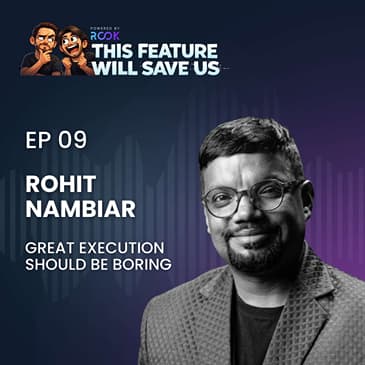
After more than 20 years in large organizations, Rohit Nambiar decided that if he really wanted to understand AI, he needed to get his hands dirty.
That took him from studying AI at MIT and advising startups to building one himself. Today, he’s CEO and co-founder of Sabai, an AI-powered health companion, where the move from corporate leadership to startup life has put him much closer to the day-to-day work of building, testing and growing a product.
Rohit joins Marco and Jonas to talk about what that experience has taught him about product and execution, including why the day-to-day discipline behind good execution can be surprisingly boring. They also get into building a remote team, deciding when to keep going and when to cut, and where Rohit thinks human judgment still matters as more of the work gets done with AI.
Rohit breaks down:
→ Why the feature a product team spends the most time on may not be the one users actually value
→ What he looks at when deciding whether to keep iterating or cut
→ How product usage changes across markets, languages, and urban versus rural users
→ What he’s learned from building a fully remote team across several countries
→ Why he thinks execution matters more than strategy
→ Why he focuses on lead indicators like usage, retention, and acquisition
→ How Sabai approaches guardrails for AI in healthcare
→ Why he asks his team to share their AI prompts, not just the finished output
Follow Rohit Nambiar:
LinkedIn: Rohit Nambiar
Website: SabaiHealth
Book: The Simplicity Trap
Get in touch with This Feature Will Save Us Podcast
LinkedIn: https://www.linkedin.com/showcase/this-feature-will-save-us
Website: https://thisfeaturewillsaveus.com/
Powered by
ROOK: https://www.tryrook.io/
1:45 - Why healthcare and insurance struggle with trust and complexity
6:05 - Where Rohit looks for talent and why his startup is fully remote
8:15 - Building culture and accountability across a remote team
11:30 - Leaving corporate life, learning AI and becoming a startup founder
13:10 - Building Sabai’s MVP and the problems that showed up after launch
14:00 - Growing from 3,000 to 35,000 users and what Sabai is building
17:15 - Product bets that worked, failed and surprised Rohit
19:45 - Why Sabai’s medication reminder became an unexpected hit
22:10 - Using data to decide whether to iterate, persevere or cut
24:50 - When a product is too early versus solving a problem that doesn’t exist
26:00 - Building guardrails for AI in healthcare
29:30 - Why culture comes before frameworks when building quickly
32:00 - Why execution beats a brilliant strategy
33:55 - The lead KPIs Rohit uses to manage the business
36:45 - Why human judgment becomes more important as AI gets better
37:55 - Why Rohit asks his team to share their AI prompt
Every product team has that moment. Someone pitch a feature and says, This is the one. Sometimes they are right. Sometimes they are very wrong.
SPEAKER_01I am Marco Benitez. And I am Jonas Dokker, and this is This Feature Will Safe Us, where we dig into the decisions, debates, and occasional disasters behind building great products. Let's get into it. We always love to start with rapid fire questions to heat up a little bit the jet lag in your case. So Rohit, corporate CEO or startup founder, what is more terrifying? What is more challenging?
SPEAKER_03For me, for sure, a startup CEO, because I don't know this job. I've been a startup CEO for only three months now. You know, even though I started as a co-founder about 10 months. I did not start as a CEO because I wasn't sure if I will be ready to take the role. And I don't think my other co-founders also were. Although the intention was that it was never the case. So while I was managing the whole thing, I still didn't take on the role because I don't know what a startup is. I didn't even know if I will like it. If you ask me today, have I figured it out? I haven't. You know, when I call people and I say, hey, you've been such a successful startup CEO. Tell me a little bit about it. And he says, Hey buddy, do you know this is my third attempt? So you're only seeing my third attempt. You haven't seen my first and two second attempt. And I'm like, okay. So yeah, it's it's it's very different because your role is not defined at all. You know, I was joking with my wife that I don't know what my morning looks like. It's not like a corporate CEO when you walk into the company. There are exception days when, you know, something's on fire and you need to get in. But generally, your day, you know what you're doing. But with startups, you just don't know.
SPEAKER_02That's great. You are going to do it really well. And the other day, also, by the way, you will be cleaning. So it's like too many things in one day. You are going to put so many hats in one hour. So you will enjoy these activities. I have another one. Insurance or healthcare?
SPEAKER_03Which is slower to change? There was a study done by Bain a decade back, and it shocked me when I was in AXA when that study came out. That in many, many countries' jurisdictions, insurance and healthcare was the least trusted businesses to work with, but for consumers. You would think insurance and healthcare are the most noble professions. One actually is trying to protect the life of people, make it longer, healthier, and so on and so forth. And the other is actually paying for a protection or for the life that you know it is actually financially making you better off for an event that may or may not happen in the future. Both of this is built on heavy trust. Unfortunately, both industries over a period of time have become unbelievably complex. And part of what I write in my book as well, the Simplicity Trap. And the complexity is the reason why you will notice the NPS of insurance and healthcare is also very bad, you know, with exceptions. So for me, there is a nice intersection point. Even when I worked in insurance, my specialization was actually health insurance. So I believe there is a massive space, be it healthcare, be it insurance, to make things simpler for the customer. So whichever industry I'm in, I believe it's about making things simple. And today the biggest issue is one, the insurance the consumers don't trust us. And even versus we don't trust each other. Insurers blame healthcare systems, healthcare blame insurers. So it's a it's an interesting, vicious cycle that we are in. It's a weird relationship, right?
SPEAKER_02It's like uh if you consider that it's one depends on the other. So everyone, it's it's the dependencies between each other, it's really complicated right now.
SPEAKER_01And worse if they make money on each other because money moves a lot of things. You mentioned it already Hong Kong, Singapore, Kuala Lumpur. So favorite city you have been living in so far.
SPEAKER_03Oh, I love Kuala Lumpur. I love every city. Singapore is a very, very cosmopolitan today's city. My wife and I loved Hong Kong because A, we didn't have kids, we were newly married, so we had a lot of fun. I don't even want to talk about the Friday nights and the Saturday nights in Hong Kong. And then we had both our kids in Hong Kong as well, so obviously very fond memories of Hong Kong. But in terms of living among the cities in India, I've also lived in London. I find KL the best city I've lived in for three simple reasons. One, I think it's culturally very diverse. You have all kinds of religion, all kinds of ethnicity, live here. And people are very warm in Malaysia by and large. Second is it's not a great place if you are worried about your wasteline. Malaysia is very proud about its food. They call themselves the best food place in the world. In fact, you speak to a local Malaysian. I always joke with Malaysian friends. Hey, if I ask you five things to do in Malaysia, four and a half things are food. When will you go to something else? You know, so they're very proud of your food.
SPEAKER_00So I think and you must know Marcos from Mexico City, and they say the same about Mexico, obviously. So uh exactly.
SPEAKER_02I was just about to say that we have that in common. That is very uh we call it comfortable food, right? Yeah, and we have very similar type of food, like tamales. You also in Malaysia you have this type of tamales, which is rice with some leaps and everything. So we are very similar culture, even though that we are in a very separate, you know, uh countries.
SPEAKER_03And then the third part is I think Malaysia is quite centrally located, and from a cost security, and political perspective, it's quite stable. You know, politics everywhere is politics. I I never talk about it, but it's stable. That's the point.
SPEAKER_01That makes sense. What did you piggyback on that? There's one more question, actually, because now that you started obviously building a startup and like building product, building team between all these different cities, like what's coming through as like that's a good city to build a startup. What's what's your thinking around that?
SPEAKER_03I think there are very different reasons for choices. If you're looking for sheer talent volume, obviously you can't beat China and India. No chance. Just the sheer volume of talent coming out of India and China is massive. Ease of setting up startups, I think Singapore and Dubai are just way ahead of anyone. It's easy, it's pro everything. As one of the famous Indian entrepreneurs once said that you can set up a business in India, but you can't shut it down. You know, Singapore and Dubai, it's that's not how it works because they know how the entrepreneurship world works. So it's very different from that perspective. Malaysia is starting to reposition itself as a hub for AI and also for shared services and particularly focusing on data center. My questions remain on electricity, but that's one other day for any country who's going into this kind of data center creation. But I think there is no one country that can solve all of the requirements, is my view. That's why if you look at the setup I have now, it's truly remote. I have a small team of 18 people, but I can't even tell you which country my majority of my people are because they are dispersed across five, six countries. And when I hire, I don't define I'm gonna hire here. I look at where I can find the best talent. And uh, if that particular talent is coming from India or Vietnam, uh Vietnam is another place with very good tech talent in Asia, I will go. You know, I will I will get them. Singapore affordability becomes a challenge for startups, you know, because obviously it's it's a very different cost jurisdiction, almost comparable to North America. Oh, yeah, definitely.
SPEAKER_02One question for you. It's like uh I I'm going to I really want to go a little bit more deep on what you said about the talent, because we do believe the same thing. You can find nowadays very good talent all over the places, all over the world. My only struggle, it's about the culture and of course the language. So, how do you manage that? Because every single country that you mentioned have a different language.
SPEAKER_03We do hire English-speaking people. We have no choice because I think, especially even in a in a remote setup, it's very difficult to build culture, right? I'm someone who loves to speak to people, meet people. I have two or three simple things that I insist on. One is we have a stand-up meeting on Monday and Friday, and everybody have to be there and everybody have to keep their videos on. On a lighter note, I can tell you another story I had with some interview process where I'm pretty certain that was not a human being I was talking to. And I I'd even mention that on LinkedIn. I'm pretty certain that was an AI that I was talking to. The answers were near perfect, and I put it on LinkedIn saying, this really happened to me. I got spooked because the precision with which the answers came and the the almost, you know, no emotion answers felt weird. And then interestingly, someone wrote on LinkedIn to me saying that it is now a well-known phenomenon. And what they do is to tell the other side, can you take the laptop and show your place or show the outside of your house? That's kind of the trick question now. Coming back, so one is we insist on a video call twice a week. We also try to get together once in three months. So we physically get together because all of us are in this part of the world. I think in the world of remote working, project management becomes even more important because you have to manage by objectives. You can't manage by time. Unfortunately, as I did in the past, I can't go behind somebody's chair, tap on it, and say, hey, what's happening? How's it going? You know, shall we sit together and talk? So now uh we use Trello as an example, and Trello is like a Bible for us. So every Monday morning we're looking at Trello and saying, hey, what's the moment on this? What's the moment of this? So I think that execution discipline becomes very important. And the fourth is a bit tricky. Unfortunately, you will not be able to attract a certain type of people who still want to meet people, sit in offices, etc. At the same time, you will be able to attract a certain type of people who no more want to go to offices, no more want to drive in traffic. So your cohort, there is definitely a bias, which I don't like personally. I'm a big believer in having a diversified employee group. But I do think with remote working, fully remote working, you will end up naturally building a more homogeneous group, not so diverse as you would have in a working setup.
SPEAKER_01That's an interesting thesis, actually. Uh I haven't thought about it that much. But yeah, obviously, you attract a certain type of uh breed as as as we say when you have a certain kind of setup. Maybe on that note, um, you can just give us a little bit of that spiel around like what are you up to with Sabai? How did you come up with the idea? I mean, obviously, you mentioned a bit of your background already. You've been in insurance, you have to look at life insurance, but health insurance, and now you start actually in the product role, if I'm not mistaken, with Sabai, and then now moving into that CEO seat. So tell us a bit like how did Sabai start? Why did Sabai start, and how did you kind of end up now in the CEO role?
SPEAKER_03So I I um resigned from my last listed company role in late 2024. I said I'm gonna take a break. I took a few months' break from working, and then I went back to school. I did an AI course from MIT because I was convinced that AI is the future. AI is a bit like fire and tire to human beings. It's gonna change our life fundamentally. So I went back to school, studied, and then I started sitting on a few boards as a board advisor, as a board member. I also did a couple of angel investments and I started working with them. And then I realized if I really want to do AI, I have to get in hand study. And I had the question in my head on whether I go back to a corporate role or whether I go back to when I do something new. And that's when this project came up. The idea is from uh one of the other co-founders who had this idea. He's a serial entrepreneur and he wanted to pursue this idea, but he does not have the execution capability. So he brought us together, the initial co-founding group of four people. My role was supposed to be fractional operations lead. I took over product, and for me that was great because I felt that my whole idea was to retool myself for this new world and the best ways to do it. So we came up with in November 2025, we came up with a list of 12 things we will do for an MVP. And we got the MVP ready in the end of Jan. February was a complete nightmare. People all the time putting pressure to say, fine, can you find a tactical solution?
SPEAKER_00Can you tell us more? We want the details, we want the details.
SPEAKER_03Let's go with there, yeah. So, you know, we had all kinds of issues. AWS not responding for 23 minutes, and you know, WhatsApp not responding, then we're trying to learn why is WhatsApp blocking us or what is the reason that's happening. So we had you know multiple issues, as you would expect, and I'm happy to talk to it. And then by the end of February, early March, we've been growing quite well. Our numbers have grown from you know having 3,000 users a month to now having about 35,000 users, and it's it's growing at 1,000 users a day. So obviously the numbers are growing, and this is without a lot of the pilots we're doing with the government as we speak. So then in March, I took over marketing. Previously I've managed marketing, but trust me, I've not done you know marketing at a practitioner level. And thanks to the world we live in, I just wipe coded it on Claude, right? Every time I'll tell Claude, I don't understand, explain, and we will eventually get to the answer. So within the next few hours, I had UTM links set up. I had a dirty campaign tool ready in which I could track these UTM links and I sent them out and I started working. But that's how I think the current world has changed all of us, right? And today now we are focusing a lot on B2B and B2G. B2C, of course, we have it. We are here to help the healthcare system not go against it. And that's why I think the healthcare system is starting to feel comfortable working with us. So if you go to Sabai and you say you want medical advice, it won't give you. It's a care companion. It will never tell you what medicine to take or what treatment to make. Medicine compliance is a massive issue. We check in on them on how they are feeling. That's where we integrate, you know, data using rook as an example. We also get their nutrition data, their photo of their food, and we give them feedback saying can work. There's all kinds of side effect questions that happen. You know, I'm feeling nauseous. Very common side effect of the medicine you're taking. The problem is doctors and nurses don't have the time or cannot be contacted that easily. So we become the intersection. And where it has to be escalated, we escalate. There's two issues we are potentially trying to solve. One is to see if we can be a support system for the government and hospitals on their initiatives by being the engagement layer, while the others are the fulfillment layer. We don't intend to be the fulfillment layer. So we never will have a telemedicine business or we are not going to have a hospital. We are here to support the business. The second layer is for consumers, your data is in multiple places. Be it your wearable data, be it your food data, be it your health reports. It's either in the drawer of your house or it's on an email or it's on soft copy. There's no one place that's making sense of all of this. So every time you put in new medical reports, it remembers how your HDL moved, your LDL moved, your HBA1C moved, you know, etc. etc. That can be helped with doctor conversations, also your own improvement. We're just making their life easier through better engagement and tracking.
SPEAKER_02Right. It's super interesting. And I do believe it's like uh at the end of the day, you are a support tool. Which is great because that gives you the opportunity to do so many things and test things also with the end users, but you have to be very careful also in all the features that you are going to build because you could be also like a medical device at some point or a medical tool. So you have to be very careful with all the insights that you are going to build to them. But I I want to ask you a couple of things. One, I need your hat of you know, product team when you were in the product side. Can you remind the first features that you were building and say, like, oh my goodness, this is going to be the best feature ever? And if that happened, is it's still alive? What happened with that feature?
SPEAKER_03I can tell you all through my life, even when I was CEO of large organizations, I personally believed I was also the chief product officer. It's a fact. Because if as CEO, if you don't own your product, you don't buy your own product, there's something wrong, right? I'll give you a very interesting example. In 2018, in insurance, it's not common to launch a product in three months from paper to market, which means everything, uh the product, the systems, the pricing, the commercials, everything. And I said, let's launch a product in three months. My team thought I was joking. After a couple of weeks, they knew I'm not joking, they have no choice. And then we talked about you know scoping and putting the squads together and all of that. Two days before launch, we realized a health online health insurance product meant for young families and young individuals. We forgot to put kids. And at those times, you will realize coding wasn't as simple as it is now. And then the team said, Oh, this is a one-week change, and then we have to UAT test, you know, blah blah blah. And I was like, a drop down is one week? Seriously? And then they said, no, it has to go to the back-end system, blah blah blah. So I thought about it and I said, listen, we'll launch this as a product meant for young individuals. And then six weeks later, we will say, coming soon for young families, and six weeks later we will launch a young family feature. Interestingly, the product first product did very well. It was one of my most successful products I've had. And then we created the hype that young family product was coming. We already had people messaging us saying, Can you put me on a shot, you know, wait list kind of a thing. And then when we launched the next feature, actually, it was just a small feature of an existing product. But it became almost a product of its own when we launched it. Now that's a positive example. I had a really shocking example. I had this wonderful idea based on what examples we've seen in other countries of launching online home insurance in Malaysia. And we launched it. The company spent about $300,000 marketing budget, and we felt Eureka, this was a special product, great consumer feedback. We launched it, and in the first month we sold all of 32 policies. Probably not even enough to pay the salary of the junior most tester in the team. But that's life. Hey, I didn't know. I thought I had got consumer feedback, focus group discussions, the structured consumer conversation. We as a product team sat in the room, argued for hours together, saying this is the feature. And then we had another product. I remember where I was telling one of the people I respect a lot in my past organization who heads sales, and I said, Really, this product is gonna sell? It's like a you know very focused PA product. Where are you gonna get users? I actually said, Really, I don't think you should waste time on the team. And she insisted she knows this sales model, she has a partner, she wants to sell. And we launched it, and before I know, in three weeks, she told me she saw 98,000 policies. And I I lifted my hand and I said, Okay, I clearly don't know this business. After 20 years, I'm still figuring out you know what sells and what doesn't sell. So it is kind of a fact of what I'm also discovering with Subai, right? People make it something. Do you think out of the 12 features, the medical reminder was a feature I thought people will talk about the most? No, I thought people will talk about nutrition, but what I realized is nutrition is available everywhere, so they don't need subai for it. It's just a feature that brings it together, that's all. But the medical reminder was very important because suddenly you have someone putting medical reminder into WhatsApp versus downloading an app in which I have to go and check my medical reminder. So people started using us for all their nutrition reminders, all their vitamins, all their medicines, and it worked. It was something that was interesting to people. I can tell you out of the 12 features, Sammy will be the first one to tell you that he probably spent uh less than two percent of his time on this feature, and probably spent twenty five percent of his time on the nutrition feature, but the usage pattern. Turns out different.
SPEAKER_01This is super interesting. Yeah, sometimes it's the unexpected feature. Sometimes it's like the one you didn't even had much faith in, which suddenly explodes. And the other one you were so sure about it's gonna be massive is just completely failing. When you have these moments of like, okay, this one is not selling. Is that a hard cut move on? Or is that still often a fight to kind of, ah, maybe we have to iterate? Like, how did you know it's not something that needs iteration? It's actually hard cut off and move on to something else.
SPEAKER_03So I've had all kinds of experiences. I've also had to shut down one of the startups I've had in my previous life in in a large MNC where we set up a startup and you know we had to shut it down. I think we took too long on it. And I think one of the things I have learned is as time matures, you become a lot less emotional about products. It's difficult not to be, and I would say you shouldn't be, you should be emotional, but that balance is always very difficult. For me, it all boils down to data. What is the data telling about your product, your feature, and your consumer usage? And if the data gives you an interesting insight, then we go deeper. Why is the data saying this? For example, why are people in Malaysia using Sabai in a different way to someone in Thailand to a different way in someone in central India? That will tell us a lot in terms of which feature matters to someone. For example, we notice in the urban parts of Asia, they still largely text Sabai, and it's a lot of English. The minute it is rural parts of India, uh sorry, Asia, it is largely voice and local language. And it's it's very obvious. But did we think about it? No, we didn't. And the voice and the local language can get more and more and more localized because you know each region has its different, you know, dialect, different nuance. So to your point, I think it boils down to data. Sometimes if the data is giving you something interesting, then you keep trying. But if the data is telling you that you know something is not moving, which is why we have a data analyst, he sits in in France. He is very important for us because every time the product team tells me they love something, or this the partnership guys tell me they love something, or the tech guys say something, I always say, show me the data. Let's have a look at the data, let's go more and more deeper into the data to find out what is fact and what is fiction. So I think the decision on whether we continue, because in some cases you have to persevere, in other cases you have to cut.
SPEAKER_02But what about uh timing? Because you know, you know very well that part. Timing is everything sometimes. So maybe it's because it's not right now at the moment, but maybe you have to do it or try it again to use that feature maybe next year or in a couple of years when the market is ready. Have you ever had that experience before?
SPEAKER_03All the time. I believe online home insurance didn't work at that time because we were too ahead of our times. Because at that time, people still bought home insurance in Malaysia only through loans and banks, and they bought it only when they were forced to buy because otherwise they won't get a loan, and a few bought through agents, but nobody found the real need. Now, as floods happen and unfortunate events happen, people's awareness spikes, and slowly the knowledge will spike, slowly people will become more aware. So, definitely, some products are ahead of its time, some products are just not what the consumer wants. We also need to remember this. Why do a significant majority of startups fail? We're trying to solve a problem which never existed, which we think exists. And that's that's part of the biggest problem. I always ask the team. Like, I'll give you an example. One of the things I'm very happy about Sabai is we put a lot of focus on the guardrails and the safety, safety mechanisms. So we ran an independent study using a researcher on a couple of LLMs versus Sabai in terms of different health conditions. And what does Sabai say? So, because of the architecture we have, Sabai doesn't hallucinate as much, and also it definitely has safety preventions. If somebody says a snake bit me, Sabai is not gonna sit and talk to you for 20 minutes. Like we've had many instances with some of these LLMs. There was a famous article written in the US as well about how a particular health LLM had, I think, 600 to 800 cases where it didn't escalate. Now, if you say snake bit me, Sabai will say you have it's an emergency, go meet a doctor. That's it. It's not gonna entertain you beyond that. In some other LLMs, it'll keep talking. It'll tell you it's an emergency. How do you feel now? Seriously? How do you feel now a snake has bit me? This is hardly the sensible conversation to have. So we had about 30 use cases, but I'll give you a couple, right? So for example, there was somebody who has diabetes, chronic diabetes, took two doses by mistake. So they asked, What should I do now? One of the LLMs actually said, take 15 ml of sugar syrup immediately. Now, our clinical advisory committee said, No, there are certain chronic diabetes cases in which you cannot say that. It can be very threatening. Sabai says, Sorry, this is something you need to talk to the doctor immediately because your case may be unique. Now, some can find it frustrating, saying, Why does Sabai not tell me an answer? But the others will tell you, Sabai will give you an answer on questions it should answer. We will never do what a medical professional should be doing. Now, in another example, somebody said, Oh, I have pain in my left neck, my left ears, and my left chest, and I'm sweating and I'm feeling breathless. Two of the LLMs asked to take aspirin immediately. Sabai said, This is a medical emergency, you gotta go to the hospital immediately. Again, aspirin cannot be given as a general advice. So that's the point. There is always this feedback we do receive from people saying you're too guarded. And we tell them, we are guarded because we work with the healthcare system, we don't work against it. AI will improve healthcare from an engagement and efficiency perspective. Yes, there are now talks about how AI helps in radiology and stuff like that, but that's not the space we are in, and I do believe it will. But our role is to improve the engagement and efficiency of AI, not so much about doing what a doctor or a nurse should be doing.
SPEAKER_01That's awesome. I wanna I want to switch back a little bit to kind of like I'm impressed with how much you've built with Savai in such a short time and like the pace you're growing at right now, it's massive. And a lot of the listeners are coming from that product angle, right? They're like product managers, product builders. And obviously, they ask themselves, like, how can I build product so fast? How do you build the rest of the company around a product? The go-to-market, how do you get it adopted? How do you get that client feedback so quick? What are these first signals you really focus on that you can make quick decisions on cut off or iterate, or you know, like maybe you can give us a bit of your methodologies, the frameworks you're using with the company, like just a bit of the internal workings inside your team that allows you to move at this incredible pace that that you guys are up to?
SPEAKER_03People underestimate the most important word in an organization, culture. And when I say this, most product or most technical people don't take me seriously. They say, but we need a framework. And I say, No, we need a culture. First is the culture. If you have a culture where people are heard, if you have a culture where I'm the first one to say I don't know much, and it was a very difficult learning for me. I can tell you, when I started off as an analyst, I started off as a customer analytics, you know. I was doing SaaS, SaaS, and I don't know if you guys remember the old SaaS and desktop research kind of work. I thought I knew quite a bit. As I grew up the ladder and I became a CEO, I realized I know very little. I don't know most things. I don't know how to run HR, I don't know how to run finance, I don't know how to do technology. I was joking when I first started managing technology as a COO. I said, I've never been allowed into a server room before this because I was never in technology. So as you grow up the ladder, you will realize that you know very little. So coming back, I think first is culture. Build that culture where people are being spoken to, people are being engaged, people see this is what the leadership means, and this is what success looks like, and it's totally fine to make mistakes. And that creating that environment becomes important. The second is you need clarity of vision for the team. If the team doesn't know what is the rallying call, where do we want to go, it'll be very difficult to inspire people. The third for me is to have a clear action plan. How are we gonna get to the strategy or the vision that we want to get to? Now, this is where I feel my strength is. I'm a very much an execution guy. Maybe because I was head of strategy and strategy for many years, I have over a period of time realized something. Strategy is overrated. It's all about execution. I've seen some of the worst ideas do exceptionally well because they were executed so well. And supposedly the most brilliant strategy in the world never see the light of the day because it just was executed shabbily. So I am heavy on execution. I'll give you an example of a marketing team. When I hire marketing folks, I don't look for the most rock star marketing folks. I actually look for marketing folks who have the discipline to do the thing over and over again. I say something to marketing folks, initially they say, no, marketing is very exciting. And I tell them, I love marketing, but I will tell you, marketing has to be an unbelievably boring job on a day-to-day basis. Only then will you do a kick-ass job at it. What do I mean by that? You have to do SEO every day. You have to create content every day. You have to look at usage every day. You can't say, oh, I have this rock star idea. Rockstar without executing day to day today is gonna get you nowhere. Most of us know a good SEO will take four months. I can't say this morning I'm gonna throw money and I'm gonna get 100,000 users. It's not gonna stick. It's never gonna stick. So coming back, I think it's about execution. It's so important that execution reverse. That Monday meeting where you go through the Trello dashboard and you say, What did you say you will do? Have you done it? Okay. If you haven't done it, it's fine. Let's talk about what happened. How am I as a leader gonna help you remove whatever roadblocks you have? If you have done it, wow, awesome guys. What does it mean for us? And on Friday, we look at KPIs, we look at performance. We don't talk, what are you doing? Because that's on Monday. On Friday, we look at what are our dashboards, what is our CAC, what is our usage, what is our user. Hey guys, what happened here? So your Monday plan probably needs to revise because something happened in this cohort as an example. So the rigor is so important. And when I say marketing, I don't want marketing folks to think, oh, marketing is not boring. No, marketing is exciting, but what I mean is the discipline has to be boring. It has to be every day. You can't say, I will come up with the coolest idea on day on day one and then I will talk to you 20 days later. It's just not happening, right? Then comes, do we have the right resources? So I'm always asking, one of the things I'm learning the hard way in life is the team that you have from zero to one may not be the team that you need from one to five and may not be the team from five to ten. So constantly looking at whether you have the right resources is important. And the most important is KPI rigor. For me, I'm driven by lead KPIs. I never ever give my team a financial KPI in a weekly dashboard. It's the most ridiculous thing to have because financial KPIs are lag indicators. We need lead indicators. What I want to know is how many users did we have? How long did they interact with Sabai? How many consented? How many fell away? When did they fall away? Why did they fall away? Where did they come from? What was my cost of acquisition of this cohort? Let's look at different cohorts because that matures as well. The CSC typically starts dropping. That's what we look at. Not to say what was the revenue of the company, what's the bottom line of the company? If I go and tell the girl who's managing social media and influencer, saying the KPI we're gonna track is profit. She's hardly going to be inspired, I can tell you. But if you tell her the KPI I'm tracking is how many users came through your channel, who stayed with us longer, which quality was better, and which interaction was in line with what our objectives were, then she starts thinking, oh, okay, I'm being tracked on this, so I need to ensure my ideas, my campaigns, my you know designs make that happen. So I think that's kind of broadly the framework I follow. But I think the the rigor is something that is very, very important uh for me.
SPEAKER_02Amazing. As Jonah said at the very beginning, we need more time with you, Rohit. We are we knew it from the beginning. Yeah, we are. We knew it. We knew it, we knew it. And definitely I would love to have another conversation with you, definitely, because we have we need to go into the widths. So many things, so many learnings that you have been during the last 20 years, so between corporate, between startup, between angel investments, board, and everything. And I and we were smiling.
SPEAKER_03I'm very bad at angel investment, so all I can tell you is all the wrong things with angel investment. I have a whole I might write a book one day on how that's gonna be a good episode, then that would be great.
SPEAKER_02We have to do it. We have to do it, but definitely I will we will love to have you again. Any any last things before we close that you will love to share with the audience?
SPEAKER_03I put a post recently because I'm now entrenched in AI, like you guys, like all of us, right? And first of all, thanks to the rogue team. We're still exploring together, and it's an exciting phase how we can use and you know uh engage the users, and it's very exciting what you guys do. And and I can tell you why we also started working with Rogue because your team was unbelievably fast. Sebastian and whoever you're talking was so fast, and we felt that aligns with our value system. That was a big tick already. And second, I think your model of charging for users on not usage was very critical because otherwise, in a model where we want to drive usage, it'll suddenly make us want to not drive usage, and that kind of goes against the philosophy. I just want to say in the times we live in, the humanness will become even more important. I tell this to the teams all the time: do not send me an AI document without your thoughts in it. It is the most easiest thing to catch when you say facts first, let me put it, it is AI language. Stop. You know, I know it's AI. It is totally fine to use AI, you should use AI, but put your brain cells to it. If you're all you're gonna do is my question goes into Claude or Perplexity and an answer comes out, I don't need you. I need you to put your thoughts together, research it, bring it together, and then so what we do now is one small trick. Do not share your document, share your prompt with us. We asked you a question, share your prompt with us, we will all work on it together. So if I told you I want to enter Indonesia, Marco, can you tell me your thoughts? Once you do all your prompting, you share it back with the team, because it's enterprise anyway, Claude Enterprise or Perplexity earlier. Then all of us will go in and prompt as well. So when we meet up, one, we don't ask the same question. We can avoid those questions, right? Which we can already ask. We talk about what's outstanding, and that helps. Because invariably, when I get documents today, when I get presentations from consultants, it is such a turn-off for me to see unresearched AI documents just being thrown. I think it's extremely disrespectful to people.
SPEAKER_01A new skill we all have to learn. Great way to end this podcast, Rohit. Thanks so much for jumping in. Thank you.
SPEAKER_03Thank you, Marco.
SPEAKER_01Thanks, Anis. I appreciate it.
SPEAKER_02That's a grab on this feature will save us. If you are building with wearable or health data, check out what we are doing at tryrook.io.
SPEAKER_01And if this episode was useful, share it with the one person on your team who needs to hear it. See you in two weeks.