
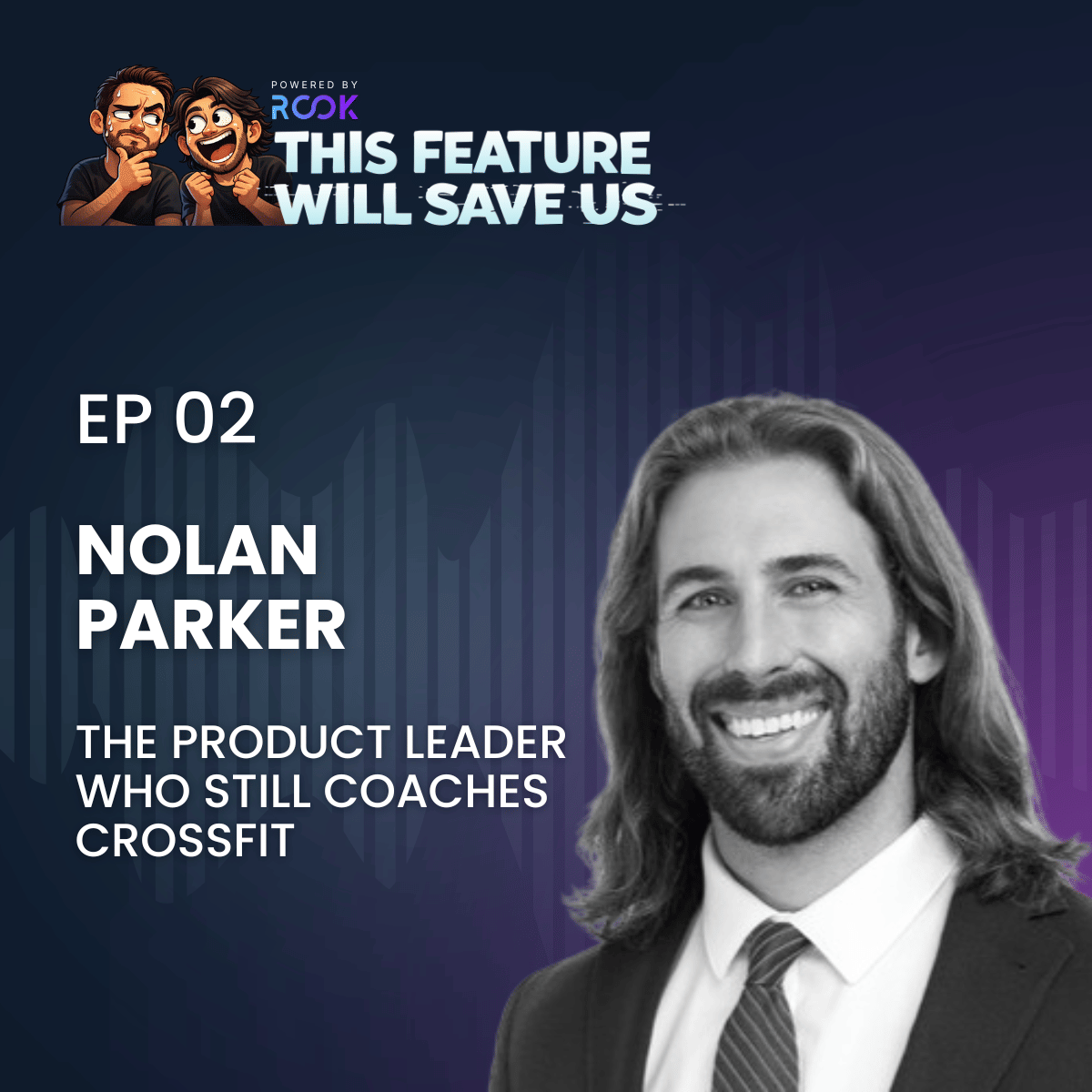
Nolan Parker - The Product Leader Who Still Coaches CrossFit
Nolan is a Senior Product Manager at PushPress, an all-in-one gym management platform, where he leads their growth and mobile teams. He spent over 14 years as a CrossFit coach, trainer, and gym owner before finding his way into tech through a customer support role at TrueCoach and eventually moving onto the product side. He still coaches three nights a week, which means he's using the software he builds in real time. His work at PushPress sits at the intersection of behavior change and gym operations, with a focus on giving gym owners and coaches tools that actually reduce what they have to think about.
Follow and Subscribe
Nolan Parker’s product perspective was shaped long before he had a product title.
As a former gym owner, CrossFit coach, and trainer, he understands the day-to-day reality of the people using fitness software: busy operators, time-strapped coaches, overwhelmed staff, and members who do not care how complicated the system is behind the scenes. Now, as a product leader at PushPress, he is building for those same workflows from the inside.
This episode is about the calls product teams actually have to make: when to trust customer feedback, when to challenge it, when to say no to a “good” feature, and how to keep a platform from becoming a bloated collection of edge cases.
Nolan also brings his experience from ROOK into the conversation, where he worked with digital health companies using wearable data as product infrastructure. That background opens up a deeper discussion on data, behavior change, onboarding, AI, and what it takes to build tools that are not just technically useful, but actually usable in the field.
Nolan breaks down:
- Why being both the builder and the user can create better product instincts, but also stronger bias
- How coaching taught him to simplify product experiences and avoid overloading users
- The TrueCoach app rebuild that taught him the cost of adding too much information
- Why SaaS products become bloated when every customer request turns into a feature
- How he thinks about market parity, differentiation, world-class features, and “filler”
- Why product teams need analytics to understand whether users actually love a feature
- How Dashboard 2.0 showed him the difference between user resistance and product failure
- Why adoption is often harder than building the product itself
- How PushPress is thinking about AI, member intelligence, and surfacing the right context at the right time
- Why pricing recommendation tools can be useful in theory but difficult to make work at scale
- How gym owner benchmarking, AI assistants, and gamified performance loops could change fitness business software
- Why internal trust matters before hard product tradeoff conversations happen
Connect with Nolan
LinkedIn: https://www.linkedin.com/in/nolan-parker
Follow Marco Benitez and Jonas
Marco: https://www.linkedin.com/in/marcobzg/
Jonas: https://www.linkedin.com/in/jonas-ducker-37460bb3/
Get in touch with This Feature Will Save Us Podcast
LinkedIn: https://www.linkedin.com/showcase/this-feature-will-save-us
Website: https://thisfeaturewillsaveus.com
Email: jonas@tryrook.io
Powered by
ROOK: https://www.tryrook.io/
Timestamps
1:45 - Nolan’s most useful AI workflow
2:06 - Why product teams may over-index on NPS
2:49 - Garmin, Whoop, Polar, and Nolan’s wearable preferences
3:15 - Acquisition, retention, and the first habit moment
4:05 - Nolan’s underrated recovery habit
5:25 - Nolan’s role at PushPress and his coach/operator background
6:41 - From dietetics and gym ownership into tech and product
8:00 - ROOK, behavior change, and why information is no longer the main problem
8:51 - The advantage and bias of being both builder and user
9:21 - “Don’t make me think” as a product principle
11:26 - The TrueCoach app rebuild and the danger of too much information
13:48 - How product bloat happens in gym management software
15:40 - Market parity, differentiation, world-class features, and filler
17:00 - Using product analytics to decide what deserves to stay
18:17 - Dashboard 2.0 and why users resist better products
20:01 - Why adoption is often harder than building
20:58 - Meeting users where they are instead of being louder
21:45 - Member Intel and giving coaches the right context before class
23:53 - Turning scattered coach knowledge into usable product context
25:41 - Managing noise from CEOs, clients, tech teams, and the roadmap
28:00 - Building in public vs. using a smaller beta group
29:25 - A feature Nolan expected to work better than it did
31:20 - Gym benchmarking, pricing data, and business insights for operators
32:14 - AI assistants, gym leaderboards, and gamifying operator performance
33:31 - Where internal product friction really comes from
34:25 - Why relationship-building has to happen before hard product decisions
36:16 - Building trust and alignment on remote teams
Transcript
Jonas Dücker (00:00)
Hey everyone, super excited. Episode 2 of the podcast. This feature will save us.
Today we have Nolan Parker, Senior Product Manager from PushPress with
and we will dive into his background as a coach and athlete, but also being a product manager in the fitness space. Super excited for this one.
Marco Benitez (00:19)
Very excited, let's go!
Welcome Nolan Parker, aka Mr. Liver King. It's great to see you, my friend.
Nolan Parker (00:29)
you as well, Marco and Jonas. Pleasure to be here.
Marco Benitez (00:33)
Alright, so let's start with the rapid fire. Alright, so my friend, which color do you prefer, red or blue?
Nolan Parker (00:42)
blue.
Jonas Dücker (00:44)
You can tell from the t-shirt. Crossfit or HYROX?
Nolan Parker (00:49)
it all day.
Jonas Dücker (00:52)
I kind of knew. ⁓
Marco Benitez (00:54)
Yeah, meat or salad.
Nolan Parker (00:57)
Gotta go with meat.
Jonas Dücker (01:00)
Favorite fitness product you use every week.
Nolan Parker (01:02)
easy ones.
The new one, it's been all about the mobility tools. I knew you guys were gonna ask me that, so I grabbed out here. This is the Alpha Ball on Amazon, and it's just like so much better than a regular lacrosse ball. Get it right here in the hips, in the glutes, in the low back.
Jonas Dücker (01:22)
All
Marco Benitez (01:23)
or alone?
Nolan Parker (01:24)
I am married.
Jonas Dücker (01:26)
No, it's all alone. Great question. Product management or growth management?
Marco Benitez (01:28)
That doesn't mean that you prefer that one.
Nolan Parker (01:31)
do I prefer? Yeah.
We won't send this to Rosie.
the answer is product management, I think.
Marco Benitez (01:45)
most useful AI feature you have used.
Nolan Parker (01:49)
I think ⁓ within Claude Cowork, ability to just have MCP connection to all the other tools I use in one place is like the biggest game changer life hack for me. Just being able to plug in everything and query the database and from Slack, email, linear, all the above.
Jonas Dücker (02:06)
From a product lens, what metric are people obsessing about way too much?
Nolan Parker (02:11)
might be a hot take, but I would say NPS. One thing I see, like NPS obviously gives you a great overall signal if people like and enjoy your product, think people over index on it. And one trend that I've actually looked at when I look at NPS data is it's very highly correlated with problems that people might have in the platform. So they tend to answer the NPS. Like if you have like say, you know, an outage or something, you get a ton of bad feedback.
and something good happens, new feature release, you get a bunch of good feedback. So tying it and looking at it with your product cycle in mind, I think is really key. So don't look at it just as a snapshot up by itself.
Marco Benitez (02:46)
Tell me your favorite wordable.
Nolan Parker (02:49)
We're on Team Garmin now. Team Garmin.
Marco Benitez (02:51)
That's
interesting. Before you have a Whoop, right? using a goop.
Jonas Dücker (02:54)
I have one flying around here somewhere
Nolan Parker (02:56)
did whoop and
polar for a long time, which I enjoyed all of them, but the Garmin has been really good. I've gotten into more cycling and nice for that.
Marco Benitez (03:00)
Meh.
Jonas Dücker (03:05)
Adidas or Nike?
Nolan Parker (03:07)
Mmm Nike though. I will say I haven't I haven't worn I guess I got a pair of Nike Metcons, but not a fan of either really
Jonas Dücker (03:09)
Ouch
Marco Benitez (03:15)
or acquisition.
Nolan Parker (03:18)
I see them as a little bit of one in the same. I guess when I think about acquisition, I think about getting users to that first habit moment. And really, I would say that's your first retention checkpoint. So you have to retain them for the first time, get them coming back. But then when I think longer term retention, ⁓ I answer varies a ton when you're looking at B2B versus B2C.
Like B2B, think actually retention is a little bit easier. are locked in a little bit more, longer cycles. And the cost of changing is a lot more painful.
Jonas Dücker (03:47)
Best from a fitness wellness perspective for traveling.
Nolan Parker (03:51)
Ooh, first thing in the morning. When you're traveling, you're out of your routines, you're out of your normal ⁓ cycles and you're worse sleep and less to do. So wake up, get the workout done when you're on the road. Otherwise I'm like an afternoon guy.
Jonas Dücker (03:54)
sunlight.
Marco Benitez (04:05)
most underrated recovery habit?
Nolan Parker (04:08)
underrated, I'm going to go I think using your breath to switch up your physiology and kick off sympathetic nervous probably the biggest thing you can do. Doing a quick body scan, 10 deep breaths, just like throughout the day, stress cycle a big hack.
Marco Benitez (04:27)
It's really interesting, right? How does that work? it's like, ⁓ you never imagine that only learning how to breathe, that helps you to improve everything. It's really crazy,
Nolan Parker (04:37)
Yeah, it's up there with the I mean, it's not quite meditation, but it puts you back in control again, right? You know, if you're frantic, if you're scattered, whether that's from work, from a workout, you know, change it up, change the vibe entirely. so like after workout, it's like change the music to something way more mellow. Turn the lights down and then just get reconnected again. So, yeah, huge.
Jonas Dücker (05:00)
awesome, awesome. So we're going to reconnect now and then we change gears a little bit. ⁓ maybe you can give us your spiel of like 30 seconds, real quick, your role at Pushpress, what is Pushpress doing how did you end up there? Especially what we want to focus on in today's session is a bit your background as an athlete and coach at the same time as a product builder because I think that's super interesting for
for many folks out there in that space.
Nolan Parker (05:25)
Amazing.
Yeah, so I joined Push Press almost two years ago as the product manager for kind of their newly formed growth team. since then I've also taken mobile teams. So our staff app and members app our train workout building product. So Push Press is kind of all in one gym management solution, which ties in really well with my background having been a former gym owner and operator, having been a CrossFit coach and trainer for.
14, 15 years now. So it's been a I still have my hand in the coaching pot. Like I'm coaching, you know, three nights this week having that dual perspective of I get to actually go use push press in my gym experience firsthand, kind of the pain points owners and coaches feel day to day then actually have the ability to do something about has been a huge unlock. So yeah, enjoying the time at push press.
Marco Benitez (06:11)
You have a very interesting ⁓ background because it's like you are from two worlds. One on the fitness and the other one on the product with technology. That allows you also to understand a little bit better the end user, the consumer and everything.
tell us a little bit more about your background because this is where you are today but before what happened because I think you were working with so many companies building different products. So tell us a little bit more about that
Nolan Parker (06:41)
Yeah, definitely. So I kind of found my way into tech, not on accident, but it was never the plan. to school for dietetics and nutrition coming out of school and decided to open a gym for myself and kind of spent six, seven years, kind of most of my early twenties training of some sort or nutrition coaching and
I was really kind of struggling at that point. It wasn't going well all the time and everyone knows kind of the demands of that lifestyle as a coach, as a trainer. have to be available to your clients when they are, which means super long days working on the periphery of the nine to then trying to do whatever I could during the middle of the day to make ends meet. so kind of saw tech as a way to have some stability and be able to support myself while I grew my training business.
fell in love with it. So I got my first role in tech as a customer support specialist at True Coach, which is a one-on-one personal training workout builder product. And kind of fell in love with it up kind of working my way up, getting into more management, and then eventually making the leap over to the building side of product, which at that point I'd had.
thousands and thousands of conversations with coaches and trainers and I had been on the front lines of support and had been using the tool myself and was like, okay, like I know what to build. I know how these people think I'm one of them and having that firsthand perspective and I've always tried to keep that in mind as I choose my roles and positions that have worked. ⁓ So kind of coming through, ⁓ you know, did some agency work.
And then found my way over to Verb and then my time with you guys, which was amazing as we kind danced on the periphery of health, longevity, medicine 2.0, just finding ways, I think, to connect users and technology. And I love sitting at that intersection of behavior change. see so much of like.
The opportunities that are coming today are a lot of data unlocks. so information is no longer the problem. now we're able to focus on like, well, like what do we need to do to motivate people? Because the answer is there, but the behavior is not. And so like that's been kind of my superpowers. Like having spent so much time in that coaching seat, I really get to think a lot about what blockers exist for people and like, what are they running into? And then trying to find ways to use the technology to help.
navigate around that or to better their journey.
Jonas Dücker (08:51)
great. And I want to actually double down a bit on what you mentioned with like you being a user or like kind of part of this value chain at the same time a builder. you think like having that perspective from a user coach perspective, like is that helping to better understand really the needs and what we need to Or is there some bias as well when you are so involved on the other side that this actually can be also
against building the right thing from a product perspective.
Nolan Parker (09:21)
Yeah, no, definitely. think ⁓ I definitely have some strong biases and some strong One way that I combat that is one just through awareness. actually easier because I know that I have the bias. I think we all do. because it's such a direct one to one, like, I have this and I want it in the product. It's easier for me to say no to the things that I'm like, that's that's a Nolan specific because I tend to maybe be a little bit more nerdy. I want to geek out on data more. I want to like do things, but I'm like.
the user need to hear this? And I kind of teach myself the same lesson when I'm coaching, right? If you're a really good coach, you don't tell client that you're working with all the technical cues, you don't tell them the things that go into programming, you don't explain how a muscle works and hypertrophy is developed. So you have to give them cues that relate to them. And I kind of try to do the same thing when I come back to the product side and the building side. I'm really thinking about, well, like, what are most
owners need to do. How much time do they have? What is the job they're trying to get done? favorite thing to say back to myself is, don't make me think. For most of our users, they're busy, they're time strapped, they're trying to do a million different things, wear a million hats. I'm like, what is the don't make me think version of this feature or way to solve their problem? In doing that, I'm like, this is how I'm going to remove myself from the situation and what I want. Just really think about where are they at when they're making the decision or using this tool or feature.
Marco Benitez (10:41)
That's interesting. And it sounds really holistic, right? Because it's like you are connecting the dots between your experience plus you are using the shoes of your the other coaches and fitness clubs and everything. Just talking about fitness clubs, of course. But it's like it's really interesting. That's perspective. that's when things are going really well. What happens when you're
product decision where your instincts were wrong. mean, what happened with, you think that, feature really is going to be really, really, really good. And then when you show to everyone answer or the results were wrong, you any experience?
Nolan Parker (11:26)
Yeah, definitely. Luckily, I made one of these mistakes pretty early on and I able to, I was going to say, well, now was that rook. No, no. ⁓ So for me, I think it's that bias you know, my desire for more information, more exposure. when we were at True Coach, we did a pretty major rebuild of client facing app, which is where users perform the workout. So the most touched surface of the platform.
Jonas Dücker (11:31)
And hopefully you're not here with us. No, I'm kidding.
Marco Benitez (11:33)
When I was in Rogue, I remember that.
Nolan Parker (11:54)
we basically like redid the way that workouts are displayed and we put all the information and basically like it led to these really long kind of scrolling views that a lot of people just didn't care for. And we had to kind of go back to the drawing board and clean things up a little bit. But it does not feel good when you, you know, launch a new version of the app. And then even though it's a small, maybe subset of the audience, like if it's even 1 % of people, that's still hundreds of,
emails, app yelling at you. So lessons in there. One was just like, yeah, more user testing and get that feedback early on. Don't just do what you think is best because you're informed and you know sometimes like a fish, it's hard to tell and explain to a fish, you know, what's the water? The water's all around you. So you don't see it, you don't think about it and you get a little too familiar and comfortable in it. And so it's like, no, you get a kind of
kind give it to someone who's not in the water with you and kind in that day to yeah, good lesson there.
Jonas Dücker (12:48)
What I also imagine is challenging if you connect that actually to the company perspective, right? Because one thing is being in the product seat and having to build the product and you want to build the features and you having that first-hand experience as a user, as a coach, you're like, okay, we need this and that, et cetera. But like from a company business perspective, not all the great features are necessarily features that actually clients would be willing to pay for.
or that actually drive like, you know, the impact from a business So kind of differentiating here as well from like product roadmap, product vision, cool features that you can see as athlete and builder, but then you have the flip side of it. Actually, it has to drive business impact. Have you seen kind of these types of decisions where you felt like, we're building something that is really cool. And I see there's a lot of value in it, but at the same time, even it is very valuable. It might not really drive business impact.
And whatever you can share, obviously, like feel free to go into some examples as well if you have.
Nolan Parker (13:48)
Yeah, yeah, there's a couple different ways we could take One thing that comes to mind is
are lot of things that people ask for in products. And we see this in legacy SaaS products and things that have evolved over time. so gym management software is a great one, a great example. seen this at Pushpress. I've seen this at Tribe back when I was at Explore Explore, where users ask for something. It's a good idea. It works for 10%, 20%, 30%, 40 % of your user base. And you say, great, we'll build the feature, add it in the product.
and then somebody else comes along and another 10 % says, we need a slightly different version of this thing. And so you start to end up with these very bloated products that now get harder to navigate, harder for users to it's for. And then maybe you start to expand your TAM and you go out and you add a slightly new type of user and they need all these same things, but now a slightly different version. So you end up with these like big bloated Frankenstein projects that are just all these pieces stuck together. And then you have a bigger code base to maintain and you're just kind of get yourself in the spot of like,
Who are we building for and how do we kind of adapt give them what they need and highlight they need? And this is one of the reasons where a lot of the changes with AI I think are getting really exciting, is you don't need to spend so much time doing the customizations within all these different features. And you can kind of start to assistants and agents and some of these that customization and personalization for you. So now you don't have to keep building bigger. I actually am really excited about a future where we're actually starting to get smaller and a little bit more zoomed in in that regard.
So yeah, that's kind of like one direction I would take that
Jonas Dücker (15:15)
No, no, that's great. The big question for me then always is how do you avoid this from happening? Right? Like because it's so easy to fall into that trap. It's so easy that yet another big client knocks on the door and says, Oh, you know what? Tweak this a little bit more like this for me. And even if it's just for me, you know, for everyone and you start building like these, you know, V2, V3, and like there's a customized version for someone. Is that a product decision not to do this or is that a company decision not to do this? And how do you avoid this from happening?
Nolan Parker (15:40)
Yeah, no, totally.
I forget the exact terms that they use, we've been going through and packaging thinking about what are the features. One way I like to think about it is what features do we have that are needed for market parity? What do we need to have that's above market parity to gain more market share? And then what do we need to be world-class at based on whatever your industry and specialty is?
isn't one of those three, and those are all the filler features. It's just extra stuff that's in there. And I think you can make a case for the removal of that. So every time a new feature decision comes up, be like, okay, where do we kind of place this and stack this and rank this in our feature stack? And if it's just filler, if it's not hitting a large enough part of a TAM, and this is where think product analytics need to come into play. You don't always have this when you're maybe an earlier startup.
as you get more advanced, making this kind of a first-class principle as you build of, I'm really monitoring and engaging with each of the features and understanding like who uses this? Does our ICP use this feature and how many of them and how often? And that way you can start to put some numbers to story of like, we have this thing, everyone loves it. And it's like, well, do they, do they use it? And then what impact does that ultimately make?
another thing that kind shift and like I mentioned earlier like this consolidation has me thinking a lot about is The job to be done and then how do we you know start to use AI and to like unlock? These jobs to be done and go from just being like hey Here's a place where you can do a click to make it happen to how do we start to automate this for you? think ahead and be a little bit proactive so that way again We're not trying to build more service area for you to do things We're actually just focusing on getting that job done for you
Marco Benitez (17:25)
And Nolan, did you have like an experience on the opposite? I mean, in terms of that feature that was underestimated, but then you realized receive a lot of engagement. So it was like, because nowadays you have AI tools and you can do prototypes very easy and you can do so many things, but in the past, and in the past, I'm telling you about five years from now.
or maybe two years from now, ⁓ where you don't have those days AI tools and make prototypes or do these features very quickly. But before you were like, I have like an idea because I received XYZ from the clients. And then you create something underestimated and then receive a lot of engagement. Do you have one story?
Nolan Parker (18:17)
Yeah, think a great example of that is we did a rebuild of our dashboard, the main homepage that users would operate from. This hadn't really gotten a really, since I don't know, it's been years and learned a couple things in launching Dashboard 2.0. One is some people, just like things the way they are and they don't want them to change, but they don't know why. They're just familiar and comfortable with it.
We do usability testing and we're like, this new one's better, it's faster, it's more performant, it gives access to more of the information that I know people are looking at on a daily basis based on where they spend their time in the product. that's why I said these product analytics tools, once you get to a place that you can stand that up, seeing the heat map of where are people clicking, where are they spending time, how long are they staying on the page, watching user replays. And so what I saw was we go from dashboard 1.0 to 2.0.
But I kept 1.0 open because I said, I want to see how many people, I don't want to piss them off. I want to see how people adopt this new one. so we see the initial, the crossing the chasm of user adoption. You see your early adopters and then you kind of see the middle group. Then you have long tail. It was like to a T. was like early adopters in there, love it, great, perform it. then I do some nudging and push other people and they like it. And we get to like 60%.
the laggards and they just don't want to come along for the ride. And so I'm like, okay, we're just going to have to put a date on the calendar and eventually rip the old one off. And then they come over and nobody really complains. They all use it. They love it. It's just, they didn't want to try the new thing. I think that was a really good lesson in that I was a little too actually ⁓ reliant on what users were telling me when I knew I had something better for them.
Jonas Dücker (20:01)
which kind of brings us to a different point of like what, what sometimes makes it hard to build great products. It's maybe not even just building the product, but adoption of the product, right? the same even, mean, AI is being hyped, Claude is being hyped who work with these tools, they feel like we're falling behind. We need to move faster. And then you look world and you see like how much adoption is actually happening of these types solutions far. And you're like, Oh, it's actually a tiny percentage.
of the population using these tools. So you translate that a bit to the example that you just gave, thinking about building great products, but building great products that are easy to What's been your experience there? you an example from Push Press or previous experiences where you felt like the product was great, but there was no easy way to adapt the product.
there's a good way to adapt the product and you know like how did you kind of tease that up out to the penetration you expected.
Nolan Parker (20:58)
think there's kind of a couple different stages in the journey. I think one is initial awareness. when you're trying to launch something new, how do you get people bought in? Because there's more noise now than there's ever been. I feel like I end most days just absolutely drained from the barrage of input that I receive, right? some of my own doing, but a lot of just the world trying to get my attention.
I think being louder is no longer the way to get seen and recognized and get users to start doing something. I think you need to meet them where they're at. You need to kind of put yourself in their shoes and anticipate like, where's the best way to surface my solution in that it's going to feel like it's already a part of their world. And again, going back to that, don't make me think like it's easy for me. It's natural and it's solving kind of a problem that I already have. And I know that it's there for me to ⁓ help solve that problem. So.
getting it in front of them in a little bit more covert way. example of that that I'll probably give is building this feature called member Intel right now. And this is like my absolute baby. It's like a feature that I am so passionate about. And it's basically like an Intel report for coaches before they coach class. And it's solving a problem that's very like real for me, which is I spend my day at the computer, know, doing my job here at Pushpress. And then I zip over to Coda CrossFit and I go coach classes.
Jonas Dücker (22:15)
Five minutes, yeah.
Nolan Parker (22:17)
And I'm me the 32nd Intel on like what I need to know who's going to be in my class tonight. Whose birthday is it? Who's, you know, membership any injuries I need to know about any new people that are going to be there. And that way when I show up, I'm like ready to go. put my coach hat on and I'm like looking around for all these people that have been flagged in my Intel. And so one thing that I realized with this feature is owners and their staff have a lot of different ways of working.
And so it's like, like, where are they solving this problem today? And like, for me, when I, when I realized I was like, we're doing everything in iMessage and I'm like, I ended up messaging my gym owner and being like, we had, know, so and so Sarah was new. She dropped into class last night. Here's how she did. And I'm like, push press doesn't know about any of this. We need to get all this information into the system. And so what I'm realizing is we need to find ways to extract data. again, in the age of AI, this is becoming more and more.
necessary and we actually have the tooling now and the power to do it. if I can gather a broad context, but then only surface the insights that are important, I'm able to give coaches something super valuable, right? I'm telling them how to spend their time and create touch points with members that are going to ultimately create a huge impact in their coaching experience and give everyone a great class. So one where I'm really trying to figure out how to close that information gap of like, you do all these things out in the world, you use all these other tools in addition to the one that we have.
How do I help bring that context in and make it really easy? So I'm like, I'm thinking about everything now in terms of notes. I'm like, how do I log this as a note? How do I get this Intel into the system and out of either the coach's head or out of the iMessage chat or the Slack thread pull it into a place where it can be used by other people at the right time.
Marco Benitez (23:53)
That's really cool because it's like something that you really need. it's like at the end of the day, you have the knowledge to manage your people and the classes and everything. But it's more like trying to engage with the end user, trying to engage with them in order to, you know, only for the birthday, happy birthday. It's just like, or what happened yesterday, you were not over there. Is there something I can help you? It's like, try to engage with them. It's
Because at the end of the day, are talking about human component and also that we are part of one team and your workout and Coda, it's like that. It's you're building a team facility. it's, it's, it's really interesting. That lead me also to another question for you, which is what happened with the communication in terms of your, because you are the, the product owner.
But you have a lot of noise, as you said before. You have AI, you have data here, data there. You have your, maybe the CEO, he wants specific things. Then you have clients and then you have, yeah, I know, they are the worst. Because they have, they're really crazy ideas. So that's a problem. But then you have your tech team and they say all the time, I don't have time for that. The roadmap too big.
Jonas Dücker (24:58)
CEOs.
Marco Benitez (25:13)
how do you manage everything and then you realize like, guys, this is exactly what we need because I need it. Because on your case, you are the coach, you are the owner who is using the technology. But if you are not, how can you manage all these situations? Because I'm pretty sure that on your previous experience, you were not like the end user talking with that product. So how do you manage all these types of communications?
Nolan Parker (25:41)
Yeah, I think... ⁓
It's a lot. think that what you're describing is essentially like having product sense or product taste. Like how do I choose the right things to do? And so for me, that means you do have to ingest. have to take in information from so many sources to start to develop your own opinion. And then you start to see patterns and trends emerge over time. And I think this can happen. Like you can do this well, whether you are in the industry or like in something that is specific to your role and you have that subject matter expertise.
I think all that does is help you actually accelerate maybe some of that data capture though. think if you're coming in from the outside, even if you don't have that background, if you spend time with users, and I would encourage people who don't have the background to spend even more time with users, because the things that you can look at in a product and measure and see, only telling you the story of what's happening. It's not telling you the story of everything else that's happening outside of that product and how people are trying to solve problems. And so for me, context is king.
So what I try to do is take in information from a ton of sources and we have a feature request log that's getting 10, 20 things added to it every day. the CEO has a million ideas and he's dropping into gyms and he's saying, is a pain point, we got to fix And for me, thank God for AI, it's making it easier to organize this information. But for me, it's like there's the product sense first, you have to have that qualitative, all that different input in that kind of context.
And now I go look for the data. Data has to help, and you can use a prioritization framework. I know people use Rice and that sort of thing. For me, it's really just trying to flush how much of our user base does this cater to, and what problem does it solve for them, and then to what degree. So thinking about something like the member Intel feature that I was just describing, one of the challenges I realized is, ⁓ our notes feature is under adopted. It's one of the key inputs to this feature.
I realized not enough people are using that that could actually make the Intel more valuable. And so I had to have the idea about what problem we're going to solve. And I had to have the context to kind of put it together and get it out in the world. And now I'm like, but here's like here's where in this funnel of adoption, it's getting blocked or limited. Let me unblock that.
And I think when you go to build something new or iterate on something that's already existing, you need to be asking those stories and getting to the root cause and always go back to like the problem that you're solving rather than kind of falling in love with the solution that you already have.
Jonas Dücker (28:00)
This wants me to go back to rapid fire questions almost. ⁓ So a few questions maybe. Open backlog building in public. Is that something you would prefer over closed doors then? Is that kind of what I'm taking from your argument?
Nolan Parker (28:03)
and
I'd be a fan of building in public, but I think actually if your company wants to try a lot of things, it depends on exposed you want to be and how committed to that you want to be. I think if you can build in public without the expectation that everything is going to stick around forever, love to do that. But honestly, I find it's a little bit better to keep it a little closer to the chest. So what we end up doing is having kind of a smaller beta squad of about 100 gyms right
It's called the inner circle. have direct access to them and I'm usually getting ahead of things and trying to just launch features within that group first. One from just a like a bug flush out, but I've started to realize that having features in beta a little bit longer with that cohort and letting things kind of bake and gel a little bit actually changes the way that I want to ultimately bring it to market with a full launch. So I think that's like been a helpful way to do it is like not fully in public, but
enough to ⁓ a wide array of your audience, know under people you can really get an idea of how people feel about something Without announcing it because as soon as you announce, know, people are they're stuck to timelines. They're stuck to deadlines and You might change your direction or you know, the company's needs might might alter or another problem could pop up That's better to solve right now. Yeah in the backlog for now
Jonas Dücker (29:13)
Yeah. Yeah.
Marco Benitez (29:25)
you mentioned about fell in love problem rather than the product or the feature. Have you ever felt in love with one feature that didn't work?
Nolan Parker (29:37)
oooo
trying to think.
Jonas Dücker (29:40)
He got you.
Marco Benitez (29:42)
Yeah.
Nolan Parker (29:44)
I wouldn't say I'm too in love with it, but ⁓ I've definitely had some that I'm like, I think this will be useful. ⁓ it was hard. was not that it was like went poorly, but it just didn't take off the way I expected. And I think just those things that like people don't really remark on or they don't really adopt a ton. I think one was like, I did like pricing recommendations for gyms. so.
thought was, gyms want to be competitively priced and if they're not charging enough for their memberships relative to their area, they're leaving money on the table. I'm trying to think, how do we make gyms more money? I did project where I ⁓ sourced a ton of data, looked at all our gyms, looked at average pricing in different areas, and then also looked
by industry, you know, because we want to separate out, you know, CrossFit from Jujitsu and that sort of thing. so basically now every, every pricing or every time you go to develop a plan, we have a template that says, this is what we think you should charge for this based on your area. like owners are pretty locked in. They kind of know what they want to charge and it's, hard to do at scale in a way that's actually effective, I think, because you don't know what their service is and how much they pay their coaches. like, without more context there, feature just didn't quite hit.
So that'd probably be one, not a flop, but also just not like didn't quite do what I was hoping it could. It was underpowered.
Marco Benitez (31:00)
Got it. It's like having this Airbnb, right? It's like you more or less know how much you pay for the rooms and everything. it's a lot of power for the end user. I see that, but for the coaches or maybe the owners of those facilities, they were like, no, it's not accurate. I can see that.
Jonas Dücker (31:20)
Like actually on that note, like there's probably a lot you can do by the scale with a company like Pushpress you're getting right now. You have so much data you're sitting on top, right? Like the average class being charged by class on average, membership, pricing, typical kind of and so on. foresee even features that go in that direction where other coaches or other gyms or CrossFit boxers can kind of benchmark themselves against.
the norm against what you've seen across the board. Which is interesting because again that ties back to more of a business perspective, which I know is sometimes challenging in fitness, right? Because a lot of the gym owners are doing this out of see more the coaching aspect of it rather than the business side of it, which is also a challenge then to obviously build the right features that I actually appreciate it because not always the business driving ones are necessarily the most appreciated
Nolan Parker (32:14)
Totally. And we're seeing this now. have kind of a new AI assistant that lets gym owners be able to query against their own data and have the smart logic on top of But we kind of in the background, we've always talked about a gym leaderboard. And we do have these built out internally where we can look at the list from revenue, 1,000 to 5,000, how are gyms stacking up? And gym owners are also competitive. So I think there's something there to the gamification
hey, here's where you're at in the list relative to your peers. been actually dreaming about a little Duolingo-style feature where you know how each week, I think you guys are Duolingo users or have it at times, don't know, Jonas speaks every language already. ⁓ But each week you get put into, there's 10 or 20 people in your group and you just compete against that cohort and see if you advance or you get dropped. I'm like, think gym owners would really have fun with that.
Jonas Dücker (32:54)
Almost.
Nolan Parker (33:07)
It motivates you. makes you actually start to do more for your gym. So I'm like, we're gamifying it and you're playing a fun game, but it's like, actually, if you are getting another lead this month, if you're closing another deal, if you're keeping one member who you might've lost, all these things are contributing gym owners are really, they're living in the margins. it's like one member plus or minus each month, that trajectory over time makes a huge difference in the business.
Jonas Dücker (33:31)
Can't totally see that.
Marco Benitez (33:31)
That's interesting.
I have more questions about communication. I want to connect a couple of dots because it's like nowadays, you're a senior product. You have been working with so many products before. From all your experience in the organization, who creates the biggest friction?
And of course you have it's really good friction and you understand that once the product is released or you have a beta testing or whatever. But what happens internally when you have that and everyone is like, I don't know, you know, or the, or the CEO is, don't know, or you're whatever. So do you have like a before or
something that happened that created a lot of friction and you were like ⁓ my goodness this is i need to push this one
Nolan Parker (34:25)
Yeah, definitely. think for me even zoom back from that, it's do you avoid that situation happening? And for me, it's going upstream. And this when you first join an organization, I always liked the phrase, like, people don't care how much you know until they know how much you care. And so the relationship building has to come before moment that you get to that tough decision, right? need to push, I need to call in the favor, I need to get someone behind me on this.
Marco Benitez (34:33)
Right.
Nolan Parker (34:51)
as you guys know me, I get along with most anyone and everyone pretty pleasant in the day to day. like, but that's intentional. Like obviously it's me, I work really hard to check in on people to make sure both my immediate team, but like also every new person who joins the organization, like I'm reaching out, making sure I can just get that first coffee and sure I'm really getting leaders. And this is something that I see is maybe the biggest gap and the biggest.
anyone to look around their organization and say, am I someone who's helping move the needle on projects and enabling other teams and helping to get stuff done and looking beyond just myself and my own agenda? ultimately that's the best way to get your agenda across is to help other people achieve their goals. so if you know, our VP of growth and our head of CX and our engineering manager and our head of sales, like if they know that I have their best interest in mind.
And I've developed that relationship and that rapport and I've been able to help them get some wins by doing those favors, doing those things. I'm like, this isn't the thing right now, but you know what? I want to help them out. And ultimately if it's in service of the customer, of course, like let's get it done. And that way, like when we get to a hard decision, I'm like, hey, here's the trade-off, here's the rub. It's a lot easier to have those conversations and it's not just a shouting match or a, you know, me versus you. It's like, hey, here's the trade-offs and I think we should do this.
So yeah, my strategy is never get to that point where I have to do the hard sell.
Marco Benitez (36:16)
So I'm hearing like trust, building trust with the team, building that community, building all the relationship. But how do you handle it today? Because everyone is remote. So I don't know, in Pushpress, do you have like headquarters or I don't know, anything? Everyone works remotely. So now how you are building this with them?
Nolan Parker (36:34)
No.
Yeah, unfortunately I say, ⁓ but Slack culture has to be where these things live. I spend a lot of time in Slack and a lot of time in meetings. And find ways to ⁓ mix in the business and the fun and be the person at the beginning of the meeting who's gonna try to kick things off with a joke or a check in on people's day. How are they feeling? What are they doing this weekend? And you just get these little opportunities, this little like kind of micro at bats.
least a couple of times a week, just reach out to someone I haven't talked to in a while and just check in and just say like, hey, how's it going, man? You looked like you were a little stressed in that meeting. And so just making them aware that it's more than just work. And then also it humanizes us. I think that's one of the biggest traps we fall into with this remote work culture is just like everything's an exchange. Everything's a transaction. And it's like, your department needs to do this for me. this is a bug ticket. You guys got to go fix it. And like,
They're stressed. They're talking to an angry customer. They're giving it to me. I got to fix it. But I'm getting yelled at from 10 different directions. And I'm like, why can't everyone just calm down? So taking that step back and sometimes you even do it physically, right? Like take a step back, breathe. All right. Now I can, I can approach it again.
Marco Benitez (37:45)
you
That's cool.
Jonas Dücker (37:53)
That's a great, great note actually to almost end the session on. ⁓ But we can't let you go without having to ask the question. I the podcast is called This Feature Will Save Us. So what is going to be the feature that saves What's, what's that next killer feature?
Nolan Parker (38:09)
next killer feature. I always go back to the, I take this off, off of the gym owner's plate, right? How do we get rid of it? For me, that it's actually the team of assistants that we're building. And so what we're thinking about is what are each of the key roles that someone needs help with that they're probably not an expert in. So for a gym they don't have time to hire or the resources to hire a full-time staff.
So we're like, what is the best sales and marketing assistant look like? What does the best general manager look like? What is the best head coach look like? is the best member experience look like? And so we're kind of starting to rethink the way that we do this to focus on expanding the capabilities of what one gym owner can do with a team of smart assistants who are helping to automate these actions. Cause we have, like you said, all this data sitting in one place. have all this context about how other gyms are operating. What does successful gyms do?
And how do we start to translate and turn all these daily jobs to be done into just automations that the gym owner can sit back, look at one place and say, ⁓ know, new member Jonas is coming in today, send him a message, click, ⁓ Marco hurt his leg, check in on him, click.
Here's a churn risk report. These are the three people that are most likely to churn this month based on recent attendance trends. Do you want to send an outreach? Click. So now you're just, sitting at the helm. You're not the one who has to be the expert in all these areas and how to solve the problem. You just need to be the one making the decisions, calling the shots. So will it save us? I hope so.
Jonas Dücker (39:32)
and the world I appreciate it. No, no, was great to have you on. Thanks so much for taking the time. Really appreciate it.
Marco Benitez (39:32)
Okay.
Thank you, brother.
Nolan Parker (39:41)
It's been a pleasure guys.