
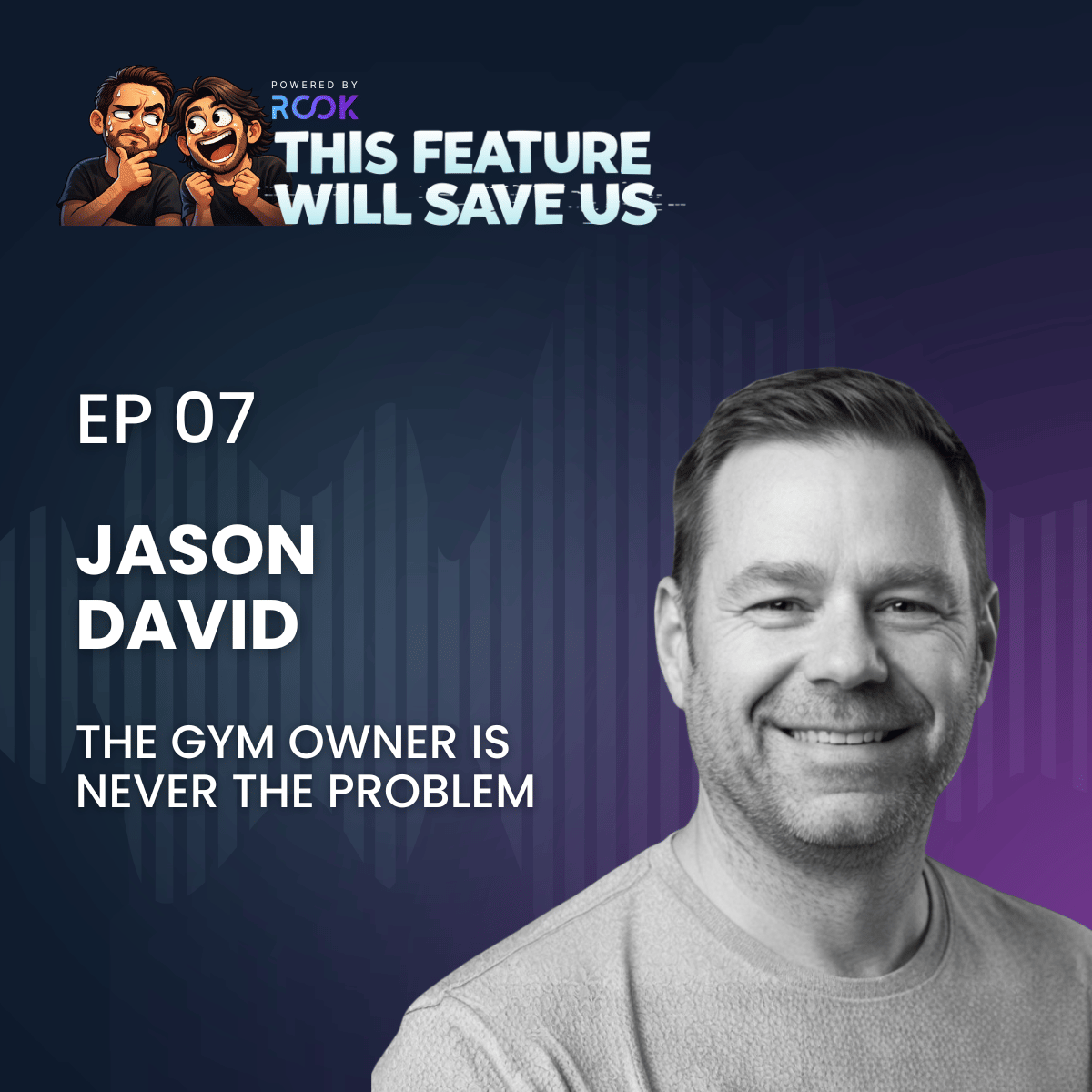
Jason David - The Gym Owner Is Never the Problem
Jason spent years running a CrossFit gym before he started building Gym Force.That experience gave him a pretty specific view of what wasn't working. He'd used gym management software, marketing tools and outside business support, but having access to more tools didn't necessarily make running the business any easier...
Follow and Subscribe
Jason spent years running a CrossFit gym before he started building Gym Force.
That experience gave him a pretty specific view of what wasn't working. He'd used gym management software, marketing tools and outside business support, but having access to more tools didn't necessarily make running the business any easier.
Now he's on the other side, building a product for the kind of operator he used to be.Jason talks with Marco and Jonas about how that experience has shaped Gym Force, from the problems they chose to build around to how they listen to gym owners without taking every request at face value.
They also spend time on community and what actually makes people stay with a gym. The discussion gets into the role of coaching, learning and skill development, where technology fits into those relationships, and where Jason thinks it doesn't.
Jason breaks down:
Follow Jason
LinkedIn: https://www.linkedin.com/in/jason-david-2642371
Website: https://www.linkedin.com/in/davehannum
Follow Marco Benitez and Jonas
Marco: https://www.linkedin.com/in/marcobzg/
Jonas: https://www.linkedin.com/in/jonas-ducker-37460bb3/
Get in touch with This Feature Will Save Us Podcast
LinkedIn: https://www.linkedin.com/showcase/this-feature-will-save-us
Website: https://thisfeaturewillsaveus.com
Email: jonas@tryrook.io
Powered byROOK: https://www.tryrook.io/
Timestamps
0:21 - Welcome and quick questions with Jason
4:31 - Jason's path from CrossFit gym owner to building for gym operators
5:41 - How COVID exposed the business side of running a gym
6:51 - Having the software doesn't mean the problem is solved
8:51 - Wanting to coach without constantly selling and finding new members
12:11 - Why the gym owner is never the problem
13:01 - What Gym Force is being built to do
13:46 - Building the roadmap around customer struggling moments
14:31 - How Gym Force thinks about measuring success
15:21 - Identifying what gym owners are actually struggling with
17:16 - What customers ask for vs. what they're trying to accomplish
18:51 - Connecting independent gyms with corporate wellness
21:01 - The missing data between fitness, employers and insurance
28:01 - Is community actually the product in fitness?
28:41 - Why lasting communities need learning and skill development
31:11 - Building around coaches and communities
35:41 - What the fitness industry should stop building
That experience gave him a pretty specific view of what wasn't working. He'd used gym management software, marketing tools and outside business support, but having access to more tools didn't necessarily make running the business any easier.
Now he's on the other side, building a product for the kind of operator he used to be.Jason talks with Marco and Jonas about how that experience has shaped Gym Force, from the problems they chose to build around to how they listen to gym owners without taking every request at face value.
They also spend time on community and what actually makes people stay with a gym. The discussion gets into the role of coaching, learning and skill development, where technology fits into those relationships, and where Jason thinks it doesn't.
Jason breaks down:
- What running a gym taught him about the software built for operators
- How Gym Force identifies the problems worth building around
- Why customer requests don't always lead to the right product decisions
- What "the gym owner is never the problem" means for the way they build
- How Gym Force thinks about measuring whether the product is actually working
- Why community plays such a large role in Jason's thinking about fitness products
- Where technology can help coaches and gym owners, and where Jason draws the line
Follow Jason
LinkedIn: https://www.linkedin.com/in/jason-david-2642371
Website: https://www.linkedin.com/in/davehannum
Follow Marco Benitez and Jonas
Marco: https://www.linkedin.com/in/marcobzg/
Jonas: https://www.linkedin.com/in/jonas-ducker-37460bb3/
Get in touch with This Feature Will Save Us Podcast
LinkedIn: https://www.linkedin.com/showcase/this-feature-will-save-us
Website: https://thisfeaturewillsaveus.com
Email: jonas@tryrook.io
Powered byROOK: https://www.tryrook.io/
Timestamps
0:21 - Welcome and quick questions with Jason
4:31 - Jason's path from CrossFit gym owner to building for gym operators
5:41 - How COVID exposed the business side of running a gym
6:51 - Having the software doesn't mean the problem is solved
8:51 - Wanting to coach without constantly selling and finding new members
12:11 - Why the gym owner is never the problem
13:01 - What Gym Force is being built to do
13:46 - Building the roadmap around customer struggling moments
14:31 - How Gym Force thinks about measuring success
15:21 - Identifying what gym owners are actually struggling with
17:16 - What customers ask for vs. what they're trying to accomplish
18:51 - Connecting independent gyms with corporate wellness
21:01 - The missing data between fitness, employers and insurance
28:01 - Is community actually the product in fitness?
28:41 - Why lasting communities need learning and skill development
31:11 - Building around coaches and communities
35:41 - What the fitness industry should stop building
Transcript
Marco: Great to have you, Jason. We are very excited to talk with you. As you know, this is This Feature Will Save Us. And very quickly, we're going to start with a quick fart chat, which is just to know you better. Sounds good?
Jonas: OK. It's the warm up.
Jason: Yeah, yeah, yeah, no, that's good.
Marco: Cool. I can start. Fibo or HFA?
Jason: If I was going to pick one, HFA.
Jonas: Mountains or beach?
Jason: Mountains.
Marco: Traditional gym or boutique studio?
Jason: A hundred percent community based coaching led gym studio. If you want to call it a boutique, that's fine. Yep.
Jonas: Freeway training or guided with a machine?
Jason: Never machines for me. Always free weights unless it's thrusters.
Marco: K2Bells or what type of things are you normally using?
Jason: I do like kettlebells. They're versatile and you can do a lot of different things with them. But there's no competing with the, you know, building the strength using a barbell in the Olympic list. So. Yeah, either of those.
Marco: Nice. I'm going to do one tough one. Jiu-jitsu or CrossFit? Oh, you know, I would say
Jason: at this point now for me, it would be Jiu-jitsu, but only because I'm still in the, you know, development process and, you know, early in my journey where CrossFit I did it for so long, I could be in the middle of a workout and think about other stuff. Jiu-jitsu, I'm still worried about getting choked and kind of keep your mind. You're able to be you're able to be in the moment a lot more for me anyways in a Jiu-jitsu class.
Marco: It's really interesting, right? The Jiu-jitsu. Yeah. Everything can happen.
Jason: It's very humbling, obviously. And I know you have a martial arts background, too, Marco. So like there's there's something to be said about going into something where you don't know how to do it and you have to figure it out just by doing the thing for a long time. And it's very difficult. So whatever that is, that's what I'm drawn to.
Jonas: Kind of the case with any type of art, right? I'm going to shift to community. What's harder, building community or keeping it alive?
Jason: I would say building it is probably the hardest thing. Keeping it alive depends on a lot of different factors. But I think a great coach and a great gym owner is what creates both. Sometimes they're not the exact same skills. So community, definitely building it hard, keeping it hard, but in a different way.
Marco: OK, feature every fitness app copies that no one should be copying.
Jason: That's a good question. You know, I would say if you're trying something like I listened to your podcast with Nolan and I really like their philosophy, you know, what they do over a push press. But I think if you copy something and you do it better than somebody else and you're trying different things, then try to copy it. If it's working, go ahead and do it. If not, then you should obviously throw it out and move on.
Jonas: That's awesome. What kills most gyms? Is it being a bad business owner or is it being a bad fitness professional?
Jason: I think it's almost, you know, for our customer segment anyway, I think it's almost never being a bad fitness coach. In fact, I think if you're a bad fitness coach, which I think I was when I started, I have no way to think otherwise. When you run your first class, it's the worst coach you'll ever be. And that was the most that my gym ever grew. So the better I got as a coach, the more difficult it was for me to run the business. So I would say it's never being a bad coach as long as your heart's in the right place and you actually care about helping others, you'll get better. So let's go with the business. Sometimes the business world gets tough.
Marco: That's interesting. I would love to hear how was the process from being in the fitness space, you know, building a fitness club, then doing CrossFit and then building something for the operators that now are in the business, right? So now you have this transition. How does that happen? Tell us a little bit more.
Jason: You know, it's a good question. It's kind of, you know, my life story in a nutshell that I don't try to go too long with it, but we have time.
Marco: We have time. No worries.
Jason: If I was going to give you my story in two minutes, I was that out of shape overweight guy in corporate America, just wasting his life, eating bad, getting fat. Started CrossFit. It changed my life back in 2008. You know, I immediately thought, Hey, this is great. I know everything. I'm going to open up a gym. And it was awesome. I loved helping people. I was good at it. I didn't go to the CrossFit games or anything, but you know, I really liked helping people. So for me, opening a gym was natural. And I'm so glad that I left corporate America to do it. Over time, it got very difficult as you know, CrossFit evolved as the business landscape changed, the market changed. And then when COVID hit, there was kind of a magnifying glass on everything, you know, that we were doing as a gym, but also the importance of the business stuff was very much highlighted and the degree of importance was up here. Whereas before it was just, if you're a coach who cares, you're going to do fine. And I was never comfortable with as well, meaning as our software providers and the business coaching companies out there, everything sounded good in theory, but nothing ever really worked that well for me personally. So that was kind of the, you know, the downtime during COVID was me thinking through all the things that I would have loved as a gym owner that I wasn't able to utilize from, you know, the outside resources that I had at the time.
Marco: I'm going to stop a little bit because I want to go into the widths. What type of things you were doing before COVID? I mean, that you keep that momentum really good that you said like, it's really good with my community, with my end users before COVID, of course.
Jason: Before COVID, it was a little bit of a learning process on the business end to kind of figure things out to have systems in place. We used mind body software for a majority of my ownership time. And for all the tools that it had, I really only used it for keeping track of members, waivers, checking in merchant services, stuff like that. And I never really had the need to build in a full functional marketing campaign, use their lead funnel systems, their community engagement stuff. And then it got to the point where it was too late. So as COVID approached and you know, you can see the businesses change a little bit by the time COVID arrived. It was like almost too little too late because now I have to learn all these new skills. I mean, the software is there, but it's not just a matter of pushing a button and having everything work. So it was perfect for when you have a steady stream of new customers coming in the door. When that goes away, then there's a problem. So my problem was what do I do now?
Marco: What was your feeling in that moment? Right? Because you were before like, okay, things are working, are running really well. And then COVID hit. Did you saw that coming or did you say like, aha, this is a hot moment that I need to change everything. Or was during COVID that you have to change everything? So how was the transition and what type of things you did with the technology and everything with your fitness club?
Jason: Okay. So here's where I'll get kind of a little bit delusional, I guess. I, I felt like I saw it coming. I just saw the numbers going down a little bit. So right in, in March, the first week of March of 2020, I hired a gym consulting company to help me get my stuff together, automate my systems, put together marketing campaigns, stuff like that, Facebook ads, all of that. And then the pandemic hit right then. And I think as a gym owner with so much new time on my hands and all this happened, not to mention a series of unfortunate events, right? You spend all this money on this new product or this new service and then COVID hits and then your gym shut down and everything downstream from that. I thought to myself, I want all of my customers to come to me where I don't have to be the one selling them and nurturing them and cultivating that. I just want them to be there. And I also don't want to do any of the work. I don't want to spend the time. I just want to coach people like I did in the beginning and just have a steady stream of people and it's my job to provide them a service where they have a safe place to exercise, learn the proper technique, meet cool people, have a good time, get fit. I didn't want to sell stuff. I didn't want to be the one pushing the secondary sales. I didn't want to beat them up on nutrition. If they saw me in the grocery store, I didn't want to be the guy judging their grocery cart. So to answer your question, when all that happened, I think I sort of got a little crazy in my head of, you know, what it'd be nice is if somehow we could just set these gyms up, these hardworking gym owners with some sort of system where they can be free to coach and do what they want. And if they want to learn more about business, they can do that on their own time, but it shouldn't be because they need to constantly worry about bringing in new members, if that makes sense.
Jonas: Is that a general problem you see in the space? Like the gym owner that is really good at being, you know, like a fitness coach. A lot of people start in fitness building gyms because it's kind of their passion, right? It's like they love coaching. They love doing good for people. They love working out themselves. And then they move into the business side and they realize, okay, the business is actually not fun. Like for most, I would say like, I would make the argument for most fitness professionals, the business side of the business here is what's actually the most annoying part. Is that what you've seen across the board? Or is that something like very personal experience?
Jason: You know, it's personal, but I'll give you a specific comparison. So our early adopters at gym force have been testing with us for three years. Uh, what's working, what's not working. I have two examples. One gym, I can say his name because he's doing amazing. So nobody minds having good things said about them, right? Owns Wolverine strength and conditioning. The guy's got great systems in place. He's a very solid operator in every regard. He's got great coaching. And he also is free to do other things on his spare time that he wants to do. Right. Real estate. I think he dabbles in stuff like that. So he's a great example of somebody that has that ability to put systems in place to make money, to make a living owning a gym. By the same comparison, one of our other early adopters, one of the most qualified coaches you'll ever see. I had not met another coach that cares more about her clients than she does. Although I care, I cared about mine deeply. Every single person in her gym, she looks at as a, that she's saving their life, you know, and somebody like that, that does not have the ability to take themselves away from helping people. Like the true thing that's really going to help somebody, you know, change their life. I wanted to give them something that benefits them. Right. That person who just can't not, it's the principal agent problem personified to the detriment of the owner. So let's help them both.
Jonas: I love that statement. You know, I want to help both, not just
Jason: the person that knows how to build spreadsheets, learn systems, all that stuff.
Jonas: Isn't it even unfair? Like the person who really deeply cares in that type of profession should be the one getting rewarded.
Jason: Absolutely.
Jonas: And not necessarily the other way around.
Jason: Gym force is being built for everybody, including especially amazing gym owners that are just not great business people. And we will never ever blame the gym owner for anything. So the gym owner in my mind is never the problem. It's technology's job to solve it for them and not blame them. So that's kind of where I think I'm a little bit different than most, I guess you'd probably say founders or business consultants in the spaces. We're not going to blame them for anything. So I will never tell a gym owner, they're not doing a good job using gym force.
Marco: I'll never say that. Yeah. It's, it's really awesome.
Jonas: Maybe you can use this that you just give us a little bit of like the big picture of like, what is gym force and like, yeah, the 30 seconds to be on what you're up to and what is capable of doing for, for gym owners.
Jason: So I'll say, uh, gym force as it stands right now is being built from the ground up as a revenue layer for the independent gym industry. We've been testing for three years. And right now we're building on the application layer to kind of see how everything's flowing. And then once we have that done, then we add in the financial rails to your other point. And when we were going back and forth on these messages, Marco, we talked a little bit about Bob Mesta. So I don't know if this is lock or one of those things where, you know, you buy a car and all of a sudden you see them all over the road, but there's a podcast. He was on, I heard him say it. Then I saw him say it at a conference. And then I heard him say it, you know, on some LinkedIn posts. And he always talked about the struggling moment. So if you're not addressing a customer struggling moment, there's nothing there. So all we've been doing for the last three years is testing our specific struggling moments and the solutions for those struggles for the gym owner. Is it working? Is it not? So that's what our entire roadmap is based on over the past three years. And oh, by the way, the AI piece has done nothing but help what we're trying to do. So, you know, we're not going to tell a gym owner, learn how to use AI. We're not going to have them choose between 10 different AI solutions. We are going to do that for them so that we can implement our outcome based solution. And if I'm too long winded, go ahead and stop me. But you were talking to Nolan about NPS, right? And I agree with him on NPS that it shouldn't be always the end all be all. I look at it differently though. So our North star on that end is our gym owners opening businesses because we're driving that much revenue to these gyms. If our NPS is good, that's fine. But if these amazing coaches that let the industry since COVID, if they're not coming back to the industry because of what we're doing, we got to keep going. And if the gym owner spends any more than zero time on customer acquisition and retention, we have work to do. They should spend no time on marketing and advertising efforts on their own. So those are our two North stars.
Jonas: I would love to go deeper on one aspect, which is like identifying the struggles of your clients. Like how do you really understand what is a struggle for the client? Because it's, it's often easy to say like, Hey, we just asked them, but sometimes even themselves, you know, like the end user, the client, they don't know what's the real struggle, like they can't even figure it out. So like, what is your approach Jason to really understand where are the struggles for your clients to then go about it and fix it.
Jason: Other than my own personal trauma for my own struggles, as I've worked through these testing phases and our beta tests, they all say the same thing, but they also they shoulder the burden of everything on their own. It's like these gym owners are some of the most radical responsibility type people you'll ever meet. They get up early every day to coach. If something needs to get done, it has to get done. They do not make excuses. They don't blame people, but I don't think they think there's a solution to these problems like class pass. The company itself notwithstanding might've created a little bit of revenue, but it also added time commitments to the gym owners. So it wasn't like, Oh, look at all this new revenue. No, it's like I get this revenue, but I also have to kind of run a special class for these people that aren't a part of our program or don't understand kind of where we are, how things run. So I think to your point, like they know what the struggles are. It's clear. They just never thought there was even a way to get around it. So that's our goal is to surprise some of them with a few things, which they're already pretty excited about. And they're just, they just want us to hurry up now. So we'll see if we can execute.
Marco: Execution is everything at the end of the day. Right. So it's important just to show exactly what you have in your mind and the struggles you are trying to help them to understand the big problem that they have in front of them, and then they can simplify everything and then they can focus only on what matters.
Jason: Yeah. I mean, it's like, I call it like the Elon philosophy.
Marco: It's like when I'm going through all
Jason: this talking to these gym owners, I felt like that's why I call what we're doing an outcome based solution is if we're not putting money into their account and it's easily, they can see it on their bank statement every month, like we're not doing our job and a lot of times they will define their struggles as dealing with leads, following up with people, scheduling introductions, and they need help solving those problems. But what they really mean is I just want customers. I don't want leads. I want members. I don't want marketing campaigns. I want people in the door. I don't want to beg people to join my gym. I just want them to come. So if we go to the first principles layer of all that stuff, our deliverables and what we're providing them is very clear, just like the weight of the rocket for Elon, right? He's got to get the weight of the rocket down to X so that he can afford to launch and come back over and over again. And there's like a price point where that becomes, you know, feasible for him to Mars, right? We get to a point where the revenue is large enough that it creates more gyms. And when it comes to the owner's time, who is our customer, the users being the gym members, our goal is zero. We want zero time spent worried about anything related to sales and operational responsibility. It's a tall task, but my heart's in the right place.
Jonas: I was about to ask, is that realistic, Jason? Like as a business owner, you're still a business owner. Right? Like what's, like, what's feasible?
Jason: As of yesterday, I am no longer a gym owner. It was kind of operating in a skeleton capacity, but yesterday was our final day. My goal, I think if it's not unreasonable, I think every person should be a member of one of these types of gyms. And I think companies should subsidize it. And I think we should plug the gyms leaky buckets for them. And I think we should highlight them. And I think if this doesn't create a global expansion and an entirely new revenue stream, I'm not doing my job anyway. So why not think big? And there's a reason why if there's a great CrossFit gym and then an orange theory opens up next door on day one, that orange theory is going to be full, right? But not one person will leave that CrossFit gym and go next door to that orange theory. There's a reason for that. So we need to put that data, that information together. And that's why it's so important for a company like Rook is we believe so strongly in the solution, we need to capture all this data that proves what we've been saying, all these gym owners have been saying all along. And we need to bring this to the business community and show these corporate wellness programs what they're missing by not being a part of this industry. So the data is very important. I think we're going to prove it over time.
Jonas: My mind is going many ways and because you hit on so many things, I want to go into data, I want to go into corporate wellness and I want to make the link to the insurance world and I want to actually start with the insurance component. And because that was like coming to my mind first, which is, I was wondering, you already achieved connecting the corporates with the gym world and your thesis is somewhat like corporate should subsidize, should pay completely or in parts for the employees, gym memberships, gym attendants, health, so to say. And obviously the big gap we always still see is the fitness world to healthcare and insurance and especially insurance so that insurance is paying for fitness and fitness is really treated as the main function of preventative help. How can we solve that?
Jason: You know, you're exactly right. In businesses, healthcare costs rise. I think, I don't know when the last time I checked was on average 25% a year. Right. People are still by and large unhealthy. I think the best estimate is 25% of people exercise regularly. So our industry, again, which is amazing gyms, martial arts schools, whatever it is, it's such a fragmented community. There's never been a way to compile all of that data as a selling point or a validation, again, another thing that Nolan was talking about the chasm, right? Ar chasm needs to be, here's the data that we bring to the business community and the insurance industry that says, not only should your people be a part of these gyms, but you owe it to your business as a business owner to subsidize it. Here's how much money it'll save you. Here's how many sick days people use compared to before they join. Here's how much they spend on prescription drugs. Here's their, I mean, you can measure everything from heart HRV, right? To sleep quality. And then there's anecdotal stuff. I mean, I don't know how many times I've just talked to somebody and it says that this gym changed their life. Like, why can't we equate that to performance in the business? I think we can, and I think we'll build the data to prove it.
Marco: Do you think that maybe it's because insurance doesn't want to, I mean, they already have a really healthy revenue and business, basically. They are winning a lot of money, right?
Jason: And maybe they don't want to add more
Marco: things on what they are doing already. They don't want to prove more things. What's your thoughts around it? Because I can see a really clear path between insurance and healthy habits, which is fitness, martial arts, whatever you are doing. It's very simple. I mean, the connection looks very logical, right? So what's your thoughts around that? Why do you think this is something that it's not moving forward? Because people doesn't want to, business doesn't want to. I don't know. We need to build more connections with them. We need to talk the same language, maybe.
Jason: You know, a while back, Greg Glassman, the founder of CrossFit, did a very big study where he looked into the Gatorade Sports Science Institute and, you know, hydration studies and who the investors are in the American Diabetes Association Heart Foundation. So if you look at an insurance company, their mission, their outward mission would be, you know, we care about people who want to help them, but they are in it to make money. They got to be profitable to their shareholders. And they also sit on the boards of large corporations, stuff like that. So I don't, I believe their messaging probably doesn't directly align with real true positive health outcomes. I think they're only going to be directly aligned to their shareholders. So if, you know, there was some legitimate path where we could say, we know that this company here has our health interests in mind, I just don't, and maybe I'm wrong here. I mean, if you, if you know the industry better than I do, Marco, I mean, I, I really don't think they are truly on our team, but if we can save the money with how much they're spending on all the policies that they issue, then that might be a game changer that they never expected. But, you know, we can align with a health company that is backed by sugar soda and, you know, advertising dollars from Nabisco and not to crap on brands, but the point makes itself.
Marco: Right. No, you're right. I think there is so many things that we need to build. And again, I think it's all around connections also between both industries. We were in one event in, I think it was in New York and there was a very big disconnection between people who is only working with insurance because they were telling us that, Hey, we want to talk with the fitness industry, but we don't speak the same language. And that's something really true. I think we need to do more things around connectivity between all the industries, but also with the health industry is the same thing. It's obvious, right? Like, Hey, if you are doing workouts, if you do every single day workout, you will be more healthy. But there is like a disconnection between these industries. And I think everyone is really aligned on that. So maybe it's connection, maybe it's community, maybe something that we need to do more. It's a long game also. We need to change a lot of minds. And there is a lot of money involved in all the industries also, not only the insurance, also in the health and also in the fitness. This is something that we were, I'm always asking, what can we do?
Jason: Yeah. I, to your point, Marco, it's like if you walk into a group of, let's say, let's call gym owners, right? You got a really, a great CrossFit gym. Maybe they have a wellness program. Maybe they don't. Right. Another martial arts school, my instructor, Professor Fresh, actually he does PT on the side. He does mobility workshops and he's got a full time job, but that guy, the services that he provides his community are top-notch. I mean, they're world-class services. And with how the industry is so fragmented that it cannot provide a single access point to the $65 billion corporate wellness market for us to prove the benefit that these gym owners really have that would affect the bottom line of the entire industry is something that should have been done a long time ago, but three years in, I'm starting to understand why nobody undertook it. It's not an easy task, but I think with the right partners and people that understand our mission and want to help and want to be a part of this, I'm super excited because as we build momentum, it's another Glassman quote, and I know he's not part of CrossFit anymore, but doing the right things for the right reasons for the right people, it's an easy marching order to follow. And that's all we're doing.
Jonas: I love that. And I think you're showing the way that this is possible. We obviously need this at a bigger scale as an industry. I know that HFA is working on some components of bringing more data across the industry together to then make stronger cases out in Washington when discussing with other verticals industries or like politics even, right? Because we also have to represent the voice there from the fitness wellness side, which then can lead to many of these new opportunities that sit at the intersection, but I want to change gears here a little bit, Jason. You hit on community as well, several times already, right? Like the community in the gym, the community of the CrossFit, which has always been kind of like a special community in the CrossFit space. And you're saying that, right? Like you open an orange theory next door, it will be full, but it's not the CrossFit people from next door. You mentioned also AI, you mentioned the community aspect, you mentioned data. Like what is your take on the actual product that fitness wellness is producing today and is community actually the product now?
Jason: If we talk about the product that actually provides long-term adherence and results, the community is not only essential, it is also only properly created in a certain environment. And what I mean by that is there's a difference between somebody that's opening up and again, I don't like to sound like I'm, if anybody works out at any gym, I commend them. And if they're getting results, good for them. But if you're not learning something and you're not building skills that you can continue for a lifetime, what you're learning doesn't inspire you to teach other people that skill, that community is not a lasting community and it's not solid, the foundation is not there. It's like, nobody gets good at orange theorying. Like, all right, look at those guys are doing orange theory in the park or let's go to this orange theory competition. And I don't mean to shit on them again, but if your coach just opens the door, puts on a microphone and yells at people to keep their heart rate at a certain level versus spending hours on in teaching a 60 year old person that's been sitting in a desk for years, how to begin to try to do a properly executed air squat, that's a different thing. So the community is so integral that it's also a, if that's not there, that's not in our customer profile. Right. So if you're not teaching something and you're not building a community based on that teaching, you're not a match for what we're building. And that's why we had to create a new category in the form of a brand around those people that build those communities in that way. That is why you stay. So you join CrossFit to get in shape. Yeah, look at me, I'm going to lose weight. And then one day you'll realize that you're cutting out of work early to get to class at four 30, because you want to see Marco, right? Not because you're going to do CrossFit. You may, part of you might think it's CrossFit, but really like, Oh man, that Marco guy was cool. He's really fun to talk to. He's helped me, right? You can feed off the community, that sort of thing. So it's so important that it's probably sounds crazy to most people, but that's kind of what we're doing.
Marco: I think it's part of the success of Gigi2, for example, it's like the community is one of the most important things, even though that when you are aspiring, you are doing with your friend or maybe with any other stranger guy, but it's like around what happened, it's really important. It's like, I help you to improve yourself. So it's, it's amazing that part. So I believe that's one of the success of Gigi2 or any other martial art. It's like, how can you build that community? Because now everything has a purpose. So I agree with you. It's really important. It's really important. That's why Jonah said, like, I think community is probably the product. It's the main product. It's if you build everything around the community, then you can build more things around it.
Jason: A hundred percent. And if you look at gym force and people always ask, what is it? You know, and depending on my audience, I answer it a different way. But ultimately what it looks like is, you know, it's the ultimate third spaces, you know, marketplace, and it's built around the communities and the coaches that build them, the jiu-jitsu thing, you're right. Like I always tell people that don't want to join CrossFit or jiu-jitsu, like, oh, I wouldn't be good at that or whatever. I would say I am the shittiest purple belt in my entire school, but I have it because I just keep going there. So it's just the messaging needs to get out and that the importance of that community just needs to be more. It needs to be highlighted. It needs to be rewarded. It needs to be monetized. It needs to be supported in every possible way. And that's what we're planning on doing.
Jonas: Oh, like just because you mentioned it right now, and I think for like the audience that is listening, right? Like if you have a product and you just mentioned on different stakeholders, right? You have the gyms, you have the brands or like the corporates, you have the end user. How would you, for many like owners of solutions, it's hard to know how to position your product to the different audiences. And you just kind of mentioned that. How would you describe your business in few words to each of these audiences? To an investor, to a gym owner, to a corporate, to an end user, maybe, you know, like.
Jason: It's funny how as a first time founder, that's not technical from the Midwest. There's something to be said about learning everything the hard way. And part of learning everything the hard way along the way has been the evolution of just the story itself. And how does it line up with the mission and does it make sense? And then you have like, you look, why Combinator? What, what are you making that people want? How do you make money? Right? If I was talking to investors, I would say, you know, we are a member acquisition retention and corporate wellness platform for independent gyms. We're a revenue layer that sits on top of the industry and provide a single access point for the $65 billion corporate wellness market. And our AI integration is in the form of a secret that I don't want to say on this podcast, but it really is, you know, we, we unburden the sales owner just to say it kind of in a high level way. Our solution ultimately does what I wanted to do for years. I didn't want to do any sales stock. It never sat well with me morally to sell personal training of mine to my customers that have been my members for five years. I never felt comfortable doing it. And so I didn't want to do that anymore. So I had to figure out a solution for that. So, but if I'm talking to a gym owner, you know, I would just say, Hey, instead of leads, we give you customers. You want to talk? You know, usually they always go, it sounds fake. What's the catch? And then it turns into, why didn't anybody do this before? Why hasn't CrossFit done this? Or, and that's why we got to be apart from everything because we want to help all of these gym owners. We got to be permissionless and we have to be able to bring the solution to everybody as fast as possible. So we're excited. So I hope that makes sense.
Marco: It does. Yeah, it does. It does. All right. So we are almost in the end. So we have some questions for you. One, one wellness product that you admire right now and why.
Jason: I'm not going to say a product. I'm going to say just the kind of people that do things, community runs, group session, people that do things on their own, coaches that go above and beyond. Wellness product, far too many of them I think are gimmicks and designed to trick people. And not a huge fan of most of the tech enabled stuff. I do like the wearables. I am a wearable fan because that turns into a game. I mean, you had no choice today to say
Jonas: something different.
Jason: I'm kidding. Well, no, it's funny. It's like, whoop. I don't have my whoop anymore, but it's like for three straight years, I didn't need to be reminded every time I drank, I knew I would be red the next day.
Marco: Right.
Jason: So it's like, but you know, people can really use that for their own health journey.
Marco: After three years, what happened was you are not using anymore the whoop.
Jason: Well, it was just like, do I want to upgrade or do I need to just realize like, if you drink, you're a moron on a Tuesday, don't do it. If you eat well, you feel good. If you exercise, you feel good. And that's always been the case. So it's kind of just reinforcing something I already knew. So I found it not necessarily unnecessary, but I just didn't, didn't pull the trigger on the upgraded version.
Jonas: That makes sense. A second question we still have here for the closing is what is the industry building that they should stop building?
Jason: Anything that tries to fake a coach or a community. So the Peloton monitor is like the coach yelling at you. Yeah, you're doing great. Like that's fake. It's not really the person doesn't know you right. That even an AI coach, like it's not a real person. You can use AI to do a lot of things. An AI is not going to be a real person that's engaging, actually cares about you. So anything that fakes what a real coach, a real community, a real human is doing to impact somebody's health. I think is, um, it's not unethical. I mean, people are trying, they want to help. It's just, I'm not, I'm not into that.
Marco: Let me do one more. What feature will save your product?
Jason: The feature that will save our product will be the one that causes that first gym owner to open a gym because they know we got their back. That's it. Wherever that feature is.
Jonas: Beautiful. So we couldn't close on a better statement.
Jason: I think it'll be our Superbowl commercial where the person joins a gym in Kalamazoo, Michigan from a QR code that we put at the end of our, our ad.
Marco: Nice. All right, Jason, thank you so much for your time. We will love to see your product when it's lives and yeah, good luck with everything. Thank you so much for your time.
Jonas: OK. It's the warm up.
Jason: Yeah, yeah, yeah, no, that's good.
Marco: Cool. I can start. Fibo or HFA?
Jason: If I was going to pick one, HFA.
Jonas: Mountains or beach?
Jason: Mountains.
Marco: Traditional gym or boutique studio?
Jason: A hundred percent community based coaching led gym studio. If you want to call it a boutique, that's fine. Yep.
Jonas: Freeway training or guided with a machine?
Jason: Never machines for me. Always free weights unless it's thrusters.
Marco: K2Bells or what type of things are you normally using?
Jason: I do like kettlebells. They're versatile and you can do a lot of different things with them. But there's no competing with the, you know, building the strength using a barbell in the Olympic list. So. Yeah, either of those.
Marco: Nice. I'm going to do one tough one. Jiu-jitsu or CrossFit? Oh, you know, I would say
Jason: at this point now for me, it would be Jiu-jitsu, but only because I'm still in the, you know, development process and, you know, early in my journey where CrossFit I did it for so long, I could be in the middle of a workout and think about other stuff. Jiu-jitsu, I'm still worried about getting choked and kind of keep your mind. You're able to be you're able to be in the moment a lot more for me anyways in a Jiu-jitsu class.
Marco: It's really interesting, right? The Jiu-jitsu. Yeah. Everything can happen.
Jason: It's very humbling, obviously. And I know you have a martial arts background, too, Marco. So like there's there's something to be said about going into something where you don't know how to do it and you have to figure it out just by doing the thing for a long time. And it's very difficult. So whatever that is, that's what I'm drawn to.
Jonas: Kind of the case with any type of art, right? I'm going to shift to community. What's harder, building community or keeping it alive?
Jason: I would say building it is probably the hardest thing. Keeping it alive depends on a lot of different factors. But I think a great coach and a great gym owner is what creates both. Sometimes they're not the exact same skills. So community, definitely building it hard, keeping it hard, but in a different way.
Marco: OK, feature every fitness app copies that no one should be copying.
Jason: That's a good question. You know, I would say if you're trying something like I listened to your podcast with Nolan and I really like their philosophy, you know, what they do over a push press. But I think if you copy something and you do it better than somebody else and you're trying different things, then try to copy it. If it's working, go ahead and do it. If not, then you should obviously throw it out and move on.
Jonas: That's awesome. What kills most gyms? Is it being a bad business owner or is it being a bad fitness professional?
Jason: I think it's almost, you know, for our customer segment anyway, I think it's almost never being a bad fitness coach. In fact, I think if you're a bad fitness coach, which I think I was when I started, I have no way to think otherwise. When you run your first class, it's the worst coach you'll ever be. And that was the most that my gym ever grew. So the better I got as a coach, the more difficult it was for me to run the business. So I would say it's never being a bad coach as long as your heart's in the right place and you actually care about helping others, you'll get better. So let's go with the business. Sometimes the business world gets tough.
Marco: That's interesting. I would love to hear how was the process from being in the fitness space, you know, building a fitness club, then doing CrossFit and then building something for the operators that now are in the business, right? So now you have this transition. How does that happen? Tell us a little bit more.
Jason: You know, it's a good question. It's kind of, you know, my life story in a nutshell that I don't try to go too long with it, but we have time.
Marco: We have time. No worries.
Jason: If I was going to give you my story in two minutes, I was that out of shape overweight guy in corporate America, just wasting his life, eating bad, getting fat. Started CrossFit. It changed my life back in 2008. You know, I immediately thought, Hey, this is great. I know everything. I'm going to open up a gym. And it was awesome. I loved helping people. I was good at it. I didn't go to the CrossFit games or anything, but you know, I really liked helping people. So for me, opening a gym was natural. And I'm so glad that I left corporate America to do it. Over time, it got very difficult as you know, CrossFit evolved as the business landscape changed, the market changed. And then when COVID hit, there was kind of a magnifying glass on everything, you know, that we were doing as a gym, but also the importance of the business stuff was very much highlighted and the degree of importance was up here. Whereas before it was just, if you're a coach who cares, you're going to do fine. And I was never comfortable with as well, meaning as our software providers and the business coaching companies out there, everything sounded good in theory, but nothing ever really worked that well for me personally. So that was kind of the, you know, the downtime during COVID was me thinking through all the things that I would have loved as a gym owner that I wasn't able to utilize from, you know, the outside resources that I had at the time.
Marco: I'm going to stop a little bit because I want to go into the widths. What type of things you were doing before COVID? I mean, that you keep that momentum really good that you said like, it's really good with my community, with my end users before COVID, of course.
Jason: Before COVID, it was a little bit of a learning process on the business end to kind of figure things out to have systems in place. We used mind body software for a majority of my ownership time. And for all the tools that it had, I really only used it for keeping track of members, waivers, checking in merchant services, stuff like that. And I never really had the need to build in a full functional marketing campaign, use their lead funnel systems, their community engagement stuff. And then it got to the point where it was too late. So as COVID approached and you know, you can see the businesses change a little bit by the time COVID arrived. It was like almost too little too late because now I have to learn all these new skills. I mean, the software is there, but it's not just a matter of pushing a button and having everything work. So it was perfect for when you have a steady stream of new customers coming in the door. When that goes away, then there's a problem. So my problem was what do I do now?
Marco: What was your feeling in that moment? Right? Because you were before like, okay, things are working, are running really well. And then COVID hit. Did you saw that coming or did you say like, aha, this is a hot moment that I need to change everything. Or was during COVID that you have to change everything? So how was the transition and what type of things you did with the technology and everything with your fitness club?
Jason: Okay. So here's where I'll get kind of a little bit delusional, I guess. I, I felt like I saw it coming. I just saw the numbers going down a little bit. So right in, in March, the first week of March of 2020, I hired a gym consulting company to help me get my stuff together, automate my systems, put together marketing campaigns, stuff like that, Facebook ads, all of that. And then the pandemic hit right then. And I think as a gym owner with so much new time on my hands and all this happened, not to mention a series of unfortunate events, right? You spend all this money on this new product or this new service and then COVID hits and then your gym shut down and everything downstream from that. I thought to myself, I want all of my customers to come to me where I don't have to be the one selling them and nurturing them and cultivating that. I just want them to be there. And I also don't want to do any of the work. I don't want to spend the time. I just want to coach people like I did in the beginning and just have a steady stream of people and it's my job to provide them a service where they have a safe place to exercise, learn the proper technique, meet cool people, have a good time, get fit. I didn't want to sell stuff. I didn't want to be the one pushing the secondary sales. I didn't want to beat them up on nutrition. If they saw me in the grocery store, I didn't want to be the guy judging their grocery cart. So to answer your question, when all that happened, I think I sort of got a little crazy in my head of, you know, what it'd be nice is if somehow we could just set these gyms up, these hardworking gym owners with some sort of system where they can be free to coach and do what they want. And if they want to learn more about business, they can do that on their own time, but it shouldn't be because they need to constantly worry about bringing in new members, if that makes sense.
Jonas: Is that a general problem you see in the space? Like the gym owner that is really good at being, you know, like a fitness coach. A lot of people start in fitness building gyms because it's kind of their passion, right? It's like they love coaching. They love doing good for people. They love working out themselves. And then they move into the business side and they realize, okay, the business is actually not fun. Like for most, I would say like, I would make the argument for most fitness professionals, the business side of the business here is what's actually the most annoying part. Is that what you've seen across the board? Or is that something like very personal experience?
Jason: You know, it's personal, but I'll give you a specific comparison. So our early adopters at gym force have been testing with us for three years. Uh, what's working, what's not working. I have two examples. One gym, I can say his name because he's doing amazing. So nobody minds having good things said about them, right? Owns Wolverine strength and conditioning. The guy's got great systems in place. He's a very solid operator in every regard. He's got great coaching. And he also is free to do other things on his spare time that he wants to do. Right. Real estate. I think he dabbles in stuff like that. So he's a great example of somebody that has that ability to put systems in place to make money, to make a living owning a gym. By the same comparison, one of our other early adopters, one of the most qualified coaches you'll ever see. I had not met another coach that cares more about her clients than she does. Although I care, I cared about mine deeply. Every single person in her gym, she looks at as a, that she's saving their life, you know, and somebody like that, that does not have the ability to take themselves away from helping people. Like the true thing that's really going to help somebody, you know, change their life. I wanted to give them something that benefits them. Right. That person who just can't not, it's the principal agent problem personified to the detriment of the owner. So let's help them both.
Jonas: I love that statement. You know, I want to help both, not just
Jason: the person that knows how to build spreadsheets, learn systems, all that stuff.
Jonas: Isn't it even unfair? Like the person who really deeply cares in that type of profession should be the one getting rewarded.
Jason: Absolutely.
Jonas: And not necessarily the other way around.
Jason: Gym force is being built for everybody, including especially amazing gym owners that are just not great business people. And we will never ever blame the gym owner for anything. So the gym owner in my mind is never the problem. It's technology's job to solve it for them and not blame them. So that's kind of where I think I'm a little bit different than most, I guess you'd probably say founders or business consultants in the spaces. We're not going to blame them for anything. So I will never tell a gym owner, they're not doing a good job using gym force.
Marco: I'll never say that. Yeah. It's, it's really awesome.
Jonas: Maybe you can use this that you just give us a little bit of like the big picture of like, what is gym force and like, yeah, the 30 seconds to be on what you're up to and what is capable of doing for, for gym owners.
Jason: So I'll say, uh, gym force as it stands right now is being built from the ground up as a revenue layer for the independent gym industry. We've been testing for three years. And right now we're building on the application layer to kind of see how everything's flowing. And then once we have that done, then we add in the financial rails to your other point. And when we were going back and forth on these messages, Marco, we talked a little bit about Bob Mesta. So I don't know if this is lock or one of those things where, you know, you buy a car and all of a sudden you see them all over the road, but there's a podcast. He was on, I heard him say it. Then I saw him say it at a conference. And then I heard him say it, you know, on some LinkedIn posts. And he always talked about the struggling moment. So if you're not addressing a customer struggling moment, there's nothing there. So all we've been doing for the last three years is testing our specific struggling moments and the solutions for those struggles for the gym owner. Is it working? Is it not? So that's what our entire roadmap is based on over the past three years. And oh, by the way, the AI piece has done nothing but help what we're trying to do. So, you know, we're not going to tell a gym owner, learn how to use AI. We're not going to have them choose between 10 different AI solutions. We are going to do that for them so that we can implement our outcome based solution. And if I'm too long winded, go ahead and stop me. But you were talking to Nolan about NPS, right? And I agree with him on NPS that it shouldn't be always the end all be all. I look at it differently though. So our North star on that end is our gym owners opening businesses because we're driving that much revenue to these gyms. If our NPS is good, that's fine. But if these amazing coaches that let the industry since COVID, if they're not coming back to the industry because of what we're doing, we got to keep going. And if the gym owner spends any more than zero time on customer acquisition and retention, we have work to do. They should spend no time on marketing and advertising efforts on their own. So those are our two North stars.
Jonas: I would love to go deeper on one aspect, which is like identifying the struggles of your clients. Like how do you really understand what is a struggle for the client? Because it's, it's often easy to say like, Hey, we just asked them, but sometimes even themselves, you know, like the end user, the client, they don't know what's the real struggle, like they can't even figure it out. So like, what is your approach Jason to really understand where are the struggles for your clients to then go about it and fix it.
Jason: Other than my own personal trauma for my own struggles, as I've worked through these testing phases and our beta tests, they all say the same thing, but they also they shoulder the burden of everything on their own. It's like these gym owners are some of the most radical responsibility type people you'll ever meet. They get up early every day to coach. If something needs to get done, it has to get done. They do not make excuses. They don't blame people, but I don't think they think there's a solution to these problems like class pass. The company itself notwithstanding might've created a little bit of revenue, but it also added time commitments to the gym owners. So it wasn't like, Oh, look at all this new revenue. No, it's like I get this revenue, but I also have to kind of run a special class for these people that aren't a part of our program or don't understand kind of where we are, how things run. So I think to your point, like they know what the struggles are. It's clear. They just never thought there was even a way to get around it. So that's our goal is to surprise some of them with a few things, which they're already pretty excited about. And they're just, they just want us to hurry up now. So we'll see if we can execute.
Marco: Execution is everything at the end of the day. Right. So it's important just to show exactly what you have in your mind and the struggles you are trying to help them to understand the big problem that they have in front of them, and then they can simplify everything and then they can focus only on what matters.
Jason: Yeah. I mean, it's like, I call it like the Elon philosophy.
Marco: It's like when I'm going through all
Jason: this talking to these gym owners, I felt like that's why I call what we're doing an outcome based solution is if we're not putting money into their account and it's easily, they can see it on their bank statement every month, like we're not doing our job and a lot of times they will define their struggles as dealing with leads, following up with people, scheduling introductions, and they need help solving those problems. But what they really mean is I just want customers. I don't want leads. I want members. I don't want marketing campaigns. I want people in the door. I don't want to beg people to join my gym. I just want them to come. So if we go to the first principles layer of all that stuff, our deliverables and what we're providing them is very clear, just like the weight of the rocket for Elon, right? He's got to get the weight of the rocket down to X so that he can afford to launch and come back over and over again. And there's like a price point where that becomes, you know, feasible for him to Mars, right? We get to a point where the revenue is large enough that it creates more gyms. And when it comes to the owner's time, who is our customer, the users being the gym members, our goal is zero. We want zero time spent worried about anything related to sales and operational responsibility. It's a tall task, but my heart's in the right place.
Jonas: I was about to ask, is that realistic, Jason? Like as a business owner, you're still a business owner. Right? Like what's, like, what's feasible?
Jason: As of yesterday, I am no longer a gym owner. It was kind of operating in a skeleton capacity, but yesterday was our final day. My goal, I think if it's not unreasonable, I think every person should be a member of one of these types of gyms. And I think companies should subsidize it. And I think we should plug the gyms leaky buckets for them. And I think we should highlight them. And I think if this doesn't create a global expansion and an entirely new revenue stream, I'm not doing my job anyway. So why not think big? And there's a reason why if there's a great CrossFit gym and then an orange theory opens up next door on day one, that orange theory is going to be full, right? But not one person will leave that CrossFit gym and go next door to that orange theory. There's a reason for that. So we need to put that data, that information together. And that's why it's so important for a company like Rook is we believe so strongly in the solution, we need to capture all this data that proves what we've been saying, all these gym owners have been saying all along. And we need to bring this to the business community and show these corporate wellness programs what they're missing by not being a part of this industry. So the data is very important. I think we're going to prove it over time.
Jonas: My mind is going many ways and because you hit on so many things, I want to go into data, I want to go into corporate wellness and I want to make the link to the insurance world and I want to actually start with the insurance component. And because that was like coming to my mind first, which is, I was wondering, you already achieved connecting the corporates with the gym world and your thesis is somewhat like corporate should subsidize, should pay completely or in parts for the employees, gym memberships, gym attendants, health, so to say. And obviously the big gap we always still see is the fitness world to healthcare and insurance and especially insurance so that insurance is paying for fitness and fitness is really treated as the main function of preventative help. How can we solve that?
Jason: You know, you're exactly right. In businesses, healthcare costs rise. I think, I don't know when the last time I checked was on average 25% a year. Right. People are still by and large unhealthy. I think the best estimate is 25% of people exercise regularly. So our industry, again, which is amazing gyms, martial arts schools, whatever it is, it's such a fragmented community. There's never been a way to compile all of that data as a selling point or a validation, again, another thing that Nolan was talking about the chasm, right? Ar chasm needs to be, here's the data that we bring to the business community and the insurance industry that says, not only should your people be a part of these gyms, but you owe it to your business as a business owner to subsidize it. Here's how much money it'll save you. Here's how many sick days people use compared to before they join. Here's how much they spend on prescription drugs. Here's their, I mean, you can measure everything from heart HRV, right? To sleep quality. And then there's anecdotal stuff. I mean, I don't know how many times I've just talked to somebody and it says that this gym changed their life. Like, why can't we equate that to performance in the business? I think we can, and I think we'll build the data to prove it.
Marco: Do you think that maybe it's because insurance doesn't want to, I mean, they already have a really healthy revenue and business, basically. They are winning a lot of money, right?
Jason: And maybe they don't want to add more
Marco: things on what they are doing already. They don't want to prove more things. What's your thoughts around it? Because I can see a really clear path between insurance and healthy habits, which is fitness, martial arts, whatever you are doing. It's very simple. I mean, the connection looks very logical, right? So what's your thoughts around that? Why do you think this is something that it's not moving forward? Because people doesn't want to, business doesn't want to. I don't know. We need to build more connections with them. We need to talk the same language, maybe.
Jason: You know, a while back, Greg Glassman, the founder of CrossFit, did a very big study where he looked into the Gatorade Sports Science Institute and, you know, hydration studies and who the investors are in the American Diabetes Association Heart Foundation. So if you look at an insurance company, their mission, their outward mission would be, you know, we care about people who want to help them, but they are in it to make money. They got to be profitable to their shareholders. And they also sit on the boards of large corporations, stuff like that. So I don't, I believe their messaging probably doesn't directly align with real true positive health outcomes. I think they're only going to be directly aligned to their shareholders. So if, you know, there was some legitimate path where we could say, we know that this company here has our health interests in mind, I just don't, and maybe I'm wrong here. I mean, if you, if you know the industry better than I do, Marco, I mean, I, I really don't think they are truly on our team, but if we can save the money with how much they're spending on all the policies that they issue, then that might be a game changer that they never expected. But, you know, we can align with a health company that is backed by sugar soda and, you know, advertising dollars from Nabisco and not to crap on brands, but the point makes itself.
Marco: Right. No, you're right. I think there is so many things that we need to build. And again, I think it's all around connections also between both industries. We were in one event in, I think it was in New York and there was a very big disconnection between people who is only working with insurance because they were telling us that, Hey, we want to talk with the fitness industry, but we don't speak the same language. And that's something really true. I think we need to do more things around connectivity between all the industries, but also with the health industry is the same thing. It's obvious, right? Like, Hey, if you are doing workouts, if you do every single day workout, you will be more healthy. But there is like a disconnection between these industries. And I think everyone is really aligned on that. So maybe it's connection, maybe it's community, maybe something that we need to do more. It's a long game also. We need to change a lot of minds. And there is a lot of money involved in all the industries also, not only the insurance, also in the health and also in the fitness. This is something that we were, I'm always asking, what can we do?
Jason: Yeah. I, to your point, Marco, it's like if you walk into a group of, let's say, let's call gym owners, right? You got a really, a great CrossFit gym. Maybe they have a wellness program. Maybe they don't. Right. Another martial arts school, my instructor, Professor Fresh, actually he does PT on the side. He does mobility workshops and he's got a full time job, but that guy, the services that he provides his community are top-notch. I mean, they're world-class services. And with how the industry is so fragmented that it cannot provide a single access point to the $65 billion corporate wellness market for us to prove the benefit that these gym owners really have that would affect the bottom line of the entire industry is something that should have been done a long time ago, but three years in, I'm starting to understand why nobody undertook it. It's not an easy task, but I think with the right partners and people that understand our mission and want to help and want to be a part of this, I'm super excited because as we build momentum, it's another Glassman quote, and I know he's not part of CrossFit anymore, but doing the right things for the right reasons for the right people, it's an easy marching order to follow. And that's all we're doing.
Jonas: I love that. And I think you're showing the way that this is possible. We obviously need this at a bigger scale as an industry. I know that HFA is working on some components of bringing more data across the industry together to then make stronger cases out in Washington when discussing with other verticals industries or like politics even, right? Because we also have to represent the voice there from the fitness wellness side, which then can lead to many of these new opportunities that sit at the intersection, but I want to change gears here a little bit, Jason. You hit on community as well, several times already, right? Like the community in the gym, the community of the CrossFit, which has always been kind of like a special community in the CrossFit space. And you're saying that, right? Like you open an orange theory next door, it will be full, but it's not the CrossFit people from next door. You mentioned also AI, you mentioned the community aspect, you mentioned data. Like what is your take on the actual product that fitness wellness is producing today and is community actually the product now?
Jason: If we talk about the product that actually provides long-term adherence and results, the community is not only essential, it is also only properly created in a certain environment. And what I mean by that is there's a difference between somebody that's opening up and again, I don't like to sound like I'm, if anybody works out at any gym, I commend them. And if they're getting results, good for them. But if you're not learning something and you're not building skills that you can continue for a lifetime, what you're learning doesn't inspire you to teach other people that skill, that community is not a lasting community and it's not solid, the foundation is not there. It's like, nobody gets good at orange theorying. Like, all right, look at those guys are doing orange theory in the park or let's go to this orange theory competition. And I don't mean to shit on them again, but if your coach just opens the door, puts on a microphone and yells at people to keep their heart rate at a certain level versus spending hours on in teaching a 60 year old person that's been sitting in a desk for years, how to begin to try to do a properly executed air squat, that's a different thing. So the community is so integral that it's also a, if that's not there, that's not in our customer profile. Right. So if you're not teaching something and you're not building a community based on that teaching, you're not a match for what we're building. And that's why we had to create a new category in the form of a brand around those people that build those communities in that way. That is why you stay. So you join CrossFit to get in shape. Yeah, look at me, I'm going to lose weight. And then one day you'll realize that you're cutting out of work early to get to class at four 30, because you want to see Marco, right? Not because you're going to do CrossFit. You may, part of you might think it's CrossFit, but really like, Oh man, that Marco guy was cool. He's really fun to talk to. He's helped me, right? You can feed off the community, that sort of thing. So it's so important that it's probably sounds crazy to most people, but that's kind of what we're doing.
Marco: I think it's part of the success of Gigi2, for example, it's like the community is one of the most important things, even though that when you are aspiring, you are doing with your friend or maybe with any other stranger guy, but it's like around what happened, it's really important. It's like, I help you to improve yourself. So it's, it's amazing that part. So I believe that's one of the success of Gigi2 or any other martial art. It's like, how can you build that community? Because now everything has a purpose. So I agree with you. It's really important. It's really important. That's why Jonah said, like, I think community is probably the product. It's the main product. It's if you build everything around the community, then you can build more things around it.
Jason: A hundred percent. And if you look at gym force and people always ask, what is it? You know, and depending on my audience, I answer it a different way. But ultimately what it looks like is, you know, it's the ultimate third spaces, you know, marketplace, and it's built around the communities and the coaches that build them, the jiu-jitsu thing, you're right. Like I always tell people that don't want to join CrossFit or jiu-jitsu, like, oh, I wouldn't be good at that or whatever. I would say I am the shittiest purple belt in my entire school, but I have it because I just keep going there. So it's just the messaging needs to get out and that the importance of that community just needs to be more. It needs to be highlighted. It needs to be rewarded. It needs to be monetized. It needs to be supported in every possible way. And that's what we're planning on doing.
Jonas: Oh, like just because you mentioned it right now, and I think for like the audience that is listening, right? Like if you have a product and you just mentioned on different stakeholders, right? You have the gyms, you have the brands or like the corporates, you have the end user. How would you, for many like owners of solutions, it's hard to know how to position your product to the different audiences. And you just kind of mentioned that. How would you describe your business in few words to each of these audiences? To an investor, to a gym owner, to a corporate, to an end user, maybe, you know, like.
Jason: It's funny how as a first time founder, that's not technical from the Midwest. There's something to be said about learning everything the hard way. And part of learning everything the hard way along the way has been the evolution of just the story itself. And how does it line up with the mission and does it make sense? And then you have like, you look, why Combinator? What, what are you making that people want? How do you make money? Right? If I was talking to investors, I would say, you know, we are a member acquisition retention and corporate wellness platform for independent gyms. We're a revenue layer that sits on top of the industry and provide a single access point for the $65 billion corporate wellness market. And our AI integration is in the form of a secret that I don't want to say on this podcast, but it really is, you know, we, we unburden the sales owner just to say it kind of in a high level way. Our solution ultimately does what I wanted to do for years. I didn't want to do any sales stock. It never sat well with me morally to sell personal training of mine to my customers that have been my members for five years. I never felt comfortable doing it. And so I didn't want to do that anymore. So I had to figure out a solution for that. So, but if I'm talking to a gym owner, you know, I would just say, Hey, instead of leads, we give you customers. You want to talk? You know, usually they always go, it sounds fake. What's the catch? And then it turns into, why didn't anybody do this before? Why hasn't CrossFit done this? Or, and that's why we got to be apart from everything because we want to help all of these gym owners. We got to be permissionless and we have to be able to bring the solution to everybody as fast as possible. So we're excited. So I hope that makes sense.
Marco: It does. Yeah, it does. It does. All right. So we are almost in the end. So we have some questions for you. One, one wellness product that you admire right now and why.
Jason: I'm not going to say a product. I'm going to say just the kind of people that do things, community runs, group session, people that do things on their own, coaches that go above and beyond. Wellness product, far too many of them I think are gimmicks and designed to trick people. And not a huge fan of most of the tech enabled stuff. I do like the wearables. I am a wearable fan because that turns into a game. I mean, you had no choice today to say
Jonas: something different.
Jason: I'm kidding. Well, no, it's funny. It's like, whoop. I don't have my whoop anymore, but it's like for three straight years, I didn't need to be reminded every time I drank, I knew I would be red the next day.
Marco: Right.
Jason: So it's like, but you know, people can really use that for their own health journey.
Marco: After three years, what happened was you are not using anymore the whoop.
Jason: Well, it was just like, do I want to upgrade or do I need to just realize like, if you drink, you're a moron on a Tuesday, don't do it. If you eat well, you feel good. If you exercise, you feel good. And that's always been the case. So it's kind of just reinforcing something I already knew. So I found it not necessarily unnecessary, but I just didn't, didn't pull the trigger on the upgraded version.
Jonas: That makes sense. A second question we still have here for the closing is what is the industry building that they should stop building?
Jason: Anything that tries to fake a coach or a community. So the Peloton monitor is like the coach yelling at you. Yeah, you're doing great. Like that's fake. It's not really the person doesn't know you right. That even an AI coach, like it's not a real person. You can use AI to do a lot of things. An AI is not going to be a real person that's engaging, actually cares about you. So anything that fakes what a real coach, a real community, a real human is doing to impact somebody's health. I think is, um, it's not unethical. I mean, people are trying, they want to help. It's just, I'm not, I'm not into that.
Marco: Let me do one more. What feature will save your product?
Jason: The feature that will save our product will be the one that causes that first gym owner to open a gym because they know we got their back. That's it. Wherever that feature is.
Jonas: Beautiful. So we couldn't close on a better statement.
Jason: I think it'll be our Superbowl commercial where the person joins a gym in Kalamazoo, Michigan from a QR code that we put at the end of our, our ad.
Marco: Nice. All right, Jason, thank you so much for your time. We will love to see your product when it's lives and yeah, good luck with everything. Thank you so much for your time.